
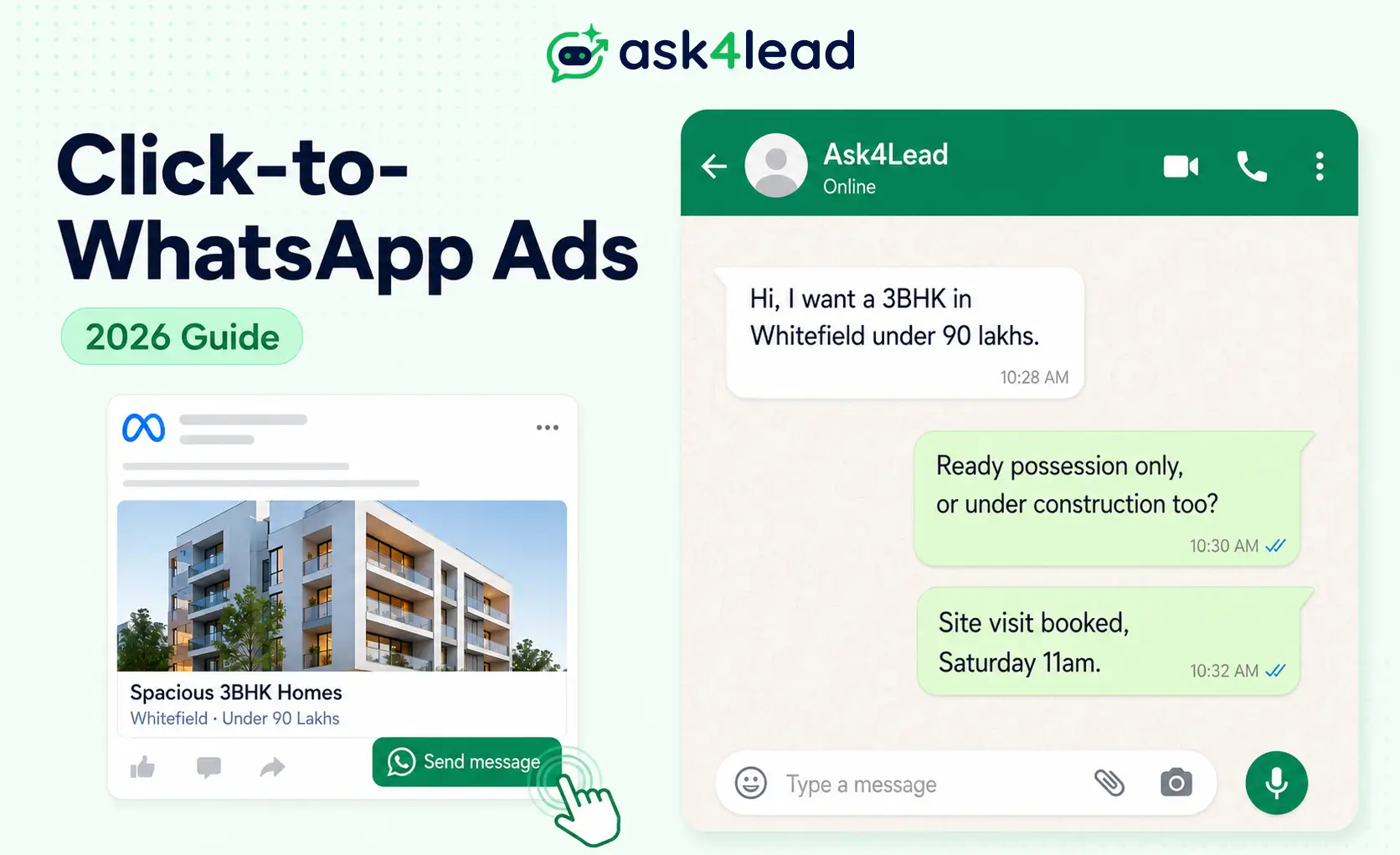
Click to WhatsApp ads (CTWA) are Facebook, Instagram, Messenger, and Reels ads that open a WhatsApp chat instead of a website. So there is no form, and no landing page. The person taps, WhatsApp opens with a message already typed, and then they press send.
Because that single tap removes every step in between, CTWA became the default paid channel for WhatsApp lead generation across India, Brazil, Indonesia, and the Gulf.
But it is also where budgets quietly disappear. The click is cheap, while the conversation decides everything, and almost nobody designs that part.
Quick answer: CTWA moves a buyer from a Meta feed into your WhatsApp inbox in 1 tap. It works when 3 things line up: the destination is wired to a WhatsApp Business number, the first reply lands in seconds, and that reply asks a question instead of quoting a price. Meta then hands you a free 72-hour window to close.
Key takeaways
- CTWA removes friction, not work. Because a tap replaces a form, volume rises while quality drops, unless you qualify inside the chat.
- Reply speed outranks targeting. Reply rates fall roughly 25% after 5 minutes of silence, and about 50% after 30 minutes.
- The 72-hour window is the real asset. If you reply within 24 hours of a CTWA click, every message for 72 hours carries no delivery fee.
- Attribution breaks by default. Meta sends a
ctwa_clidclick identifier on the first inbound message only, so roughly 9 in 10 advertisers never store it. - October 2026 inverts the maths. Once free-form replies inside the 24-hour window become billable, ad-originated chats become the cheapest messaging on WhatsApp.
- Clicks with no messages is a setup bug. Usually it is a Facebook Page left unselected in a field Meta labels optional.
What Click to WhatsApp ads are and how they differ from other Meta lead formats
A CTWA ad is an ordinary Meta ad with WhatsApp as the destination. When someone taps it, a chat opens with your number and a pre-loaded opening message.
It belongs to Meta’s messaging ad family, alongside Messenger and Instagram Direct. The difference is persistence, because a WhatsApp thread stays on the buyer’s phone for months.
As a result, each lead becomes a reachable contact rather than a spreadsheet row. That is why WhatsApp marketing treats CTWA as an acquisition channel and a retention channel at once.
1. How a CTWA click travels from the Meta feed to your inbox
There are 4 stages, and each one is a place things break.
- First, the ad renders in Facebook, Instagram, Messenger, Marketplace, or Reels.
- Then the tap opens WhatsApp with your number and a pre-filled message.
- Next, the person sends that message, which creates the inbound conversation.
- Finally, Meta attaches a referral object carrying the ad ID, headline, and a
ctwa_clidclick identifier.
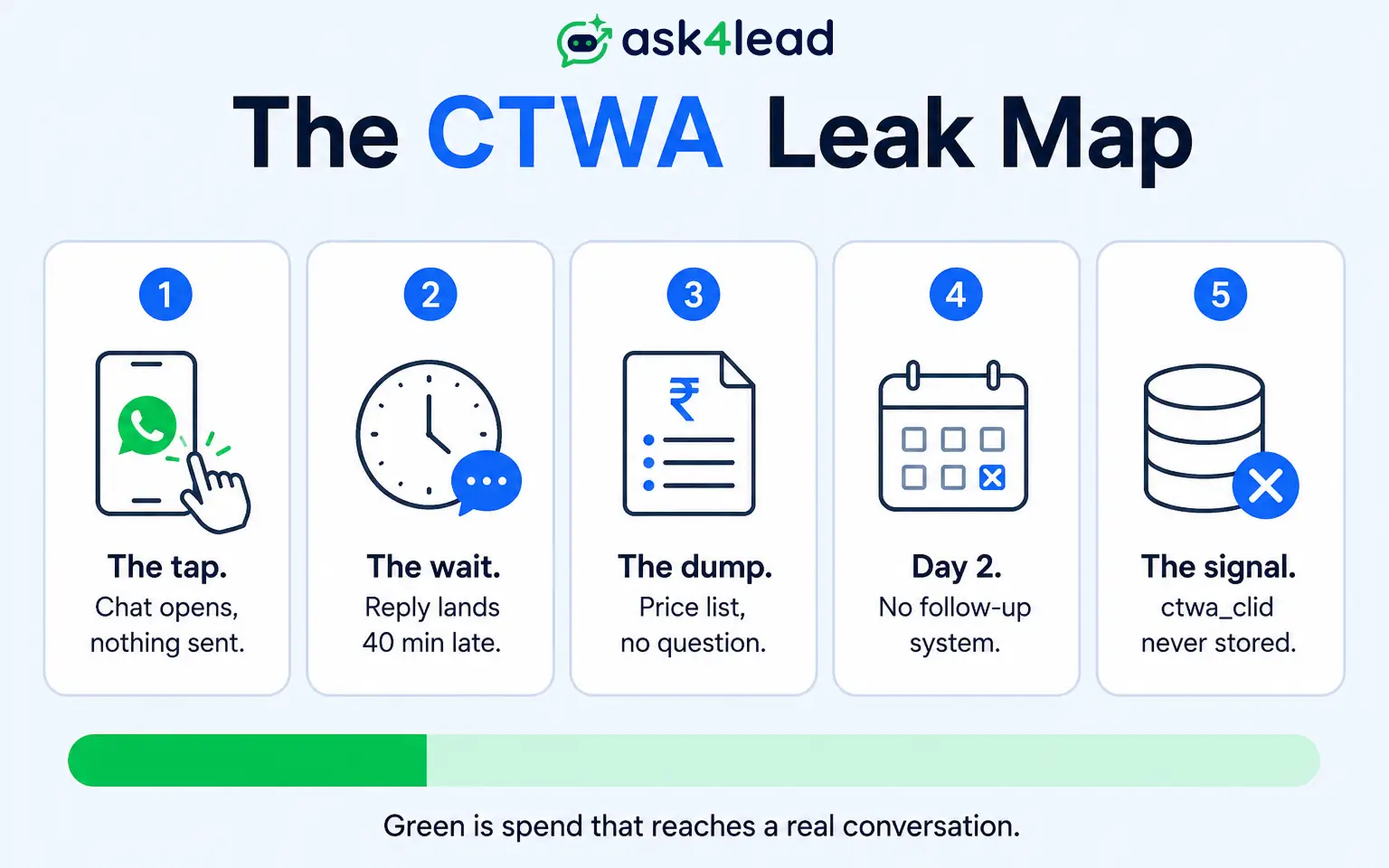
Stage 3 is the actual conversion. So a tap that opens WhatsApp but never sends is a paid click with nothing behind it.
In fact, that gap is wider than most advertisers assume. Measurement of website chat buttons puts pre-send abandonment as high as 90% on mobile, and in-app CTWA taps behave the same way whenever the opener is weak.
2. CTWA compared with click-to-chat links, lead forms, and DM ads
| Format | Buyer friction | What you capture | Where it breaks |
| Click to WhatsApp ad | 1 tap, nothing to type | Number or user ID, plus ad referral data | Dies without a fast reply |
| Click-to-chat link (wa.me) | 1 tap, no referral data | Number only | Attribution ends at the link |
| Meta instant lead form | 3 to 6 taps in-app | Name, phone, email, custom answers | Volume of low-intent entries |
| Messenger or Instagram DM ad | 1 tap | Platform-scoped user ID | Thread buried in social inboxes |
| Landing page with a form | Page load, then form fill | Whatever the form asks | Mobile drop-off, tracking gaps |
CTWA wins on friction, but loses on structure. A form hands you labelled fields, whereas a chat hands you a stranger typing “price?” at 11pm. Every section below exists to close that gap.
3. Which markets and business types CTWA actually suits
CTWA performs where WhatsApp is the default consumer channel, and not everywhere Meta will run it.
- Strongest markets: India, Brazil, Indonesia, Mexico, Nigeria, Egypt, Saudi Arabia, UAE.
- Strongest fit: purchases needing a conversation, such as property, admissions, treatment, insurance, loans, and travel.
- Weakest fit: low-price impulse retail in markets where buyers expect a checkout instead.
Cycles involving a site visit, appointment, or eligibility check convert best, because the buyer already expects questions.
For example, real estate sales teams, admissions teams, and e-commerce brands run the identical format on completely different rhythms.
What you need before launching a CTWA campaign
You need a WhatsApp number in your Meta Business Portfolio, a Facebook Page that owns it, and an objective that permits a WhatsApp destination.
Budget is the last decision. In practice, almost every “CTWA does not work for us” story traces back to a setup step rather than an audience.
1. WhatsApp Business app or WhatsApp Business API
Both run CTWA. However, they stop being equivalent at roughly 20 conversations a day.
- WhatsApp Business app (free, phone-based): fine while you validate the offer with 1 person answering. But there is no automation, no shared access, and no conversion signals.
- WhatsApp Business Platform, usually called the WhatsApp Business API: required once you want instant replies, multiple agents on 1 number, or conversion events.
You reach the API either through a Meta-approved Business Solution Provider (BSP), or through a platform with direct WhatsApp Business API integration.
So run 1 week on the app to prove the offer converts. Then move to the API before scaling, because the app cannot reply in seconds or tell Meta which leads were good.
2. Accounts, verification, and the number you commit to
Four things must exist and be linked before the first ad goes live.
- A Meta Business Portfolio, with business verification already completed.
- A Facebook Page, because it authenticates the handoff to your WhatsApp number.
- A WhatsApp Business Account (WABA), with the number registered and display name approved.
- Approved message templates for anything sent outside a live window.
Finish verification before launch, not during it. Since messaging limits are tied to verification and quality rating, an unverified account hits a ceiling exactly when the campaign starts working.
Applying for green tick verification is separate and optional. Although it lifts reply rates on cold traffic, it changes no limits.
3. The migration trap nobody mentions before you start
Moving a number onto the API is one-way. As soon as it migrates, it stops working in the phone app.
Moving between BSPs is harder than switching software, because a number registered under one provider cannot be casually handed to another.
So the cheap provider chosen in month 1 becomes a hard constraint by month 12. Pick the number you will still want in 2 years, and compare WhatsApp Business API routes before registering anything.
Campaign setup: objective, destination, creative, and budget
Setup takes about 15 minutes once accounts are linked. Three choices then decide performance: the optimisation goal, where the destination sits, and how you ramp budget.
1. Campaign objectives that allow a WhatsApp destination
Engagement, Leads, Sales, and Traffic all support a WhatsApp destination. Still, the optimisation option matters more than the objective name.
- Engagement, optimised for conversations: targets people likely to message, so it is the default wherever available.
- Sales or Leads with WhatsApp as conversion location: use this once you send conversion events back to Meta.
- Traffic or link clicks: the fallback when conversation optimisation is unavailable, because it buys taps rather than conversations.
Conversation optimisation is restricted across several European markets. A greyed-out option there is a regional policy limit, and not a broken account.
Instead, set a WhatsApp destination at ad level while optimising for link clicks. The reference for ads that click to WhatsApp documents the referral payload each route returns.
Set the destination at ad level, not campaign level. An objective that permits WhatsApp does not point the ad at WhatsApp, so that mismatch delivers a live campaign to your website.
2. Creative formats ranked by click-to-message rate
CTWA creative is judged on 1 thing: whether it makes someone want to ask a question.
| Format | Best for | Practical note |
| Video under 60 seconds | Explaining a service or showing a result | Usually top performer on considered buys |
| Single image | A specific offer, price, or availability | Fastest to test and refresh |
| Carousel | Variants, unit types, package tiers | Works while the buyer is comparing |
| Catalog or product message | Retail with a defined SKU list | Higher tap-through than a plain text link |
Write so the next step is a question rather than a purchase. For instance, “Ask which units are still available” beats “Buy now”, because the destination is a chat and the buyer knows it.
Retail teams should also connect a WhatsApp catalog before launch, so product questions resolve inside the thread.
Frequency matters more here than on conversion campaigns. Keep it under 3 across a 7-day window, since a messaging ad seen 6 times reads as pestering.
3. Starting budget and how to scale without killing delivery
Start small, but not so small that Meta learns nothing.
- First, budget 20 to 50 units of local currency per day per ad set, for 5 to 7 days.
- Keep the audience broad, ideally 500,000 reach or more.
- Then target 50 conversations per week per ad set before judging anything.
- Raise budget 20% to 30% at a time, 48 hours apart.
- Finally, add creatives to a working ad set instead of pausing winners.
If you double budget overnight on a new number, you trigger ad-side relearning and WhatsApp-side quality throttling at the same time.
So ramping is not caution. Rather, it is how you avoid paying for a restart.
The welcome flow that decides your cost per qualified lead
The pre-filled message and first 3 replies move cost per qualified lead further than any targeting change.
Setup guides usually skip this part. Yet it is the difference between a 10% close rate and a 2% one.
1. Writing the pre-filled message that pre-qualifies
The pre-filled message is the most under-used lever in CTWA, because it removes hesitation and screens out the wrong people at once.
Here are 3 openers for a law firm advertising divorce consultations.
- Weak:
Hi - Better:
Hi, I want to know more about your divorce consultation. - Best:
Hi, I understand consultations are paid and I want to book one.
The third version removes free-advice seekers before they reach a rep. In fee-based services, it outperforms a 700-term negative keyword list.
The reason is placement. Because it moves the filter from the targeting layer to the intent layer, the buyer self-selects.
Never leave the opener blank. An empty text box is the single largest source of taps that never become conversations.
2. The 3-message welcome flow
The instinct on a new lead is to send everything at once: price, packages, availability, address, photos.
However, teams who read back their own chat logs find the opposite. A long first reply reads as a brochure and gets nothing, whereas a short question gets an answer.
| Message | Purpose | What it contains |
| 1 (within 60 seconds) | Acknowledge and open | 1 warm line plus 1 question only a buyer answers |
| 2 (within the hour) | Qualify | Budget band, location, or timeline, asked helpfully |
| 3 (same session) | Move | A slot, a quote, a site visit, or a callback |
Message 2 sets your cost per qualified lead. If you skip it, reps get volume instead of leads.
Ask4Lead’s AI sales assistant runs all 3 in plain English rather than a “Press 1 for pricing” menu. That is the gap between a conversation and a phone tree.
While you build trust in it, requiring human approval before an AI reply sends keeps wording under your control without losing speed. Reps can also fire saved reply snippets for questions that repeat daily.
3. Qualifying questions that work by industry
Each question should look helpful while acting as a filter. A serious buyer answers instantly, but a browser refuses.
| Industry | Question that looks helpful | What it filters out |
| Real estate | “Which area and what budget range?” | Anyone outside your inventory or price band |
| Legal | “Are there assets to divide, and roughly what income bracket?” | Cases below your fee floor |
| Insurance | “What value do you need covered?” | Policy sizes not worth a rep’s time |
| Education | “Which intake are you planning for?” | Browsers with no timeline |
| Healthcare | “How long has the problem been going on?” | Price-shoppers with no urgency |
| Finance | “Is this a salaried or self-employed application?” | Applicants who fail eligibility anyway |
Two conditions make this work at volume. First, the questions must arrive instantly. Second, the answers must land on the lead record rather than in a rep’s memory.
Ask4Lead handles the first with an AI knowledge profile grounded in your own catalogue, pricing, and services catalog.
Because of that grounding, it can ask the follow-up a fixed script cannot anticipate. So adapt these question sets from the relevant industry playbooks rather than writing them generically.
Why CTWA campaigns get clicks but no messages
Clicks with no inbound messages is a configuration problem, not an audience problem. Meta reports the clicks, while the conversation never reaches your inbox, with no error anywhere.
So work the causes in order. Otherwise, raising budget on a broken click path just buys more of nothing.
1. The 8 causes of clicks without conversations
| Symptom | Likely cause | Fix |
| Clicks counted, 0 messages | Facebook Page not selected at ad set level | Connect the Page that owns the number |
| Chat opens, nobody sends | Pre-filled message blank or generic | Write a specific, intent-carrying opener |
| Ad live but delivering to a website | Destination set at campaign level | Set WhatsApp as destination on the ad |
| Messages hit the phone, not your platform | Webhook not subscribed for that number | Re-subscribe the number, then send a test |
| Conversation optimisation greyed out | Regional policy limit | Use link clicks with an ad-level destination |
| Delivery collapses after 5 to 6 days | Portfolio pacing or quality throttling | Ramp gradually, then check account health |
| Zero delivery on a brand new number | Number still in warm-up | Finish verification, allow 1 to 2 weeks |
| Volume fine, quality terrible | Audience Network and search partners | Exclude those placements, then retest |
The Page-connection cause catches almost everyone. Although Meta marks the field optional, the Page authenticates the handoff, so a blank field fails silently.
2. A 5-minute test that catches most of them
Do not wait for real traffic to tell you something is wrong.
- First, open the ad preview using the “Preview and share” link.
- Then tap through to WhatsApp from a phone that is not an account admin.
- Confirm the pre-filled text matches what you wrote.
- Send it, then confirm it lands in your CRM and not just the phone.
- Finally, confirm the referral data arrived with that first message.
If steps 4 or 5 fail, the ads are fine and the integration is not. As a result, that distinction saves weeks of pointless creative testing.
Turning on real-time updates makes step 4 visible in seconds, instead of requiring a manual refresh.
3. Why delivery collapses on day 5 or 6
This is the most misdiagnosed pattern in CTWA. Cost per result holds for 4 days, then CPM climbs steeply while conversations dry up.
Everyone blames creative fatigue. But on a newer number, it is usually second in line.
WhatsApp paces sending volume for accounts it does not trust yet, and large pushes get checked against quality signals between batches. So a flagged account can have the remainder slowed or stopped mid-campaign.
Two symptoms separate them:
- Creative fatigue: frequency rising, click-through rate falling, while message rate per click stays steady.
- Quality throttling: click-through rate steady, message delivery falling, and quality rating dropping in WhatsApp Manager.
Watching WhatsApp account health beside your ad metrics turns that into a fact rather than a guess. Ask4Lead shows quality rating and delivery warnings next to the pipeline itself.
Volume spikes are the trigger. That is the mechanic behind broadcast limits, the ramp rules above, and why automation rarely causes bans although sudden sending volume does.
The 72-hour free window and the follow-up sequence that closes
Reply speed is the highest-leverage variable in CTWA, and it is not close. Since a lead messaging from an ad is comparing 3 or 4 businesses in the same session, the first useful reply usually takes the conversation.
Meta gives you a generous window to work inside. Yet most advertisers use a sliver of it.
1. How the 72-hour free entry point window works
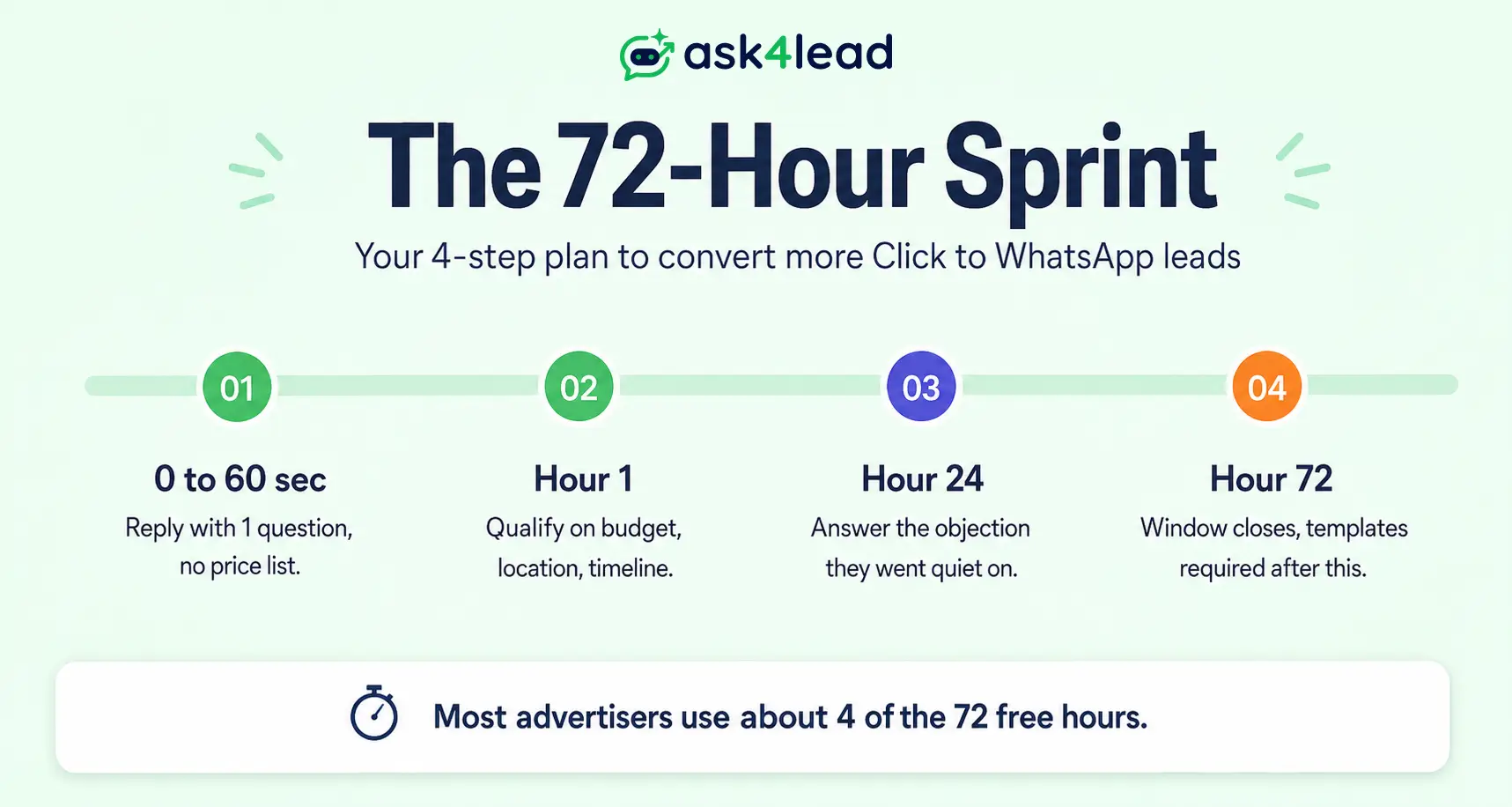
If you reply within 24 hours to someone who messaged from a CTWA ad or a Page call-to-action, Meta opens a free entry point conversation lasting 72 hours.
Messages sent inside it carry no delivery fee, free-form replies included. Meta documents this in its conversation-based pricing reference.
It is a different mechanism from the 24-hour rule, which is the ordinary service window opening whenever any customer messages you.
At 10,000 conversations a month, the free window becomes a real line item. Because every nudge inside it is free, you stop paying for template messages you would otherwise need.
2. Reply speed and what being late actually costs
Reply rates decay fast, and measurably. Field data across CTWA campaigns puts the drop near 25% after 5 minutes, then around 50% after 30 minutes.
That maths is brutal for a manual team. A 40-minute average first response means paying full price for leads, while losing half of them before anyone speaks.
Business type changes the severity, though never the direction. Someone asking a restaurant’s price leaves in minutes, whereas someone hiring an architect will wait an hour.
Both convert better when the reply is instant. That is why a WhatsApp AI agent platform answers at 3am, while your competitor answers at 9.
The real question is not whether to automate, but how much to hand over. In short, that line is the difference between an AI agent and a rule-based chatbot.
3. The follow-up sequence past day 1
The most expensive gap in CTWA is not the first reply. Instead, it is day 2.
Most leads need 3 or 4 touches before committing, and yet almost nobody plans past the first follow-up.
- Hour 0: reply with 1 qualifying question.
- Hour 4: if silent, send proof, such as a photo, a short case, or live availability.
- Hour 24: address the objection they most likely went quiet on.
- Hour 68: send the last free-window message before the door closes.
- Day 7 and Day 30: re-engage using an approved template message.
Running that across 200 chats a day by hand does not happen. So this is what automate lead follow-ups exists for, alongside the ability to snooze a conversation until its next touch is due.
Check template rejections before building step 5, because a rejected template means the re-engagement leg silently never fires.
Teams running a monthly re-touch on old CTWA leads report closes 3 and 6 months out, from conversations they had written off. Brand recall does that work, not the offer.
As a result, follow-ups that run overnight are where most of that recovered revenue sits.
Attribution: capturing ctwa_clid and sending value-based signals to Meta
Meta cannot see inside a WhatsApp conversation. So if you send nothing back, delivery optimises toward cheap chats instead of good customers.
The fix has 2 parts. First, capture the click identifier on the first inbound message. Then post conversion events against it.
1. What ctwa_clid is and why 9 in 10 advertisers lose it
Meta attaches a referral object to the first inbound message from a CTWA ad. It carries the source ad ID, the headline, and a unique click identifier called ctwa_clid.
It arrives once, on that first message only. Therefore, if you miss it, attribution for that lead is gone permanently.
Most BSPs surface it as a named webhook field. For example, Twilio’s click ID callback parameter shows what to look for in your own provider’s payload.
That one detail explains most broken CTWA reporting. Teams see conversations counted in Ads Manager, so they assume tracking works, until months later no CRM lead traces to an ad.
2. The 2 fields that make Conversions API work for CTWA
Once the identifier is stored, you post events through Meta’s Conversions API (CAPI), its server-side event endpoint. Two fields then decide whether Meta understands the event at all.
action_sourcemust bebusiness_messaging, and notwebsite.messaging_channelmust bewhatsapp, with the capturedctwa_clidattached.
If you send a standard website-style event instead, Meta accepts it, reports nothing useful, and optimises on noise.
This is the quietest failure in CTWA measurement, because from the dashboard it looks identical to working tracking.
Reporting also undercounts past the default attribution window by design. So a conversation closing on day 21 will not appear against the ad that produced it.
As a result, reconciling against your own lead management records is the only way to see true payback periods.
3. Moving from flat lead events to value-based events
Two levels of maturity exist here. The jump between them is where CTWA cost per acquisition genuinely improves.
| Approach | What you send | What Meta learns |
| Flat events | “lead received” on every inbound message | Nothing useful, since every chat looks identical |
| Scored events | Hot, warm, cold as separate custom events | Which audiences produce serious buyers |
| Value-based events | Each score with a real currency value | Which audiences produce revenue, not replies |
Most off-the-shelf messaging tools support only the flat version. That is why advertisers asking for custom event values keep hearing the feature is on the roadmap.
Instead, the workable pattern is to pull the score from your own CRM, then post the event yourself.
Ask4Lead scores every conversation into a 9-stage sales pipeline, so a stage change gives you a clean trigger and a clean value.
Reports and analytics then separate cost per chat from cost per qualified lead. Usually those are 2 very different numbers.
CTWA benchmarks and what to optimise after launch
Benchmarks swing hard by market and vertical. So treat published figures as a sanity check, never a target.
What matters instead is the direction your own numbers move week to week.
1. The 5 metrics worth tracking
Ads Manager offers 20 columns. However, these 5 tell you whether the channel works.
- Cost per conversation started. This is your true acquisition cost, not cost per click.
- Click-to-message rate. How many taps become sent messages, which is the cleanest test of your opener.
- Reply rate to your first message. It reflects reply speed and message quality directly.
- Cost per qualified conversation. The number finance should actually see.
- Revenue attributed at 7 and 30 days. Most CTWA revenue lands after the first chat.
Point 5 is where CTWA gets misjudged. Because a meaningful share of revenue arrives in the week after the click, day-1 return understates the channel badly.
An AI dashboard view of those 5 beats exporting Ads Manager columns into a sheet nobody opens twice.
2. Benchmarks by market and vertical
| Vertical | Reply rate to first message | Cost per conversation pattern |
| Retail and e-commerce | 45% to 65% | Low cost, high volume, thin margin per chat |
| Restaurants and local services | 50% to 70% | Lowest of any vertical |
| Real estate | 55% to 75% | Widest range, since it can run very high per chat |
| Education and admissions | 40% to 60% | Seasonal, spiking around intake dates |
| Finance and insurance | 35% to 55% | Higher cost, though higher value per closed lead |
CTWA reply rates typically run several times higher than landing-page campaigns at equal spend. That is the format’s structural advantage.
But the trade is simple. A reply is not a lead until somebody qualifies it.
3. What to change first when the numbers are bad
Fix in this order, because each step changes what the next one measures.
- Click-to-message rate below 40%: rewrite the pre-filled message before touching anything else.
- Low reply rate with a good opener: your first response is either too slow or too long.
- Good reply rate, poor qualification: add message 2 of the welcome flow.
- Good qualification, poor close: then the problem is offer or price, not the channel.
- Conversation metrics fine, reporting empty: this is attribution, not performance.
Jumping straight to step 4 is the standard mistake. Teams rebuild the offer, while a blank pre-filled message quietly costs them half their taps.
For a broader view of where CTWA sits beside broadcasts and drip sequences, compare it against these WhatsApp marketing strategies.
What changes in 2026: per-message pricing and business-scoped user IDs
Two Meta changes land in 2026. One makes ad-originated conversations relatively cheaper, while the other makes phone numbers an unreliable primary key.
Neither appears in most CTWA guides. Still, both are worth acting on before they bite.
1. Per-message pricing from 1 October 2026
Meta is moving service messages onto per-message billing. So from 1 October 2026, free-form replies inside the standard 24-hour service window are billed per message at your market’s rate, with no volume discounts.
Meanwhile, the 72-hour free entry point window for CTWA and Page CTA conversations stays free. WA.Expert’s per-message pricing breakdown covers the mechanics.
| What changed | Before 1 Oct 2026 | After 1 Oct 2026 |
| Free-form reply inside the 24-hour service window | Free | Billed per message, no volume tiers |
| CTWA-originated conversation (72-hour entry point) | Free | Still free |
| Page CTA-originated conversation | Free | Still free |
| Utility and authentication templates | Billed per message | Billed per message, volume tiers apply |
Read the second row again. After October, an ad-originated conversation becomes the cheapest way to talk to a customer on WhatsApp, whereas organic inbound does not.
That inverts a common assumption. If your mix leans on organic chats and template broadcasts, then CTWA gets structurally cheaper by comparison.
So model it against your WhatsApp credits forecast before the date lands. Because Meta has revised these dates before, confirm current terms in your own Business Manager.
2. Business-scoped user IDs and WhatsApp usernames
Meta began sharing a new identifier in April 2026: the business-scoped user ID (BSUID), a per-business ID formatted like US.13491208655302741918.
WhatsApp usernames roll out through 2026. When a user adopts one, their phone number may not be visible to your business at all.
Meta’s business-scoped user IDs documentation names CTWA advertisers explicitly among those required to support it.
Here is what that means in practice:
- CRMs keyed on phone number as primary identifier need a second key now.
- You can still message anyone whose number you collected via form, call, or conversation.
- But for inbound-only CTWA leads, the user ID may be all you get.
- So asking for a phone number inside the chat becomes a qualification step if your process involves calling.
3. What to change in your setup now
Three changes are cheap today, and expensive later.
- Store
ctwa_clidand the user ID on the contact record, and not only the phone number. - Stop exporting leads to spreadsheets keyed on phone number, because that key may go blank.
- Move CTWA leads into a real contact record the moment they arrive.
Ask4Lead’s shared team inbox sits on a CRM contact that survives an identifier change underneath it.
The work queue then attaches today’s follow-ups to that record rather than to a number, while roles and permissions keep the thread owned by 1 rep. A phone-number-keyed export does none of that.
Frequently asked questions about Click to WhatsApp ads
1. Do I need the WhatsApp Business API to run Click to WhatsApp ads?
No. The free WhatsApp Business app connected to your Facebook Page can run CTWA. However, you need the API for automated replies, several agents on 1 number, or conversion events sent back to Meta.
2. Why am I getting clicks but no WhatsApp messages?
Usually no Facebook Page is selected at ad set level, a field Meta labels optional although it authenticates the handoff. Other causes include a blank pre-filled message, an unsubscribed webhook, or a destination set at campaign level.
3. How much do Click to WhatsApp ads cost?
You pay Meta for ad delivery as normal. The conversation is free for 72 hours from a CTWA click, provided you reply within 24 hours. So your real cost is ad spend plus templates sent after hour 72.
4. Which campaign objective is best for CTWA?
Engagement optimised for conversations, where available, because it targets people likely to message rather than tap. Then move to Sales or Leads with WhatsApp as conversion location once you send conversion events back.
5. Is the 24-hour rule the same as the 72-hour CTWA window?
No. The 24-hour rule is the standard service window opening whenever any customer messages you. In contrast, the 72-hour window is a free entry point granted only to CTWA and Page CTA conversations.
6. Can an AI handle CTWA leads without a human?
For qualification, yes. It can reply in seconds, ask 2 or 3 qualifying questions, and route a scored lead onward. Closing usually still needs a person, which is covered fully in qualifying leads without a human.
7. Should I use CTWA or Meta instant lead forms?
Use CTWA when the sale needs a conversation, such as property, admissions, healthcare, legal, and insurance. On the other hand, use instant forms when you only need details for an outbound call.
8. Why did my CTWA campaign work for 4 days then stop delivering?
Check whether click-through rate held while message delivery fell. If so, this is quality throttling or portfolio pacing on a newer number, and not creative fatigue. So slow the budget ramp, then check your quality rating.
9. Can I retarget people who messaged me from a CTWA ad?
Yes, inside the 72-hour window for free, and afterwards through approved template messages. You can also build custom audiences from your CRM, then schedule WhatsApp messages around intake or season dates.
Turning CTWA into a repeatable lead system
CTWA is not a media-buying problem with a messaging bolt-on. The ad buys a tap, while everything that determines return happens afterwards.
How fast you reply. Whether the first message asks a question or quotes a price. Whether day 2 exists, and whether the click identifier survives long enough to teach Meta what a good lead looks like.
If you fix those in order, the same budget produces different results. But raise budget alone, and you simply buy more of the same leak.
The timing helps too. Once per-message pricing lands in October 2026, ad-originated conversations become the cheapest messaging on WhatsApp, which makes the conversation layer worth more than ever.
Start here this week. Run 7 days of CTWA on a small budget, log every conversation, then count how many died at each of the 5 leak points.
The biggest leak is your next project. If it turns out to be reply speed or day-2 follow-up, then that is an automation problem, not a targeting one.
Worth reading next: how lead generation chatbots on WhatsApp get wired into a CTWA funnel, and 5 ways AI lifts WhatsApp lead conversion.
Stop losing CTWA leads to slow replies
Ask4Lead is a humanized AI WhatsApp chatbot and CRM by GVM Technologies LLP, built for exactly this problem.
It answers every CTWA lead in seconds, in plain English rather than a button menu. Then it asks the questions your reps would ask. Finally, it hands over a lead with the problem, need, and urgency already attached.
As a result, your first call becomes a conversation instead of an interrogation.
- Instant replies at 3am, on weekends, and during your busiest hour
- Qualification scored into a 9-stage pipeline reps can actually work
- One-click takeover whenever you want to step in yourself
- Free trial with 100 AI credits, and no card required
Sign up free and get 100 AI credits
Prefer to see the mechanics first? Browse the full feature set, or read how teams turn WhatsApp into a sales channel once CTWA volume starts compounding.
