
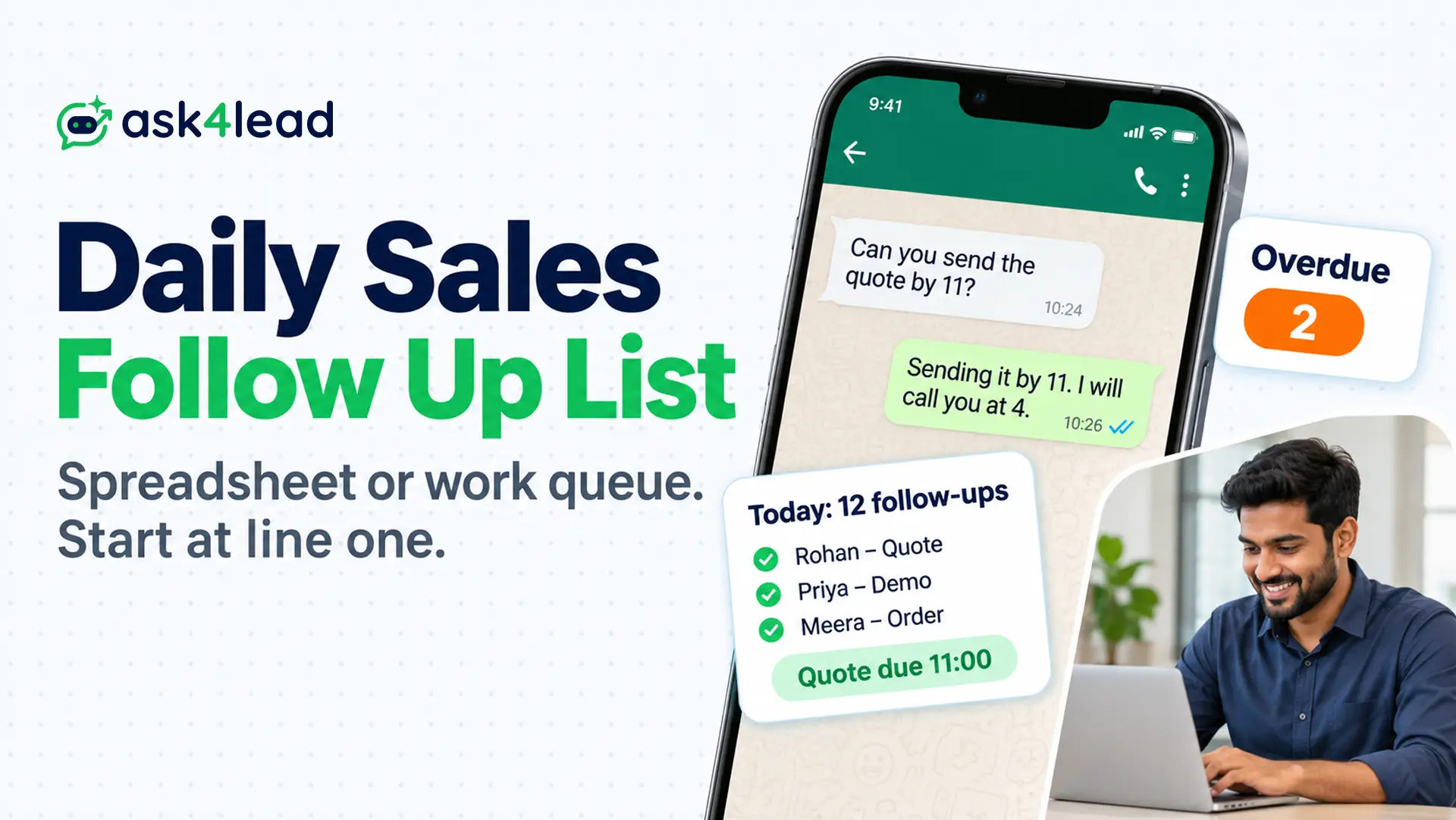
40 open leads and no order of attack means a rep works the loudest ten and forgets the quiet thirty. A sales follow up list fixes this. It is the ordered set of people a rep must contact today. Each one carries one action and one reason. A work queue, such as the Ask4Lead Work Queue, builds that list from the CRM.
Below, a hand-built spreadsheet and a work queue are compared on entries, ranking, size, daily rhythm and fit.
Quick answer: A spreadsheet suits one rep with under 30 active leads on one channel. A work queue suits several reps or several channels. Either way, the sales follow up list needs one action, one date and one reason per lead. It also needs a ranking rule and a daily cap.
Key takeaways
- A sales follow up list is a sort rule applied to dated records. It is not a to-do list you type each morning.
- Every lead needs one next action, one date and one reason. Without all three, the lead stays off the list.
- Rank by the cost of waiting, so customer deadlines come first and quiet deals come last.
- Cap the list at the minutes you really have, then re-date the overflow instead of leaving it red.
What Is a Sales Follow Up List?
A sales follow up list is the ordered set of leads a rep contacts today. Each line holds a name, one action, one due date and one reason to reach out now. A line missing any of those parts is a note, not a task.
Work queues build this list from dated records. The rep opens it and starts at line one, so no morning decision is needed.
How a sales follow up list differs from a to-do list
A to-do list holds whatever you typed. By contrast, a sales follow up list holds whatever the customers have made due. Typing is the weak point, because a rep who writes tasks after a long call forgets the last two.
So the list should come from records, not from a nightly rebuild. Then a rep who changes a date in one place sees the list reorder itself.
Why scattered notes break a daily sales follow up list
Today, customers write by WhatsApp, email and phone, and they do it at odd hours. One buyer emails the office address and then texts a personal number at 9 pm. So each message can create an obligation.
Therefore, the rule is quite simple to state. If a message can create a follow-up, it must land somewhere you can search tomorrow morning. A camera roll, a personal chat and a spreadsheet are three places, and three places mean dropped leads.
Spreadsheet and work queue at a glance
| Criterion | Spreadsheet list | Ask4Lead Work Queue |
| Entries | You type each row | Pulled from dated records |
| Ranking | You sort a Rank column | Live urgency ranking |
| Reminders | None until you open it | Overdue items turn red |
| Team view | A shared file | Managers see each rep’s queue |
| Best for | One rep, one channel | Several reps or channels |
Where Each Sales Follow Up List Gets Its Entries
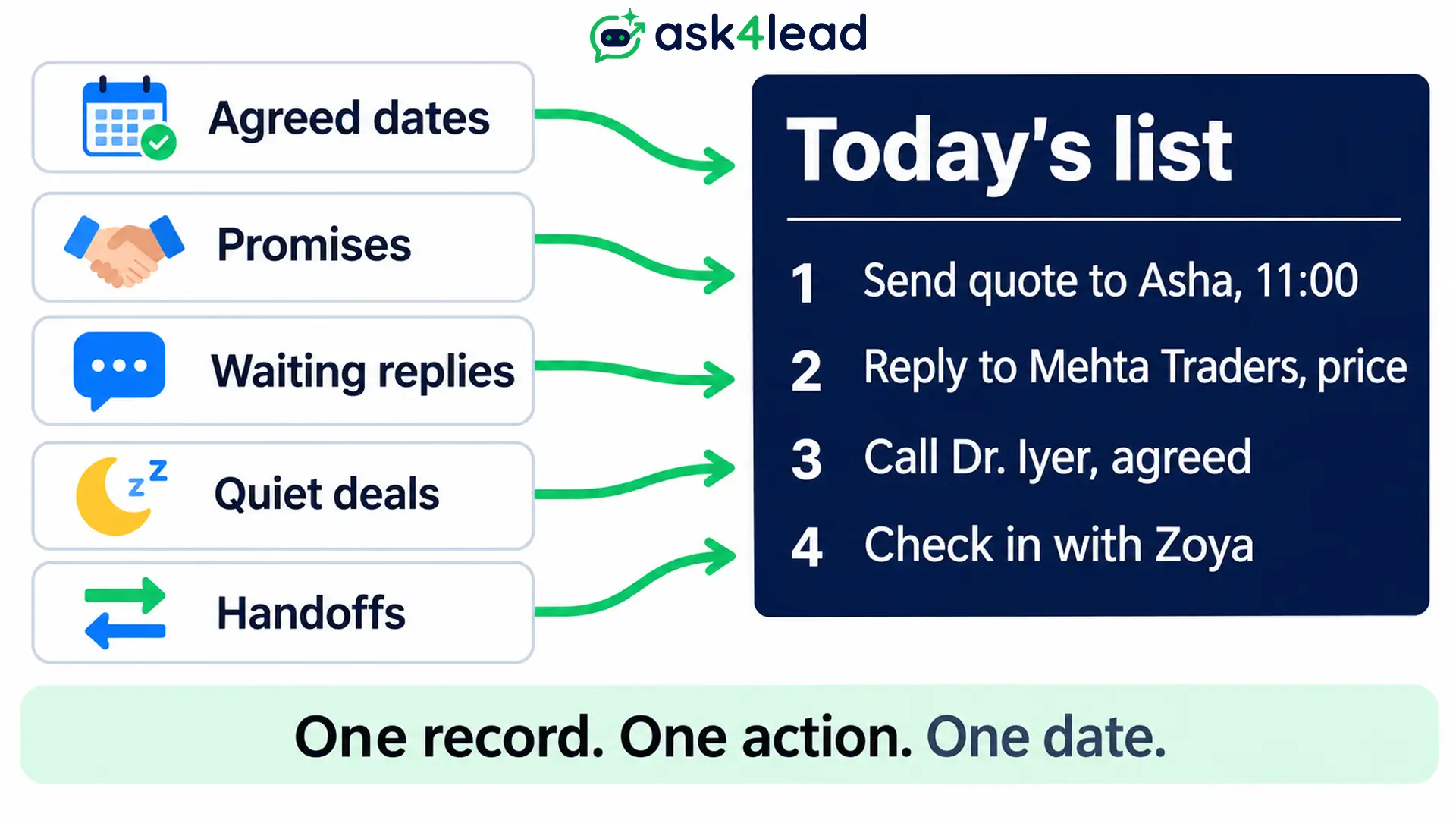
Five sources feed a sales follow up list. First, each source creates an obligation. Then each must reach the list the moment it appears. If one source stays outside, its tasks depend on memory.
- Agreed dates: “Call me Thursday after the board meeting” becomes a Thursday call about that meeting.
- Promises: “I will send the revised quote by 11 am” becomes a task due today at 11:00.
- Waiting replies: a new enquiry, or a customer who wrote last, becomes a reply due now.
- Quiet deals: an open deal with no message for 9 days becomes a check-in with a new reason.
- Handoffs: a lead assigned by a colleague or manager becomes a first touch by the stated time.
1. Capture each promise before the call ends
Trust in the list starts at capture. Before you hang up, state the next date out loud and add it to the record. If the next meeting matters, send a calendar invite while the customer is still on the line.
Then dictate a ten-second summary straight after the call. A spoken note costs less than the mental debt of “I will write it up tonight”.
2. Keep one record per lead with one action
Still, several tasks can follow one conversation. For example, a buyer may ask for a quote, a demo and a reference in a single chat. The list should show only the earliest due action as the date.
List the other asks inside the note, in the order you promised them. The Ask4Lead Next Step works this way. Each lead holds one Next Step, with a note and a date.
3. How each tool takes an entry
In a spreadsheet, you add or update a row after every touch. The Work Queue fills through three actions. First, you set a Next Step. Next, you snooze a chat with the snooze feature. Finally, the AI Sales Assistant drafts a reply for human approval.
How Each Sales Follow Up List Ranks and Caps the Day
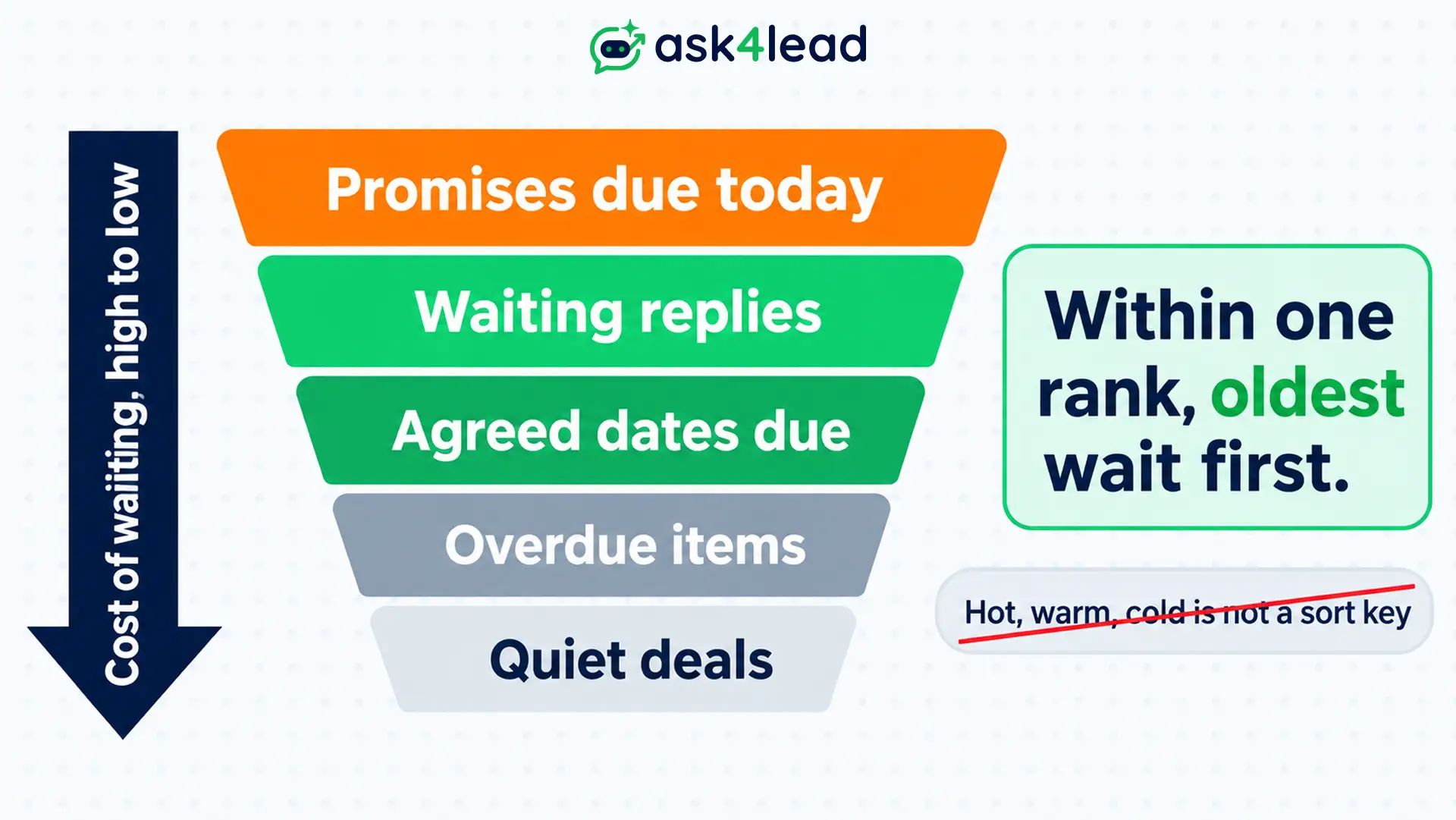
Rank a sales follow up list by the cost of waiting, not by lead temperature. Ask one question per line: who is blocked, and by when? The line with the nearest outside deadline goes first. Meanwhile, the line with no deadline goes last.
The five-rank rule for a sales follow up list
This is our working rule, so adjust it to your sales cycle. Then work from rank one down.
- Promises due today. You set the time, so a miss breaks trust.
- Waiting replies. A new enquiry or a customer who wrote last loses interest by the hour.
- Agreed dates due today. The customer chose the day, so it matters.
- Overdue items. These are agreed dates you already missed.
- Quiet deals. Open deals with no message for several days, each with a new reason.
Within one rank, the oldest wait goes first. If you score leads, use the score only to break ties. The WhatsApp lead scoring guide shows a simple model.
Worked example for a Tuesday morning
For instance, here is a sales follow up list for one rep at 9:00. Seven leads are open, and six make the list.
- Asha: quote promised by 11:00 (rank 1).
- Mehta Traders: asked “price?” at 8:10 (rank 2, the older wait).
- Rahul: ad enquiry at 8:40, no reply (rank 2).
- Dr. Iyer: callback agreed for Tuesday (rank 3).
- Kiran: next step overdue by 2 days (rank 4).
- Zoya Boutique: open deal, silent for 9 days (rank 5).
Pranav leaves the daily list, because he ignored two nudges and has been silent for 21 days. A third nudge adds noise, so he gets a revisit date 60 days out. The follow up reminders guide explains when to stop.
Why hot, warm and cold labels sort poorly
Labels describe interest, but they do not describe timing. A hot lead who asked you to call on Friday is not due on Tuesday. Besides, a long “hot” pile hides the real deadlines.
Instead, keep the label as a note and drop it as a sort key.
Size the sales follow up list to your hours
A sales follow up list should hold only what your hours can finish. Multiply the minutes you can spare by the minutes each touch takes. Use these starting figures per touch:
- WhatsApp reply: 3 minutes, including the note.
- Phone call: 8 minutes, including the next date.
- Quote or proposal: 15 minutes, including a final check.
These figures are rules of thumb. Next, time your own touches for one week and replace them.
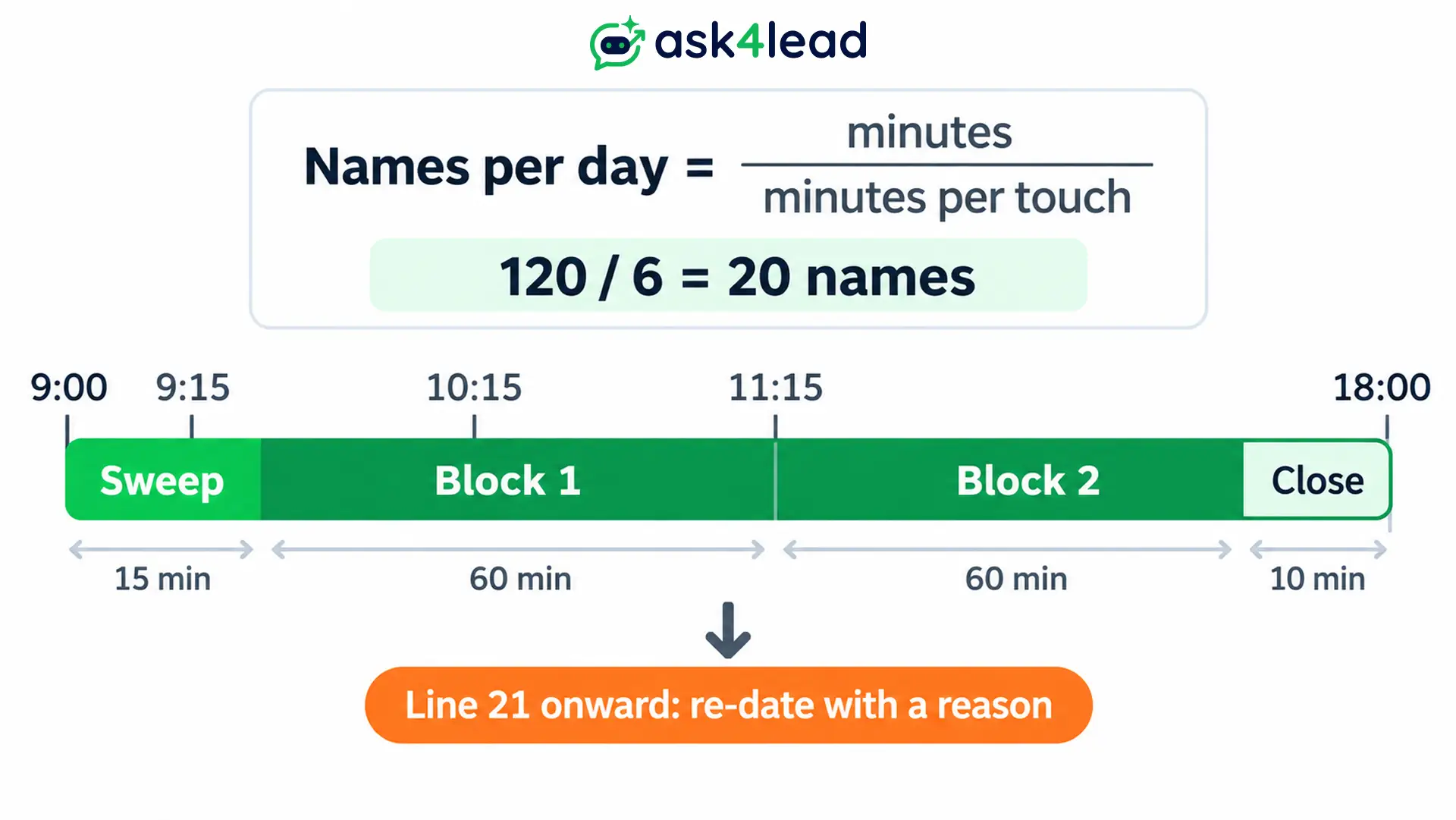
Names per day = follow-up minutes / average minutes per touch
Example: 2 blocks x 60 min = 120 min. 120 / 6 = 20 names.
Reps who run big books often report that 20 to 30 well-managed warm leads beat 100 half-worked ones. Therefore, a longer list needs more rep time, not more discipline.
Re-date the overflow with a reason
When the list runs over, first pick the lowest ranks. Give each one a new date and a one-line reason, such as “waiting for their budget review”. Allow each lead two re-dates at most. After that, simply ask the customer for a date or close the lead.
Also watch how often you re-date items. If a third of the list moves three days running, the book is too big for one rep. Then split it, or use lead assignment rules to hand part of it to a colleague.
Run the Day With Either Sales Follow Up List
Four steps keep the day on track. The list sets the order, and the steps protect your time from drifting. Nothing here needs a new tool. Instead, it needs a fixed rhythm that repeats every working day.
1. Open with a 15-minute sweep
First, read the sorted list before email or chat. Clear rank one and two, even with a short “received, on it” reply. Meanwhile, check that nothing is overdue from yesterday.
2. Work two focused blocks
Next, put calls and WhatsApp replies in two blocks of 60 minutes. Keep admin tasks out of both blocks. Drafting proposals inside a call block breaks the rhythm that makes it fast.
3. Log each touch before the next lead
So after every touch, write the outcome and set the next date. Otherwise, a lead without a new date disappears from tomorrow’s list. So the update takes 30 seconds and saves the lead.
4. Close the day in 10 minutes
At the end, scan for leads with no date and give them one. Then look at tomorrow’s top three. This short cleanup replaces the long evening session, which can eat two hours of a rep’s night.
Which Sales Follow Up List Fits Your Team
Volume and channel count decide this choice. A spreadsheet is enough for one rep with a small book on one channel. Meanwhile, a work queue earns its place once chats, calls and several reps meet. Both need the same rules above.
Choose a spreadsheet when
Here, your book is small and one person owns it. Use the columns Lead, Owner, Next action, Due date, Why now, Last contact and Rank. Then filter that column to show rows due today.
=SORT(FILTER(A2:G200, D2:D200 <= TODAY()), 7, TRUE, 4, TRUE)
The sheet has no reminders and no chat history, though. For the wider choice, the WhatsApp CRM versus spreadsheet guide shows where a sheet starts to fail.
Choose the Ask4Lead Work Queue when
The Work Queue groups items into four live buckets, ranked by urgency. Here is how they line up with the rank rule.
- Needs Human Review: AI drafts waiting for approval. These rows match your waiting replies.
- Next Step Overdue: Next Steps with a past due date. These rows match your overdue items.
- Follow-ups Due: follow-ups whose time has passed. These rows match agreed dates and promises.
- Stale No Recent Reply: open deals gone quiet. These rows match your quiet deals.
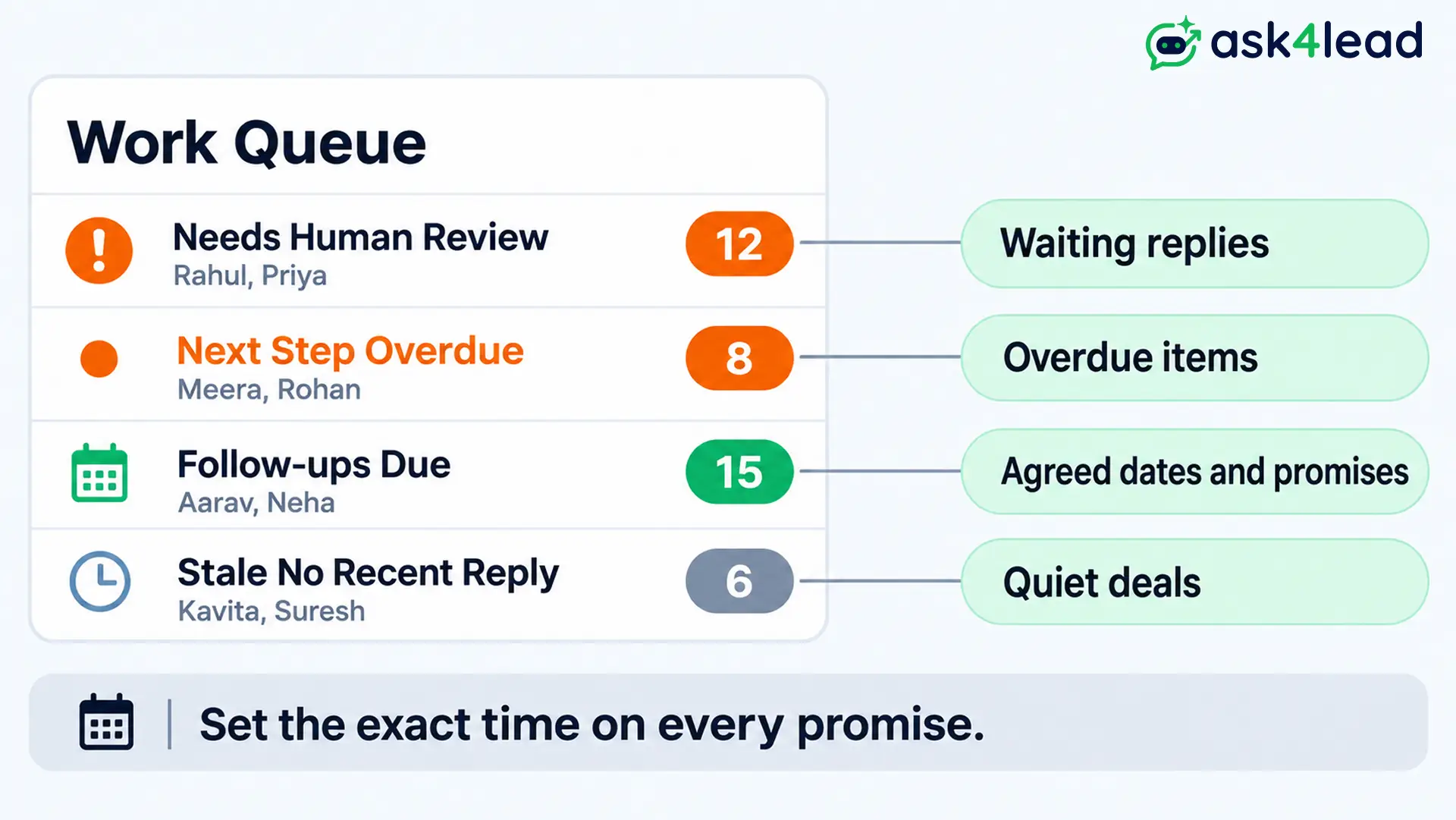
Overdue items turn red and stay until you complete or reschedule them. Also, clearing one moves you to the next chat. Managers can view each rep’s queue. However, you review tasks one by one, because the page has no bulk clear.
Add a Next Step after every call
The queue ranks items by urgency inside each bucket, but it does not know a promise unless you record it. So set the Next Step with the exact time.
WhatsApp conversations and Next Steps feed the queue. A phone call leaves no trace unless you add one. The queue also reminds your rep and does not send messages.
For automatic sending, use WhatsApp Campaigns with an approved template.
FAQs
1. How long should a sales follow up list be?
Long enough to finish, and no longer. To size it, divide your follow-up minutes by minutes per touch. Most reps land between 15 and 30 names.
2. What goes first on a sales follow up list?
Promises with a time you set come first, and then waiting replies. Agreed dates follow, while quiet deals go last.
3. Should leads without a date appear on the list?
No. A lead with no date is invisible to the list, so filter for undated leads once a day. Then give each a date or close it.
4. Is a spreadsheet enough for a sales follow up list?
Yes, for a small book on one channel. Add a Due date column and filter on today. However, nothing nudges you, so overdue rows go unseen.
5. Does the Work Queue send follow-ups by itself?
No. It reminds your rep to act. Automatic sending needs a campaign with an approved template.
Conclusion
A sales follow up list works when every lead holds a date, a reason and one action. Rank by the cost of waiting, cap the day at your hours, and close each day with new dates. Then the list rebuilds itself each morning.
Before tomorrow morning, check that you have:
- A date and a reason on every open lead.
- Promises with exact times, ranked first.
- Your own minutes per touch, used as the cap.
- A new date on every lead you touched today.
- One revisit date for each lead you removed.
Next, open your busiest lead today and give it one action and one date.
Stop rebuilding your list every night
If your daily list still lives across chats, calls and a sheet, Ask4Lead gathers it in one place. The Work Queue ranks due items by urgency. A Next Step keeps your note and time beside the chat.
Snoozed chats return on the day you chose. Meanwhile, the AI Sales Assistant drafts replies, and you approve them before they go out.
