
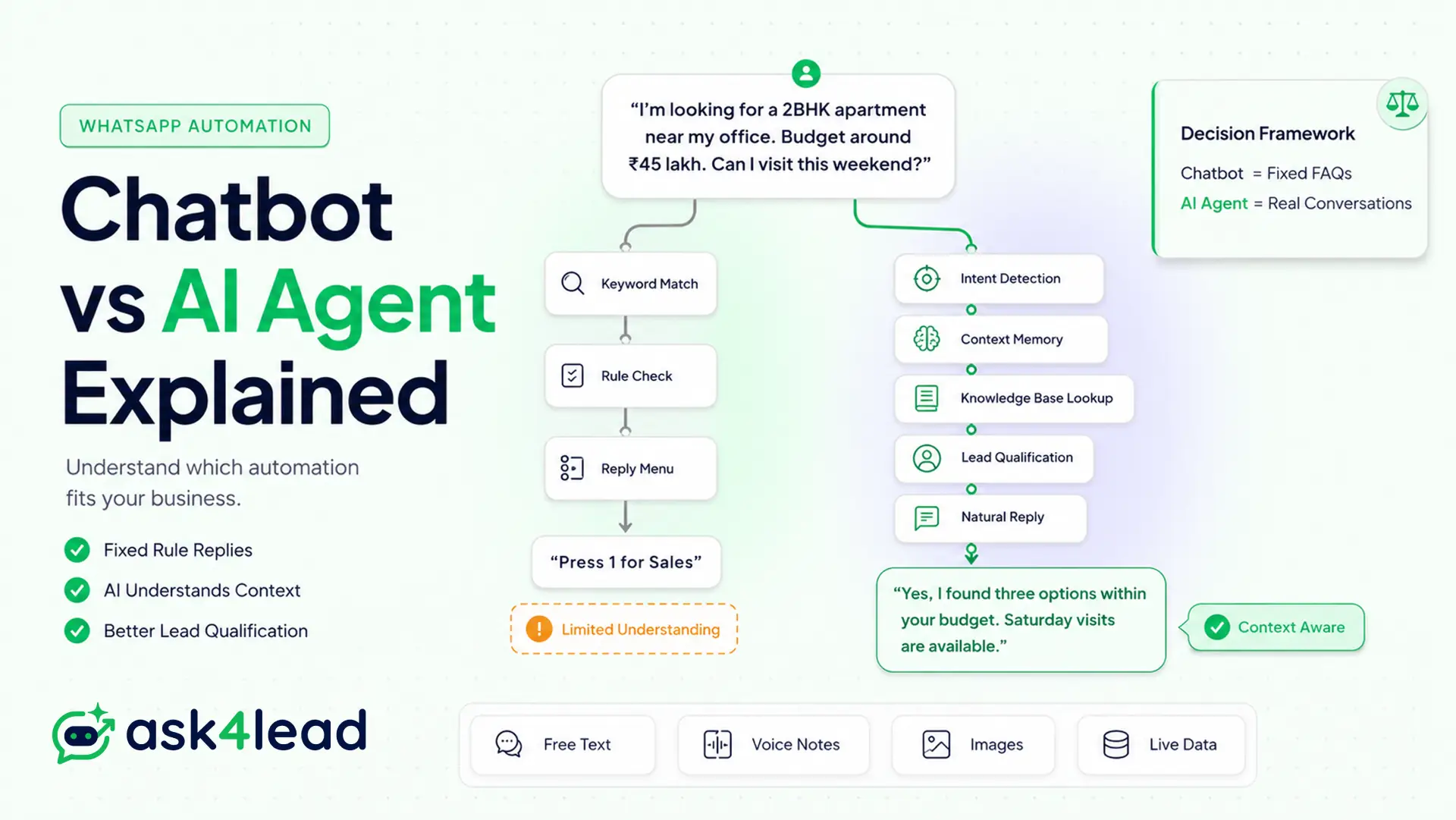
A WhatsApp chatbot replies using fixed rules, usually a button menu like “Press 1 for Sales, Press 2 for Support.” A WhatsApp AI agent runs on a large language model (LLM, the AI technology behind tools like ChatGPT).
It reads what a customer actually types and replies in a real sentence, not a menu.
If your customers only ask 3-4 fixed questions, a chatbot is enough. If they ask anything outside a script, you need an AI agent.
Quick answer: Use a chatbot for repetitive questions like hours, pricing, or order status. Use a WhatsApp AI agent once real sales conversations or unpredictable questions are involved. Most growing businesses run both together.
Key takeaways
- Chatbots handle fixed FAQs well but break the moment a question doesn’t match a rule
- AI agents understand free text, remember context, and can check real data before replying
- Official Meta pricing, not the AI itself, is usually the biggest cost surprise
- The most common failure in both types is a late or clumsy human handoff
This decision matters more on WhatsApp than on other channels. Independent messaging research (Mobilesquared, Sinch) puts WhatsApp open rates in the 90-98% range, well above email’s roughly 21%.
A bad automated reply here gets seen almost immediately, not buried in an inbox.
What Is a WhatsApp Chatbot, Exactly?
A WhatsApp chatbot is a decision-tree program. It shows a customer a list of options and waits for a matching reply, a number, a keyword, or a button tap.
It has no understanding of language, only rule-matching against a pre-written step.
1. What a Chatbot Handles Well
Chatbots are genuinely good at repetitive, predictable questions where the answer never changes:
- Business hours and location
- Fixed pricing or a product catalog
- Order status lookups tied to an order number
- Routing a customer to the right department
- Collecting a name and phone number before a human takes over
If most of your WhatsApp volume is “what are your hours” or “do you deliver to my area,” a rule-based flow answers that in seconds at close to zero cost.
2. Where Rule-Based Bots Break
The failure point is consistent: the moment a message doesn’t match a pre-built rule, the bot loops back to the menu or goes silent. A voice note or a typo-heavy sentence gets nothing useful back.
Real customers rarely type clean, single-topic messages. They switch topics mid-conversation, mix languages, or pack 3 questions into one voice note.
A rule-based lead generation chatbot has no way to parse any of that. It freezes or restarts the flow, and the lead moves to whichever business replies like a person.
What Is a WhatsApp AI Agent?
A WhatsApp AI agent uses an LLM with a custom system prompt (instructions that tell the AI how to behave and what it knows) instead of a decision tree.
It reads the full sentence a customer sends and replies conversationally.
Ask4Lead’s AI Sales Assistant works this way. It holds a plain-English conversation grounded in your own product catalog and FAQs, not a fixed menu.
1. AI Agent Context and Memory
An AI agent tracks what was already said earlier in the conversation. If a customer mentions their budget in message 2 and asks about financing in message 6, it connects the two.
Chatbots cannot do this by design; each reply starts from zero.
2. AI Agent Tool Use and Integrations
The more capable AI agents don’t just talk, they act. They check a real calendar before confirming a booking, or pull a real price from a database instead of guessing.
The better-built ones also don’t route every task through one expensive model. A simple booking request gets parsed by a fast, cheap model.
A pricing question that needs a real catalog lookup gets routed to a stronger one.
That routing decision, not a single “smarter AI,” is what usually separates an agent that stays affordable at scale from one that doesn’t.
3. Multimodal Understanding (Voice, Images, Documents)
Customers on WhatsApp send voice notes and photos constantly. A chatbot ignores all of it.
A modern AI agent with multimodal support (the ability to process voice, image, and document inputs, not just text) transcribes the note, reads the image, and responds to what’s actually in it.
WhatsApp AI Agent vs Chatbot: Side-by-Side Comparison
| Capability | Rule-Based Chatbot | WhatsApp AI Agent |
| Understands free-text questions | No, matches fixed keywords only | Yes, understands intent and context |
| Remembers earlier messages | No | Yes, across the full conversation |
| Handles voice notes, images, documents | No | Yes, with multimodal support |
| Qualifies and scores leads automatically | No, manual sorting needed | Yes, tags leads by intent in real time |
| Checks live data (stock, calendar, pricing) | Only if hardcoded | Yes, via tool integrations |
| Setup effort | Low, drag-and-drop flows | Higher, needs a system prompt and a knowledge base |
| Cost at low volume | Very low | Low to moderate, depends on the model and API route |
| Best for | Fixed FAQs, hours, order status | Sales conversations, objection handling, lead qualification |
| Breaks on unexpected input | Frequently | Rarely, degrades gracefully instead |
| Detects buying intent or sentiment | No | Yes, flags hot/warm/cold leads |
| Improves without manual rebuilding | No, needs manual flow updates | Yes, via prompt and knowledge-base updates |
| Handles a multi-step task end to end | No, one fixed path only | Yes, can gather details across several replies |
| Typical practical limit | 8-10 fixed intents before escalation dominates | Limited mainly by the knowledge base provided |
| Works across languages in one chat | No | Yes, if the underlying LLM supports it |
Is There Real Evidence AI Agents Outperform Scripts?
The most rigorous evidence available isn’t a WhatsApp case study, it’s a peer-reviewed one. Economists Erik Brynjolfsson, Danielle Li, and Lindsey Raymond tracked 5,179 real customer support agents before and after they got a generative AI conversational assistant.
Agents using the AI resolved 14% more issues per hour on average. Newer, lower-skilled agents improved by 34%, closing most of the gap with experienced staff.
The AI carried forward what the best agents already knew how to say, to everyone else on the team.
That’s the same mechanism this guide keeps pointing back to: a well-built AI agent closes the gap between your best conversation and your average one.
The study was published by the National Bureau of Economic Research and later in The Quarterly Journal of Economics, independent of any chatbot vendor.
The Real Costs Nobody Mentions Upfront
Cost is where most businesses get surprised, and it isn’t the monthly subscription fee. It’s the messaging layer underneath.
| Monthly Conversations | What Usually Happens | Biggest Cost Driver |
| Under 500 | Mostly stays inside the free session tier | Subscription fee only |
| 500-2,000 | Business-initiated fees start appearing | Official API per-conversation charges |
| 2,000-10,000 | Per-conversation fees compound fast | Business-initiated conversation pricing |
| 10,000+ | Needs volume-tier BSP pricing | Messaging tier and quality-rating limits, not just cost |
1. WhatsApp Business API Message Fees
Meta’s official WhatsApp Business API is normally accessed through a BSP (Business Solution Provider, a Meta-approved partner). It charges per conversation once you go outside the free 24-hour session window.
Business-initiated conversations, common right after a Meta or Instagram lead form, are billed even on the official route, and starting one needs a pre-approved template message (Meta calls it an HSM).
Meta also caps how many people you can message per day based on your WhatsApp account health and quality rating, a messaging tier tied to block and report rates, regardless of which route you use.
At a few thousand messages a month, the per-conversation fee alone can turn a $50/month tool into a $300+/month bill, before the AI cost is even counted.
2. Unofficial WhatsApp Web Connections and Ban Risk
Some tools connect through WhatsApp Web (via QR code) instead of the official API to avoid per-message fees. This carries a real ban risk if the number sends too fast or messages people who never opted in.
It’s reasonable for expected conversations, someone who already messaged you or filled a form, but not for cold outreach. Look for a provider with human-like delays and daily sending limits built in.
3. Hidden Cost of Maintenance
The AI reply is rarely the expensive part. What’s expensive is everything staying alive around it: a dropped connection, a follow-up that never fires.
A lead can also sit unanswered overnight simply because nobody was watching the inbox.
Ask4Lead’s shared team inbox with full conversation history fixes a large chunk of this, since your team sees exactly what the AI already said before they take over.
Common Mistakes Businesses Make With Either Option
The same 3 mistakes show up again and again, regardless of whether the business chose a chatbot or an AI agent:
- Replying to every message instead of buffering a burst of messages into one
- Escalating to a human too late, after the lead is already frustrated
- Chasing a smarter AI model instead of fixing an unreliable messaging pipeline
1. Message Buffering and Debouncing
People rarely send one clean message. They send 3-4 in a row: a greeting, then the question, then a follow-up detail.
A bot that replies after every single message creates a confusing, overlapping conversation.
The fix is a short buffer, commonly 5-30 seconds, that waits for a pause before generating one combined reply.
2. Human Handoff Timing
The single most common failure point in either type is the handoff to a human. Most tools escalate too late, only after the customer is already frustrated or has asked for a person 3 times.
The fix is proactive: trigger a handoff on complaint keywords, or the moment a lead signals real buying intent, not just when the bot runs out of answers.
A rep who picks up cold, without that history, ends up re-asking the budget and timeline questions the AI already covered, and the lead notices.
Ask4Lead’s human approval for AI replies lets an owner take over with one click and see the full thread first, so no context gets lost.
3. Reliability Over Intelligence
A more advanced AI model doesn’t fix an unreliable messaging pipeline. Customers notice a dropped connection or a missed follow-up long before they notice which LLM is generating the replies.
Reliability and intelligence are 2 separate problems. Treating them as one is the most common reason both chatbot and AI agent projects stall after launch.
The businesses that get this right check their own conversation logs daily for the first month, not just when a customer complains. A follow-up that silently failed to send stays invisible until someone goes looking for it.
How to Decide: A Simple Framework
Match the tool to your actual conversation volume and complexity, not to what sounds more advanced.
| Your Situation | Best Fit |
| Same 3-5 fixed questions, low budget | Chatbot |
| Varied questions, losing leads to slow replies | AI agent |
| High volume of both FAQ and sales conversations | Both, in a tiered setup |
| Need every lead tagged by intent automatically | AI agent |
| Zero sales conversations, pure support lookups | Chatbot |
1. Use a Chatbot If
- Over 80% of your WhatsApp messages are the same 3-5 questions (hours, pricing, location, order status)
- Your budget is under $20-30/month and volume is low (under 500 conversations/month)
- You have zero sales conversations happening on WhatsApp, only support lookups
- You’re comfortable customers hitting a wall on anything outside the menu
2. Use an AI Agent If
- You’re losing leads because replies are too slow or too rigid to handle real questions
- Customers ask varied, unpredictable questions (a real estate buyer’s budget, layout, and location preferences all differ) that a fixed menu can’t cover
- You need every lead automatically tagged by intent (hot, warm, cold) instead of a rep manually sorting a spreadsheet
- You want Ask4Lead’s 9-stage sales pipeline showing exactly which leads need action today, not just a chat log
3. Use Both When
Most growing businesses land here. A rule-based front door handles repetitive lookups instantly and cheaply.
An AI agent takes over the moment a question needs real understanding, whether that’s an objection or a quote that depends on specifics only the customer can provide.
This is exactly how Ask4Lead is built. It supports quick-reply buttons for simple cases and goes beyond them with a full AI conversation the instant a real need doesn’t fit a menu.
The sales rep then gets a lead with the problem, need, and urgency already attached, not just a name and number.
If you’re running WhatsApp lead generation across a team, the layer that matters isn’t just the AI reply.
It’s every conversation, campaign, and follow-up inside one WhatsApp CRM workspace, not scattered across a personal phone and a spreadsheet.
FAQs
1. Can a chatbot be upgraded into an AI agent later?
Rarely as a patch. Decision-tree flows and LLM-based conversation engines are built on different architectures, so most businesses replace the chatbot rather than extend it.
2. Do AI agents replace human sales reps on WhatsApp?
No, AI agents handle the first-contact conversation and qualify the lead. Complex negotiations and closing still perform best with a human rep who has the full context the AI already gathered.
3. Is a WhatsApp AI agent expensive to run?
It depends more on the messaging route than the AI itself. Official WhatsApp Business API fees for business-initiated conversations are usually the bigger cost driver, especially past 1,000-2,000 conversations a month.
4. What’s the difference between a chatbot and conversational AI?
A chatbot follows a fixed decision tree with no language understanding. Conversational AI (the category an AI agent belongs to) uses an LLM to understand free text and generate a natural, context-aware reply.
5. Will customers know they’re talking to an AI?
A rigid button-only bot is obvious immediately. A well-grounded AI agent that references earlier parts of the conversation feels far closer to a human rep.
6. How do I stop my WhatsApp AI agent from getting my number banned?
Stick to opted-in conversations, avoid cold bulk sending, and use a provider with built-in rate limits. Bans are triggered by spam-like behavior and block/report rates, not by using AI itself.
Conclusion
The chatbot vs AI agent decision comes down to one question: does your WhatsApp volume look like 4 predictable questions on repeat, or real sales conversations with real objections?
Most SMBs only see the answer once they pull up their own chat history. A chatbot is the right, cheap tool for pure FAQ traffic.
An AI agent earns its cost the moment a lead’s real problem stops fitting a menu, which for most sales-driven WhatsApp numbers is most of the time.
Ready to see it on your own leads? Sign up free for 100 AI credits and let Ask4Lead handle your next 10 real WhatsApp conversations, no button menu required.
