
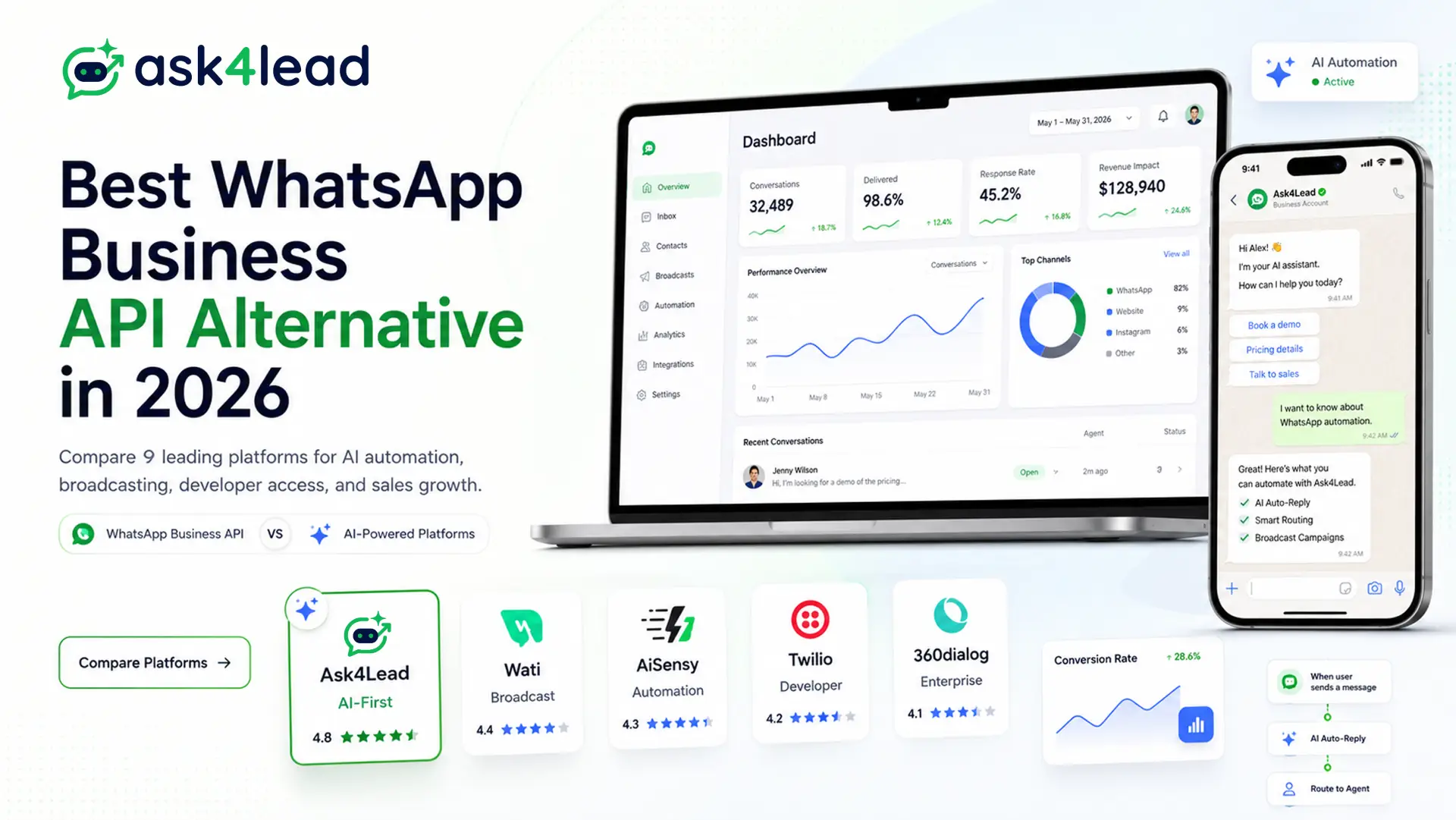
Quick Answer: The best WhatsApp Business API alternative depends on what’s slowing you down. For AI-driven lead qualification and sales follow-up, Ask4Lead is the strongest fit. For high-volume broadcast marketing, AiSensy or Gupshup work well. For a developer team that wants raw Cloud API access without a UI layer, 360dialog or Twilio are the standard picks. If you want to skip the official API entirely, Periskope is the closest thing to a true bypass, though it carries real account risk we explain below.
Your WhatsApp Business number gets a message at 9pm asking about pricing. Nobody sees it until the next morning, because the number sits inside Meta’s raw API with no inbox, no assignment rules, and no one watching it after hours.
That’s not a WhatsApp problem. That’s what happens when a business connects directly to the WhatsApp Business Platform without a layer built for actual sales and support work on top of it.
Key takeaways:
- The official WhatsApp Business API is a developer platform, not a finished product. It ships with no inbox, no CRM, and no automation builder.
- Meta switched WhatsApp Business Platform billing from per-conversation to per-message pricing on July 1, 2025. Most “alternative” roundups online still describe the old model.
- “Alternative to the WhatsApp Business API” actually means two different things: a no-code platform built on top of the official API, or an unofficial tool that bypasses the API completely. Picking the wrong category costs you either money or your WhatsApp number.
- Ask4Lead, Wati, AiSensy, Interakt, and Gallabox all run on Meta’s official infrastructure. Periskope and similar tools do not, and that trade-off matters more than most comparison articles admit.
What Is the WhatsApp Business API, Exactly?
The WhatsApp Business API (officially the WhatsApp Business Platform) is Meta’s developer-facing messaging infrastructure for sending and receiving WhatsApp messages at scale through code, not through the WhatsApp Business App on a phone.
It requires Meta Business verification, message templates approved by Meta, and either a direct integration with Meta’s Cloud API or a connection through a Meta-authorized Business Solution Provider (BSP).
That last part is the piece most people searching for “alternatives” don’t realize going in: you cannot just sign up for the WhatsApp Business API the way you sign up for a SaaS tool. You either build and maintain the integration yourself, or you go through a BSP.
Every platform in this article, including Ask4Lead, sits on top of that same underlying Meta infrastructure. The differences are in what’s built around it.
Why Businesses Go Looking for a WhatsApp Business API Alternative
A team decides to move off basic WhatsApp and onto the official API because they want automation, multiple agents, and a real record of every conversation.
Then they hit the actual process: Meta Business verification, template submissions that get rejected for wording that seems fine, and a raw API response with no interface behind it.
Someone on the team still has to build an inbox, assign conversations, and write the automation logic from scratch, or pay a developer to do it.
That gap between “we have API access” and “we have a working WhatsApp sales channel” is what sends people searching for a WhatsApp Business API alternative. The actual reasons people cite most often:
- No usable interface. The raw Cloud API returns JSON. Someone still has to build the inbox, the contact list, and the reporting.
- Template approval friction. Every outbound message template goes through Meta’s review process, and marketing-category templates can get flagged even when they look compliant.
- Development overhead. A direct Cloud API integration is a real engineering project: webhooks, message status tracking, media handling, retry logic. It’s not a weekend build.
- No lead qualification logic. The API delivers messages. It does not read a reply, understand what a customer wants, or move a lead through a pipeline. That has to be built separately or bought as a layer on top.
- Billing changed under everyone’s feet. Meta restructured WhatsApp Business Platform pricing in 2025, and teams that budgeted for the old model got surprised.
What Changed in WhatsApp API Pricing in 2025 (Most Articles Still Get This Wrong)
This is worth its own section because it’s the single most out-of-date detail across the current crop of “WhatsApp Business API alternative” content, and it changes how you should actually compare platforms.
Through mid-2025, WhatsApp billed on conversation-based pricing: a single charge covered a 24-hour conversation window, regardless of how many template messages you sent inside it.
Effective July 1, 2025, Meta retired that model entirely in favor of per-message pricing. Under the current model:
- You’re billed per delivered template message, not per conversation window.
- Messages fall into four categories: marketing, utility, authentication, and service. Service messages (replies inside an open 24-hour customer window) remain free.
- Utility templates sent inside an already-open service window are free; the same template sent cold is billed.
- Rates are set by Meta per country and per category, and they’re updated periodically, so we’re deliberately not printing a static rate table here. Meta’s live pricing calculator reflects the current numbers by market. Any article showing you a fixed per-conversation price in 2026 is describing a billing model that no longer exists.
- On top of Meta’s rate, every BSP or CRM layer adds its own markup or platform fee. That’s the number that actually varies most between the platforms below.
The practical effect: campaigns that send several template messages inside one conversation now cost more than they did under the old model, while support-heavy, reply-driven usage got cheaper, since service conversations became free and unlimited in late 2024.
If a “WhatsApp Business API alternative” you’re evaluating still pitches its pricing against “the cost per conversation,” ask what billing model that number is actually based on.
Two Very Different Kinds of “Alternative” (Sort This Out First)
Almost every roundup for this keyword mixes two completely different categories together, and picking the wrong one either wastes money or puts your WhatsApp number at risk.
Category 1: No-code layers built on the official API.
- Ask4Lead, Wati, AiSensy, Interakt, Gallabox, 360dialog, Twilio, and Gupshup all connect to Meta’s actual WhatsApp Business Platform.
- Your number is verified, your templates go through real Meta approval, and you’re protected by WhatsApp’s own terms of service.
- What you’re buying from each of them is the interface, automation, and AI logic sitting on top: the inbox, the chatbot builder, the CRM, the lead scoring.
- This is the category almost every real business should be looking at.
Category 2: Tools that bypass the official API entirely.
- Platforms like Periskope, 2Chat, and self-hosted projects such as Evolution API connect to WhatsApp the way WhatsApp Web does, using a QR code, no Meta Business verification, no template approval.
- They’re genuinely useful for WhatsApp group management and low-volume personal automation, which the official API doesn’t support well.
- But they operate outside WhatsApp’s Business Terms of Service, and WhatsApp has a documented history of banning numbers that show automated, non-API behavior at scale.
- If your business depends on that number, that’s a real cost, not a footnote.
We’ll flag which category each option below falls into, because “best WhatsApp Business API alternative” gets a materially different answer depending on which one you actually need.
The Best WhatsApp Business API Alternatives, Compared
| Platform | Category | Best For | AI / Automation Depth | Pricing Model |
| Ask4Lead | Official API layer | AI lead qualification and sales teams | Conversational AI that reads replies, qualifies leads, and moves them through a pipeline | Pay-as-you-go credits, no monthly retainer |
| Wati | Official API layer | Service businesses running structured journeys | No-code bot builder plus AI support agents; unified inbox across channels | Monthly platform fee + Meta usage |
| AiSensy | Official API layer | High-volume broadcast marketing | Keyword-based bots, strong on outbound blasts | Monthly platform fee + Meta usage |
| Interakt | Official API layer | Early-stage founders, Shopify-adjacent teams | Shared inbox, lighter automation | Monthly platform fee + Meta usage |
| Gallabox | Official API layer | Support-heavy teams needing chatbot flows | Flow-based chatbot builder, CRM integrations | Monthly platform fee + Meta usage |
| 360dialog | Official API, dev-first | Developer teams wanting direct Cloud API access, EU hosting | Minimal built-in UI; you build the logic | Flat hosting fee + Meta usage |
| Twilio | Official API, dev-first | Engineering teams building fully custom messaging infra | None built-in; programmable via API | Usage-based, no UI included |
| Gupshup | Official API, enterprise | Large enterprises needing omni-channel CPaaS | Enterprise bot platform, multi-channel | Enterprise/usage-based |
| Periskope | Bypasses the official API | WhatsApp group management without API setup | CRM and workflow automation on regular WhatsApp | Monthly subscription, no Meta usage fee, but no Meta protection either |
1. Ask4Lead: Best for Conversational AI
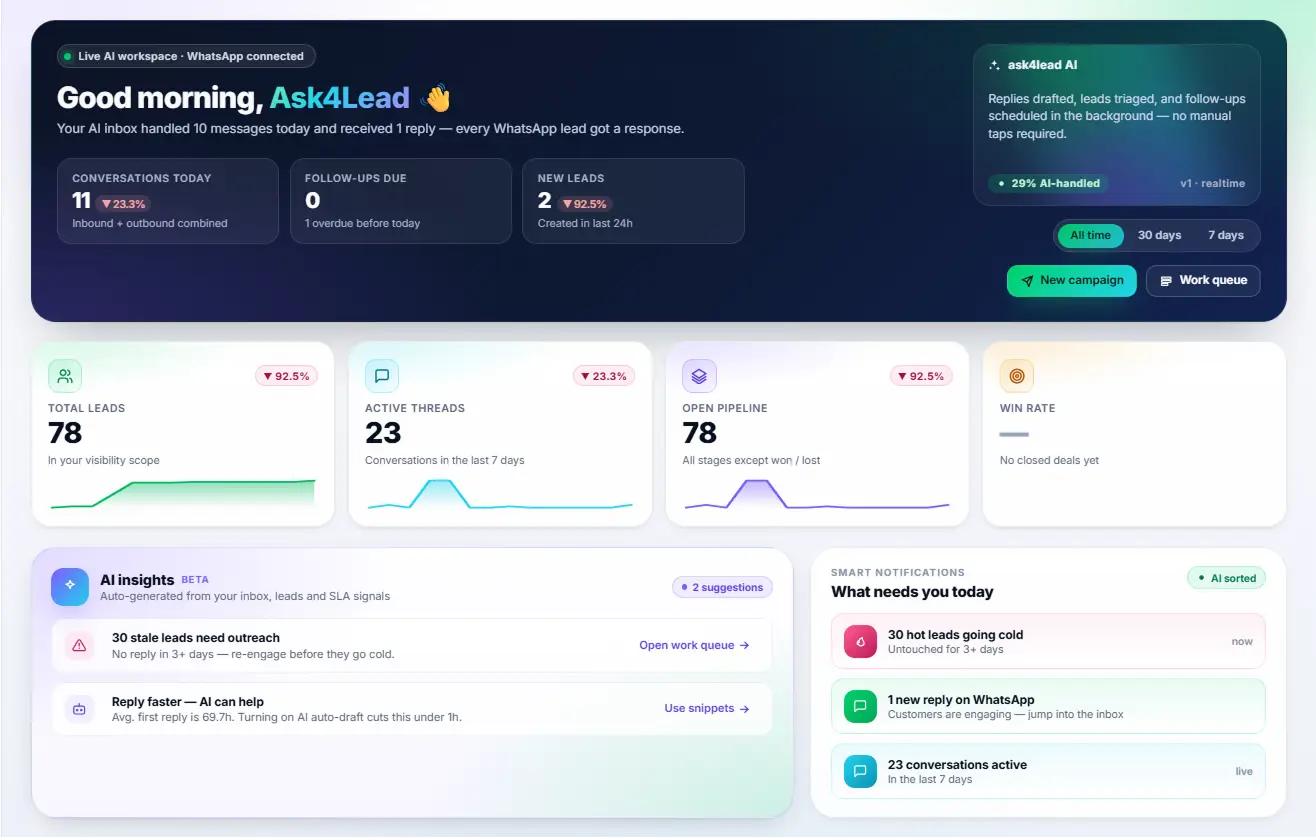
Most platforms in this list stop at “send the message and wait for a human to reply.”
Ask4Lead is built around what happens after that: a prospect messages back, and the AI reads the reply, checks it against the business’s own product info and FAQs, and asks the next qualifying question itself, no keyword menu, no “reply 1 for pricing.”
- That distinction matters most on paid traffic. A Click-to-WhatsApp ad click that lands on a rigid button-menu bot has a real chance of bouncing the moment the prospect types a full sentence instead of picking an option.
- Ask4Lead’s AI handles the sentence, answers it, and keeps the conversation moving through a 9-stage pipeline your sales team can see in real time.
- Pricing runs on a pay-as-you-go credit system through Razorpay, so a small team isn’t paying a flat monthly retainer for capacity it isn’t using yet.
Best for: sales-led businesses (real estate, education, insurance, agencies) where the value is in what happens after the first reply, not just in sending the first message.
2. Wati
- Wati is a mature, widely used platform built directly on the official API, with a no-code flow builder and a genuinely useful unified inbox across WhatsApp,
- Instagram, and other channels. By its own count it serves over 14,000 businesses globally.
- It’s a strong fit for teams running repeatable, rules-based journeys like appointment reminders and renewal sequences.
- Where it runs into the same limit as most flow-builder tools: once a conversation goes off-script, the automation hands back to a human instead of reasoning through it.
3. AiSensy
- AiSensy is built for sending bulk, Meta-approved campaign messages at scale, and it’s genuinely good at that specific job.
- The tradeoff shows up on the inbound side: its chatbot logic is keyword-trigger based, so a reply that doesn’t match a programmed trigger falls back to a generic response.
- For a business whose main goal is blasting offers to a large list, that’s a reasonable tradeoff.
- For a business trying to convert the replies those blasts generate, it’s the gap Ask4Lead’s own AiSensy comparison goes into in more detail.
4. Interakt
- Interakt targets founders and small teams who want a clean shared inbox without a steep learning curve.
- It’s a lighter tool than Wati or Gallabox by design, which is exactly the appeal for a business that isn’t ready for heavy automation yet, and exactly the ceiling once conversation volume grows past what a shared inbox alone can manage.
5. Gallabox
- Gallabox leans into flow-based chatbot building with CRM connections, making it a solid pick for support teams that want structured, branching conversation trees rather than free-form AI replies.
- It sits in a similar tier to Wati and Interakt: strong for scripted journeys, less suited to open-ended sales conversations.
6. 360dialog
- 360dialog is a Meta-authorized BSP built for teams that want to write their own logic against the Cloud API rather than use someone else’s interface.
- It’s popular with EU-based businesses for its regional hosting and relatively transparent, low-markup pricing on top of Meta’s own rates.
- There’s essentially no built-in UI here: you’re paying for clean API access, not a finished product, which is exactly the point for a team with engineering capacity to spare.
7. Twilio
- Twilio is a general-purpose communications API platform that added WhatsApp support alongside SMS, voice, and email.
- Large engineering teams choose it when WhatsApp is one channel inside a much bigger, custom-built communications stack.
- There’s no chatbot builder or CRM here either; it’s infrastructure, priced on usage, meant to be built on top of.
8. Gupshup
- Gupshup operates at enterprise scale, combining WhatsApp with SMS, RCS, and other channels under one contract, commonly used by large telcos, banks, and airlines that need a single vendor across many markets and channels at once.
- It’s a heavier procurement process than any other option here, which is appropriate for the enterprise buyers it’s built for and overkill for most small and mid-sized teams.
9. Periskope
- Periskope is the clearest example of Category 2 above: it connects to regular WhatsApp the way WhatsApp Web does, with no Meta Business verification and no per-message Meta fee.
- Its standout feature is genuine WhatsApp group management, something none of the official-API platforms support, since Meta’s Business Platform doesn’t handle groups at all.
- The honest tradeoff: because it operates outside WhatsApp’s Business API terms, the number carries a real risk of being flagged or restricted if WhatsApp’s systems detect automated behavior at volume.
- It’s a reasonable choice for internal team coordination through WhatsApp groups. It’s a genuinely risky choice as the primary channel a business’s revenue depends on.
A Real Scenario: What Happens to a Lead in the First 15 Minutes
A prospect clicks a real estate Click-to-WhatsApp ad for a 2BHK listing and sends “Is this still available? What’s the price?”
On a keyword-bot setup, the automation checks the message against a list of trigger words, doesn’t find an exact match for “still available,” and falls back to a generic menu: “Reply 1 for Price, 2 for Location, 3 for Site Visit.”
The prospect, who already told the bot what they wanted, either repeats themselves or leaves.
On a platform with AI reading the reply, the response is direct: the price for that unit, followed by one qualifying question, usually whether they’re buying for investment or to move in themselves.
The lead is now qualified without ever hitting a dead end, and it’s sitting in a pipeline stage a sales rep can act on within minutes, not the next morning.
That 15-minute window is where most WhatsApp ad spend quietly gets wasted, not because the ad was wrong, but because whatever answered the reply wasn’t built to actually hold a conversation.
How to Actually Choose
Match the platform to what’s slowing your team down right now, not to the longest feature list:
- Replies aren’t converting into booked meetings or sales. You need conversational AI, not a keyword bot. Look at Ask4Lead.
- You’re sending large campaigns and conversion isn’t the bottleneck. A broadcast-focused tool like AiSensy or Gupshup fits.
- You have engineers and want full control over the logic. Go direct with 360dialog or Twilio and build your own layer.
- You need WhatsApp group coordination, not customer-facing sales. Periskope covers a gap the official API doesn’t touch, with the risk tradeoff noted above.
- You’re small, early, and just need a shared inbox. Interakt is the lowest-friction starting point.
Migrating Off the Raw API: What Actually Happens to Your Number
Switching from a direct Cloud API integration, or from another BSP, to a new platform does not mean losing your WhatsApp number.
Number porting between Meta-authorized BSPs is a standard, well-documented process that typically completes within hours to a few days, not weeks.
Your message history stays tied to your WhatsApp Business Account at the Meta level, not to whichever BSP you were using, so it isn’t lost in the move.
The one thing that does need to happen again: previously approved templates usually need to be re-submitted and re-approved under the new platform, so campaigns don’t silently fail post-migration because a template didn’t carry over.
FAQs
1. What is the best WhatsApp Business API alternative for small businesses?
For small teams focused on converting inbound leads, Ask4Lead offers the lowest setup overhead paired with AI that qualifies leads without a developer team. For a lighter, lower-automation starting point, Interakt is a reasonable option.
2. Is the WhatsApp Business API free?
No. Service (reply) conversations are free, but businesses pay Meta per delivered template message for marketing, utility, and authentication categories, on top of whatever the BSP or CRM layer charges for its own platform. There’s no free tier for outbound business-initiated messaging at any meaningful scale.
3. What’s the actual difference between the WhatsApp Business App, the API, and an “alternative”?
The WhatsApp Business App is Meta’s free mobile app for a single user managing one number. The WhatsApp Business API is Meta’s developer infrastructure for multi-agent, automated messaging at scale, accessed through a BSP. A “WhatsApp Business API alternative” like Ask4Lead is the finished, no-code product built on top of that same API, so you get automation and a real inbox without building it yourself.
4. Do I lose my WhatsApp number if I switch providers?
No. Number porting between Meta-authorized providers is standard and doesn’t require a new number. Templates typically need re-approval on the new platform.
5. Can I automate WhatsApp without using the official Business API at all?
Yes, through unofficial tools like Periskope or self-hosted libraries that connect the way WhatsApp Web does. This bypasses Meta’s approval process and usage fees, but it also operates outside WhatsApp’s Business Terms of Service, which carries a real risk of the number being restricted at higher automation volumes.
6. How long does WhatsApp Business API approval actually take?
Business verification and initial template approval commonly take anywhere from a few days to a couple of weeks, depending on how quickly Meta reviews the submitted business documents and template wording. Platforms that pre-fill compliant template structures for you tend to move faster through review than templates built from scratch.
