
What is WhatsApp lead generation?
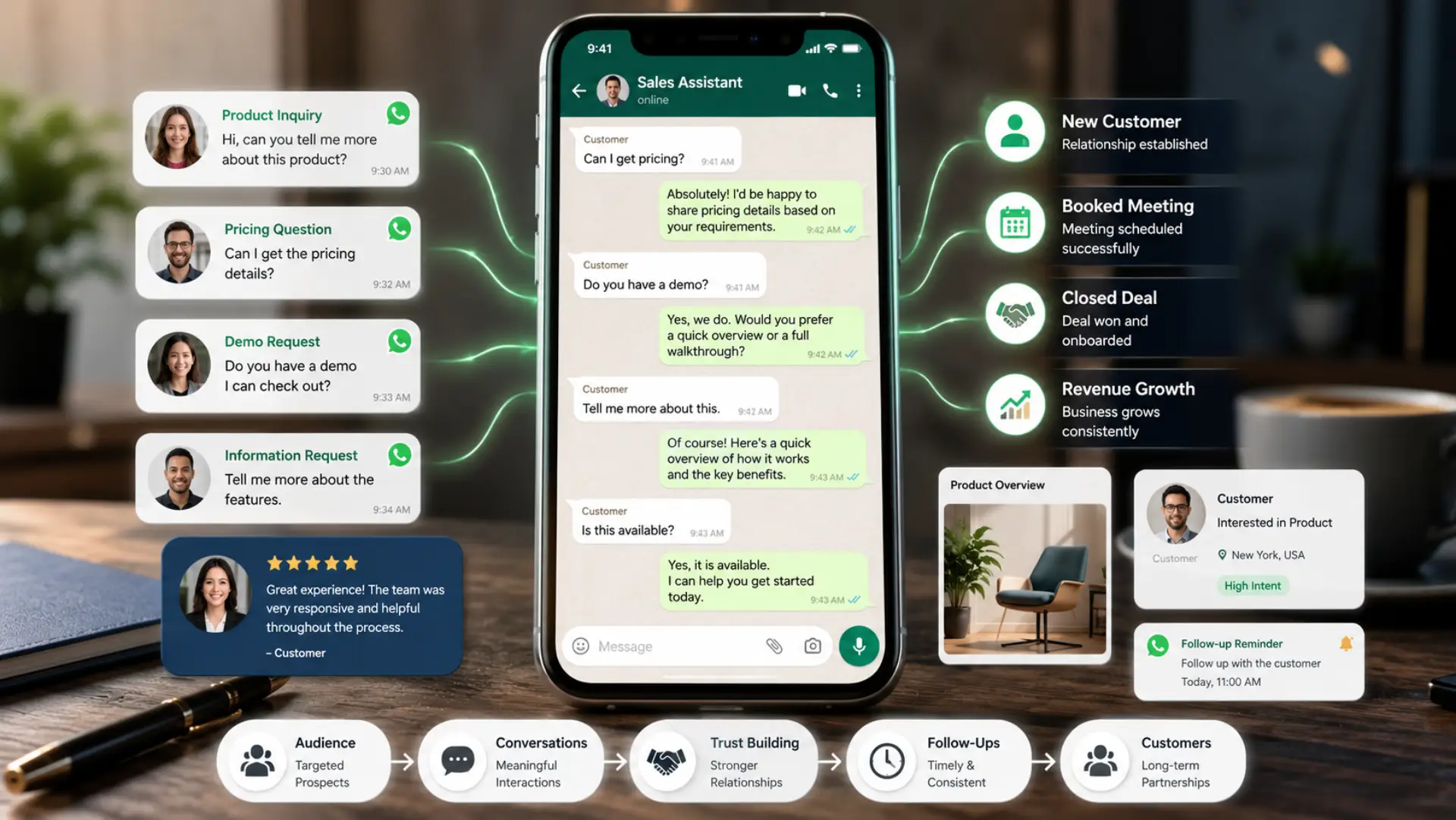
WhatsApp lead generation is the strategy of driving traffic usually via Click-to-WhatsApp (CTWA) ads or website widgets into a WhatsApp Business inbox, where an AI agent or human representative qualifies the prospect, collects their contact data, and moves them into a sales pipeline. Because WhatsApp boasts an average 98% open rate, businesses use it to replace traditional, static web forms with real-time conversations that qualify prospects instantly.
Key Takeaways
- The Form is Dead: WhatsApp lead generation replaces static web landing pages with interactive conversations, significantly increasing qualification rates by addressing prospects in real-time.
- API over App: Scaling beyond micro-business limits requires upgrading from the free WhatsApp Business App to the Official WhatsApp Business API.
- Traffic Mechanics: The most effective funnels combine Click-to-WhatsApp Ads (CTWA) with intelligent AI agents that qualify leads in plain English rather than rigid button menus.
- ROI and Cost: Meta charges per-message for business-initiated templates (averaging $0.01 to $0.08 globally), but the resulting Cost Per Lead (CPL) is typically 40-60% lower than traditional channels because the conversion-to-conversation rate is so high.
The Fundamental Problem With Traditional Lead Generation
If your current lead generation strategy relies on driving ad traffic to a landing page with a static web form, you are losing money.
The modern buyer does not want to fill out a 5-field form and wait 24 to 48 hours for a sales representative to call them back.
By the time your team dials the number, the prospect has forgotten they filled out the form, or worse, they have already closed a deal with a competitor who answered faster.
WhatsApp lead generation solves the speed-to-lead problem. When a prospect clicks an ad, they are instantly transported into a familiar chat interface.
They ask their question, they get an immediate answer, and your business captures their verified phone number automatically.
However, to execute this at scale, you must understand the mechanics of how leads enter the funnel, how the underlying technology works, and why the “chatbot” you choose dictates your success or failure.
What is Click-to-WhatsApp Ads?
Click-to-WhatsApp Ads (CTWA) are the undisputed heavyweight of WhatsApp lead generation.
Run through the Meta Ads Manager (on Facebook and Instagram), these ads look like standard sponsored posts.
The difference is the call-to-action button. Instead of saying “Learn More” and linking to a slow-loading website, the button says “Send Message.”
When the user clicks, their WhatsApp application opens instantly with a pre-filled draft message (e.g., “Hi, I would like to know more about the 3BHK properties in Whitefield”).
The moment they hit send, your business receives the message, captures their verified phone number, and the lead generation process begins.
Other Traffic Sources: Website Widgets and QR Codes
Your website is already generating traffic.
Converting that traffic requires removing friction. Instead of a contact form, embed a floating WhatsApp widget in the bottom corner of your site. When a user clicks it on their mobile device, it deep-links directly into their WhatsApp app.
For businesses with physical presence real estate site offices, retail stores, or printed brochures QR codes act as the bridge to digital lead generation.
By generating a specific `wa.me` link and converting it to a QR code, a user simply scans a poster and is immediately dropped into a WhatsApp conversation with your AI agent.
What’s the difference between WhatsApp Business API and WhatsApp Business App?
One of the most common mistakes businesses make when starting WhatsApp lead generation is choosing the wrong platform tier. You cannot automate lead qualification at scale using the free mobile app you download from the App Store.
The WhatsApp Business App is designed strictly for local micro-businesses (like a neighborhood salon or a solo consultant).
It limits you to one primary device and lacks CRM integration capabilities. If you have a sales team of 3 or more people, or if you run paid advertising, the free app will break your operations.
To build an automated lead generation funnel, you must use the Official WhatsApp Business Platform (API).
| Feature | WhatsApp Business App | WhatsApp Business API (via Ask4Lead) |
| Target Audience | Micro-businesses (1-2 employees) | Growing SMBs and Enterprises |
| User Access | Limited to 1 phone + up to 4 linked web devices | Unlimited team members via Shared Inbox |
| Automation | Basic away messages and quick replies | Full conversational AI, custom routing, and WhatsApp Flows |
| CRM Integration | None | Native CRM sync (Kanban pipelines, automated follow-ups) |
| Broadcasts | Limited to 256 contacts (who saved your number) | Unlimited verified broadcast lists using Meta templates |
Why Traditional Chatbot Menus Destroy Conversion Rates
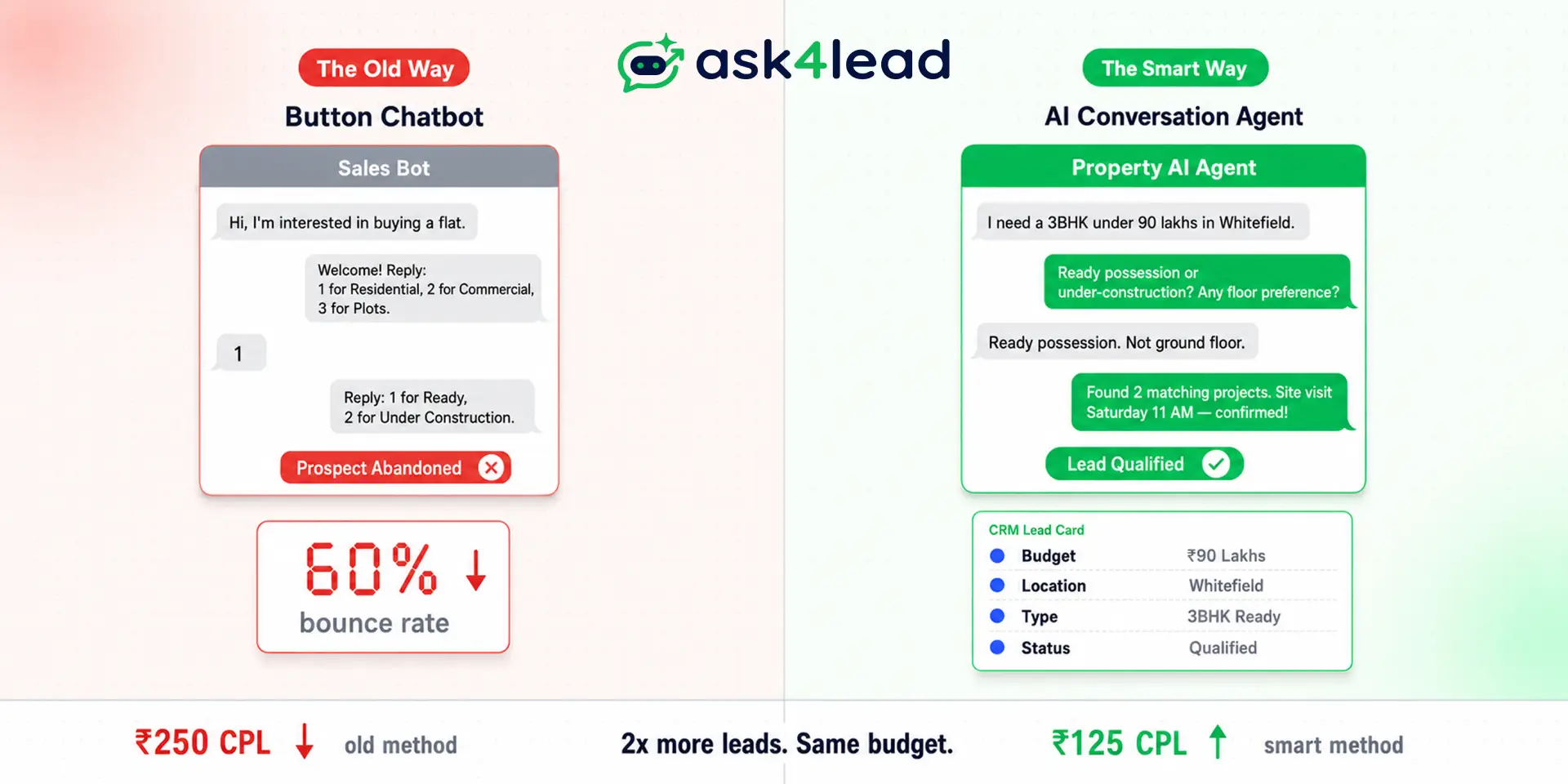
The biggest failure point in modern WhatsApp lead generation is the over-reliance on rigid, numbered button menus. Every major legacy chatbot platform relies heavily on forcing the user to click through predefined options.
An inbound prospect looking to purchase a commercial property does not want to press “1 for Sales”, then “3 for Commercial”.
They have a specific, nuanced problem. They want to type their exact requirement: “I need a 3,000 sq ft office space in Downtown under $5,000/month.”
Real Scenario: The AI Difference
A user clicks a Facebook ad for business insurance.
Traditional Bot (The old way): “Welcome! Please select an option: 1. Health 2. Liability 3. Property”
User Action: The user’s specific need isn’t listed. They close the chat. The lead is lost.
Ask4Lead AI (The new way): “Hi! Thanks for reaching out. To get you the right quote, are you looking for coverage for a physical storefront, or professional liability for services?”
User Action: “Professional liability for my consulting firm.”
Result: The Ask4Lead AI verifies the requirement against your uploaded product documents (Document-Grounded RAG) and flags the qualified lead for a human closer on the Kanban board.
When you answer a high-intent ad click with an automated menu, your conversion rates will drop. The user feels processed, not heard. By leveraging an automated WhatsApp marketing AI like Ask4Lead, you process context instantly in plain English, understanding budget, location, and timeline without forcing the user down a rigid path.
Best WhatsApp Lead Generation Tools 2026
Choosing the software layer that sits on top of the WhatsApp API dictates how your sales team will operate. Here is how the market currently breaks down for mid-sized businesses.
| Platform | Core Focus | Lead Qualification Method | Best For |
| Ask4Lead | Sales CRM & AI Conversations | Plain English AI (Document-Grounded) | B2B, Real Estate, Education, High-Ticket Sales |
| Klaviyo | Omnichannel Marketing | Broadcasts & Basic Flows | Retail E-commerce |
| Wati / Interakt | Customer Support & Basics | Rigid Button Menus (Decision Trees) | Low-ticket, high-volume support desks |
What are WhatsApp Flows and how do they help lead gen?
While plain English is the best way to qualify a lead, sometimes you need structured data like selecting a specific date for a real estate site visit, or choosing a vehicle model for a test drive.
In the past, you would have to send the user a Calendly link or a website URL, forcing them out of WhatsApp. Today, you use WhatsApp Flows.
Flows allow you to embed rich, interactive forms directly inside the conversation thread. The user taps a button in the chat, a native calendar widget slides up, they select Friday at 3:00 PM, and tap submit. The data writes directly to your Ask4Lead CRM.
The user never left the app. Removing that friction is the difference between a booked appointment and an abandoned chat.
WhatsApp vs Email vs SMS for Lead Generation
When deciding where to allocate marketing budgets, the data strongly favors conversational messaging.
While email marketing struggles with 20% open rates and spam filters, WhatsApp delivers a 98% open rate with push notifications enabled by default on most devices.
SMS provides high deliverability but lacks the rich media, interactive buttons, and native forms (Flows) that WhatsApp offers. Furthermore, WhatsApp allows businesses to share product catalogs and PDFs dynamically during a conversation.
For lead generation, WhatsApp combines the speed of SMS with the rich formatting and data capture of a web landing page.
How much does WhatsApp lead generation cost?
The cost of WhatsApp lead generation involves two main components: your CRM software fee (the platform you use to manage the chats) and Meta’s conversational API charges.
As of 2026, Meta charges on a per-message basis for business-initiated templates. Costs vary strictly by the user’s country code and the message category. Here is how the pricing breaks down practically:
- Marketing Messages: (Promotions, targeted follow-ups) Typically range from $0.01 to $0.08 per delivered message globally. In markets like India, this is extremely cost-effective (sub-$0.01).
- Utility Messages: (Order confirmations, appointment reminders) are priced lower than marketing messages.
- Service Messages: Non-template replies sent by a business within an open 24-hour customer service window are currently free. If a user clicks your ad and messages you, you have 24 hours to chat with them at no cost from Meta.
While paying per message sounds like an added expense compared to free email blasts, businesses typically see their overall Cost Per Lead (CPL) drop by 40-60%.
Qualifying 100 leads on WhatsApp yields significantly more actual sales conversations than qualifying 100 leads via a web form where 80% of prospects never answer the phone.
How Do I Generate Leads on WhatsApp? (4-Step Process)
If you want to move away from static forms and start capturing leads conversationally, follow this proven sequence.
- Connect the Official API: You cannot run this on a standard mobile device. Link your WhatsApp Business number to a conversational CRM like Ask4Lead. This unlocks multi-agent access, allowing your entire sales team to operate out of a Shared Team Inbox, and enables the visual Kanban pipeline tracking.
- Train the AI with Brand Context (RAG): Upload your actual PDFs, brochures, pricing matrices, and service tiers into the system. Ask4Lead uses Document-Grounded RAG (Retrieval-Augmented Generation) to train the AI. This means the AI will use your exact verified data to answer prospect questions accurately, rather than hallucinating generic answers.
- Launch CTWA Campaigns: Set up Click-to-WhatsApp Ads on Facebook and Instagram. Target your ideal customer profile, but instead of sending them to a landing page, set the destination to your WhatsApp API number.
- Track on a Kanban Pipeline: As the AI qualifies leads automatically 24/7, watch them move through the 9-stage visual pipeline. When a lead reaches the “Qualified” stage, the system flags it. Have your human sales reps step into the Shared Inbox, take over the chat seamlessly, and close the deal.
WhatsApp Lead Generation Case Study: GVM Real Estate Group
To understand the financial impact of conversational qualification, we can look at a mid-sized real estate agency operating in a highly competitive market.
The Before: The agency was spending $10,000/month on Facebook ads driving traffic to a landing page. Their Cost Per Lead (CPL) hovered around $12. The critical failure was follow-up: sales reps were wasting 70% of their day calling leads who never picked up the phone. Even when they did connect, the leads were often unqualified window-shoppers.
The Pivot: They switched the ad destination from a landing page directly to WhatsApp (CTWA) and deployed Ask4Lead to handle the initial conversation. Instead of a static form, prospects chatted with an AI that asked for their budget, preferred neighborhood, and move-in timeline in plain English.
The Results:
- CPL dropped from $12 to $4.50: The frictionless transition from Facebook directly into a WhatsApp chat doubled the volume of captured leads for the same ad spend.
- Qualification Speed: Leads were qualified in under 60 seconds, 24 hours a day, 7 days a week.
- Sales Efficiency Multiplied: Human agents were instructed to only step into the Shared Team Inbox when a lead was explicitly marked as “Qualified” on the Kanban board. This resulted in a massive spike in productive sales time, eliminating the hours previously wasted on dead-end phone calls.
Is WhatsApp lead generation compliant with data privacy laws?
Yes, but compliance requires active, system-level management. Unlike cold calling or purchasing dubious email lists, WhatsApp lead generation operates strictly on an opt-in basis.
If you spam users on WhatsApp, Meta will block your number permanently.
According to Meta’s Commerce and Business Policies, you must obtain explicit opt-in consent before sending outbound marketing messages.
If a user messages you first (such as clicking a CTWA ad), you have a 24-hour customer service window to converse freely.
However, to message them after that window closes with promotional content, they must have explicitly agreed to receive future communications.
To comply with regional frameworks like GDPR in Europe or DPDP in India, you must ensure your chat flow includes a clear opt-in statement.
Explain exactly what type of messages the user will receive, and always provide an easy, automated way to opt out (e.g., “Reply STOP to unsubscribe”). A professional CRM like Ask4Lead manages these opt-outs automatically at the system level.
Take Control of Your Sales Pipeline
Stop losing inbound leads to rigid button menus and slow follow-ups.
Ask4Lead gives your team the AI conversational intelligence, the visual Kanban CRM, and the Shared Inbox required to turn WhatsApp into an automated revenue engine.
Get started with Ask4Lead today.
FAQs
1. What is WhatsApp lead generation?
WhatsApp lead generation is the strategy of driving traffic usually via Click-to-WhatsApp (CTWA) ads or website widgets into a WhatsApp Business inbox, where an AI agent or human representative qualifies the prospect, collects their contact data, and moves them into a sales pipeline.
2. What is the difference between WhatsApp Business API and WhatsApp Business App?
The free WhatsApp Business App is designed for micro-businesses and only supports a single user device. The WhatsApp Business API is required for mid-to-large businesses to connect multiple sales agents, automate workflows, integrate with CRM systems like Ask4Lead, and send broadcast campaigns at scale.
3. How much does WhatsApp lead generation cost?
The cost consists of your CRM software fee plus Meta’s per-message API charges. Meta charges between $0.01 and $0.08 per marketing message depending on the user’s country code, while user-initiated service messages within a 24-hour window are currently free.
4. Is WhatsApp lead generation compliant with data privacy laws?
Yes, provided you obtain explicit opt-in consent from the user before messaging them. Meta’s Commerce Policies and regional laws like GDPR require businesses to clearly state what types of messages users are opting into and provide a clear way to opt out.
5. What are WhatsApp Flows and how do they help lead gen?
WhatsApp Flows allow businesses to create rich, interactive forms directly inside the chat interface. This lets users book appointments, select product options, or submit lead qualification data without ever leaving the WhatsApp application, thereby reducing drop-off rates.
