
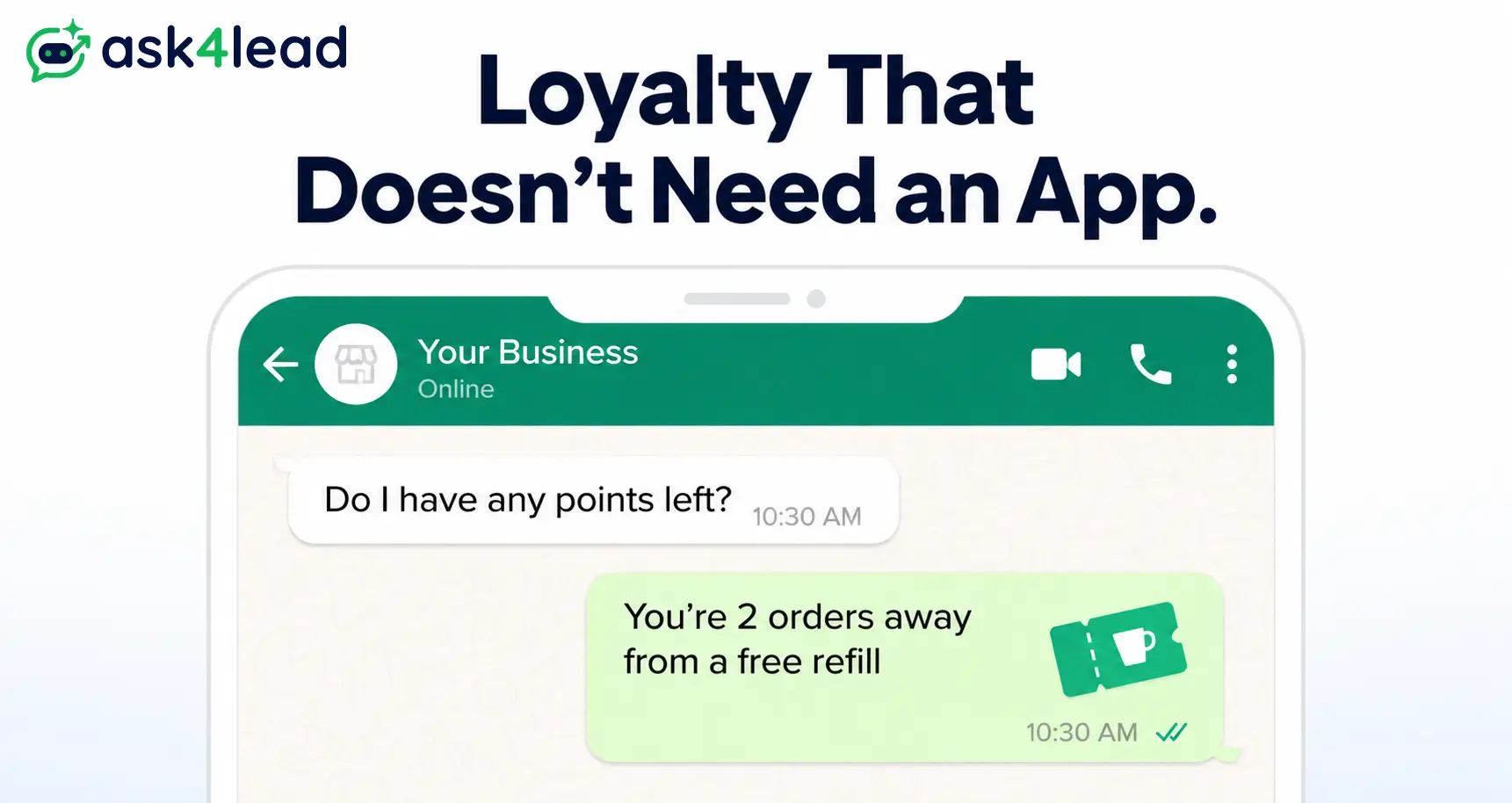
A WhatsApp loyalty program is a system for rewarding customers who already bought from you so they buy again. It runs inside WhatsApp chat itself, instead of a separate app, a plastic card, or email.
Customers usually join with a QR code or a message, then track their status inside that same conversation. They get reorder reminders or personalized offers instead of a generic broadcast.
The real problem most businesses are trying to solve is simpler than a full rewards program. A customer buys once, then goes quiet, and the WhatsApp marketing strategies built for finding new leads don’t bring that customer back.
Quick answer: a WhatsApp loyalty program keeps customers buying again with 2 things: an easy, app-free way to join (usually a QR code), and timed, relevant messages instead of generic broadcasts.
It works because it reaches people on an app they already open constantly. It fails when every message is just a points update, instead of something tied to a real moment in the customer’s journey.
Key Takeaways
- A WhatsApp loyalty program does not need a points system to work; timing and personalization matter more than the reward mechanic.
- Repeat customers are dramatically cheaper to keep than new ones are to acquire, and even a small retention gain moves profit disproportionately.
- Most loyalty messages get ignored for one of 3 reasons: they’re generic, badly timed, or sent too often.
- Sending from a personal number or an unofficial tool risks a permanent WhatsApp ban with no appeal.
- Alfamart, Indonesia’s largest convenience retailer, grew its loyalty program membership 4X after moving registration onto WhatsApp.
What Is a WhatsApp Loyalty Program?
A WhatsApp loyalty program is a set of automated and semi-automated messages. It turns a first-time buyer into a repeat one.
It’s triggered by real customer events, a purchase, a delivery, a typical reorder date, not one-size-fits-all blasts. Some programs add a points or tier structure on top. The strongest ones don’t strictly need one to work.
WhatsApp Loyalty Program vs. a Traditional Loyalty App or Punch Card
A punch card or a loyalty app only works when the customer remembers it exists. WhatsApp flips that, since the message arrives on a screen already checked constantly.
That closeness also raises the stakes. A bad message does more damage here than an ignored app notification ever would.
- Discovery: an app waits to be remembered; a WhatsApp message arrives inside a conversation already open.
- Friction: an app usually needs a separate login and a download; WhatsApp needs neither.
- Cost of getting it wrong: an ignored notification just gets muted; a bad WhatsApp message feels like an intrusion into a more personal space.
Why WhatsApp Outperforms Email or SMS for Loyalty Messaging
WhatsApp messages get read mostly because the app itself is checked constantly. That’s true even without the “98% open rate” figure nearly every article on this topic repeats without a source.
Independent benchmark data from Chatarmin’s analysis of 382 business accounts found a weighted open rate around 79%, still well above typical email performance. Judge your own channel by your own numbers, not a recycled headline stat.
How a WhatsApp Loyalty Program Actually Works
Most WhatsApp loyalty programs run on the same basic mechanic, regardless of which platform powers them. It’s worth knowing even if your own approach skips the points layer, since it’s what customers already expect.
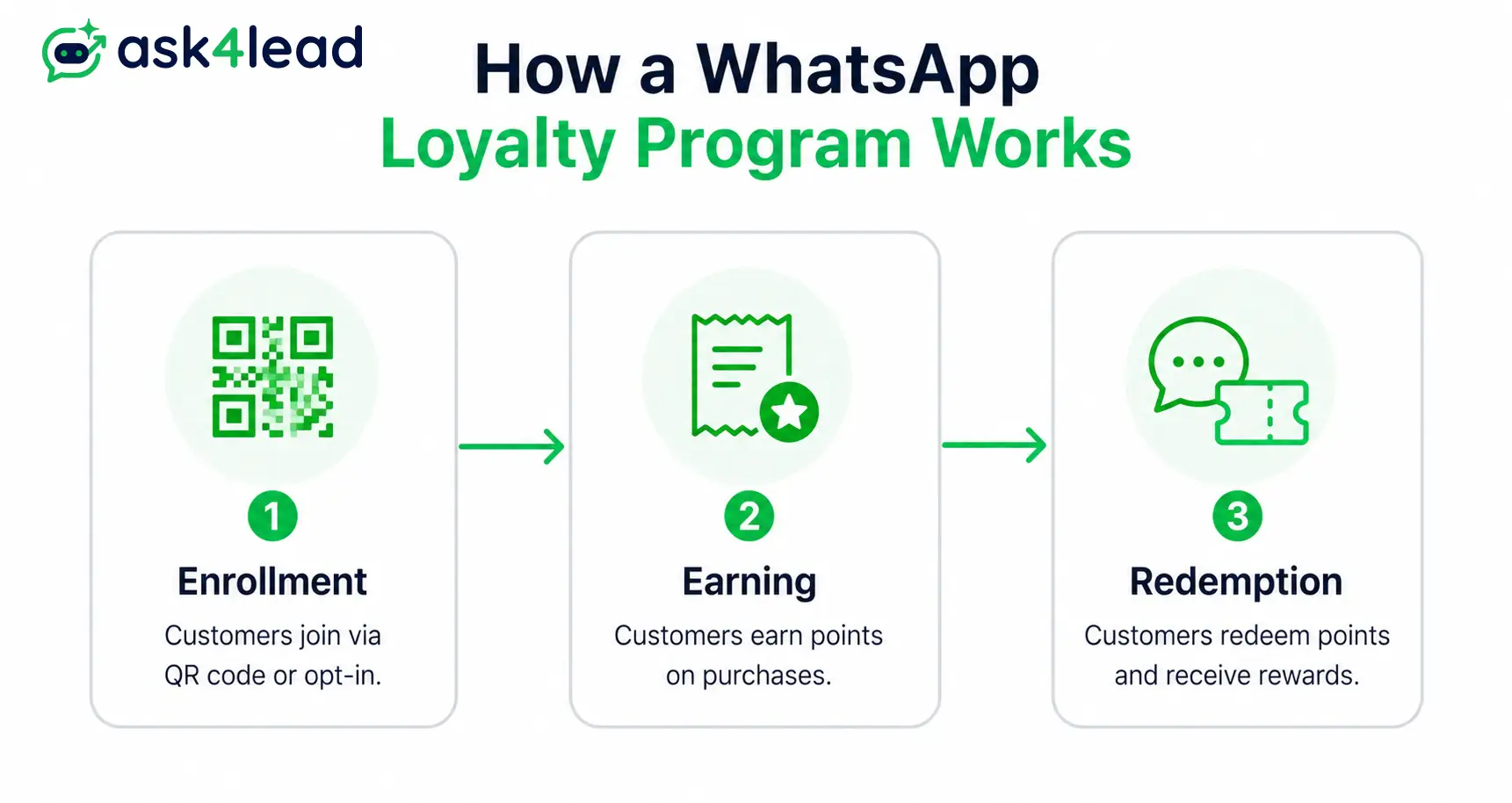
1. Enrollment: Joining Without Downloading Anything
- A customer scans a QR code at checkout, or clicks a link from an ad, a receipt, or a website.
- That opens a pre-filled WhatsApp chat with the business, and confirming a name usually finishes signup in under a minute.
2. Earning: How Points or Credit Get Tracked
- Every purchase gets logged against that customer’s WhatsApp number, either automatically through a POS or e-commerce integration, or manually when staff enter a bill number.
- The customer gets a balance update immediately, inside the same thread.
3. Redemption: Turning Points Into Real Value
When a customer hits a milestone, WhatsApp sends a digital voucher or a discount code to show or apply at checkout. The best setups let a customer check their balance and redeem a reward just by sending a message.
| Step | What the customer does | What the system does |
| Enrollment | Scans a QR code or clicks a link | Opens a pre-filled chat, saves the number |
| Earning | Makes a purchase | Logs it, sends a balance confirmation |
| Redemption | Sends a message or shows a code | Issues a voucher or discount instantly |
A genuine limitation worth naming: a points ledger only works if customers redeem what they earn. Several top-ranking guides on this topic quote a stat that roughly 6 in 10 customers forget they’re even enrolled at all.
A chat-based reminder is supposed to fix exactly that, but only when it’s specific enough to notice.
Why Repeat Customers Are Worth More Than New Ones
Repeat customers cost less to sell to and spend more over time than a business’s newest buyers. Even a small improvement in retention has an outsized effect on profit.
That gap between “customer bought once” and “customer buys on a schedule” is where most repeat-purchase revenue quietly leaks out.
The Retention Math
Frederick Reichheld’s research at Bain & Company ties a small lift in retention to a much larger lift in profit. Independent e-commerce data from Gorgias shows a similar pattern on the revenue side.
- A 5% improvement in customer retention can raise profits by 25% to 95%, per Bain’s research.
- A small share of repeat buyers, often under 10% of a store’s customers, tends to generate 30-40%+ of total revenue.
- Neither figure is Ask4Lead’s own data; check the real trend inside your own order history before planning around either one.
The First-to-Second-Order Gap
The most useful number most businesses never check is the gap between a customer’s first order and their second.
If most repeat customers reorder around 6 weeks after their first purchase, a message sent in week 5 beats any generic loyalty tactic. It answers a question the customer is already asking.
This single number should shape every reminder that follows it.
The Core Building Blocks of a WhatsApp Repeat-Purchase Campaign
A working campaign is a small set of messages tied to specific moments in the customer’s journey, not a single broadcast list. Skipping straight to promotions without these earlier moments is the most common reason campaigns underperform.
1. Post-Purchase Follow-Up Sequence
The first message after a sale protects the relationship more than any later promotion. It’s the moment a business either builds trust or goes silent.
- An order confirmation, sent immediately.
- A delivery or usage check-in, 3-5 days later.
- A clear way to reach a real person if something’s wrong.
Ask4Lead’s guide on WhatsApp order and shipping notifications breaks this exact sequence down step by step.
2. Reorder, Upsell, and Occasion Messages
For anything that gets used up, a reminder 5-7 days before the customer likely runs out beats a generic “come back” message. It answers a need the customer already has.
The same logic applies to a relevant accessory recommendation, shared through a WhatsApp catalog rather than a text list, or a message tied to a date the customer gave you.
| Message type | Best time to send | Primary goal |
| Order confirmation + next step | Immediately after purchase | Build trust, set expectations |
| Delivery or usage check-in | 3-5 days after delivery | Catch problems early |
| Reorder reminder | 5-7 days before predicted run-out | Anticipate the customer’s need |
| Personalized upsell or cross-sell | 1-4 weeks after purchase | Raise order value, not discount it |
| Occasion or milestone message | Tied to a date the customer gave you | Deepen the relationship |
| Win-back or re-engagement | After the typical reorder window passes | Recover the customer before churn |
3. Real-World Proof: How Alfamart Grew Its Loyalty Program 4X on WhatsApp
Most articles on this topic cite a case study with no name, no numbers, and no source. This one is different.
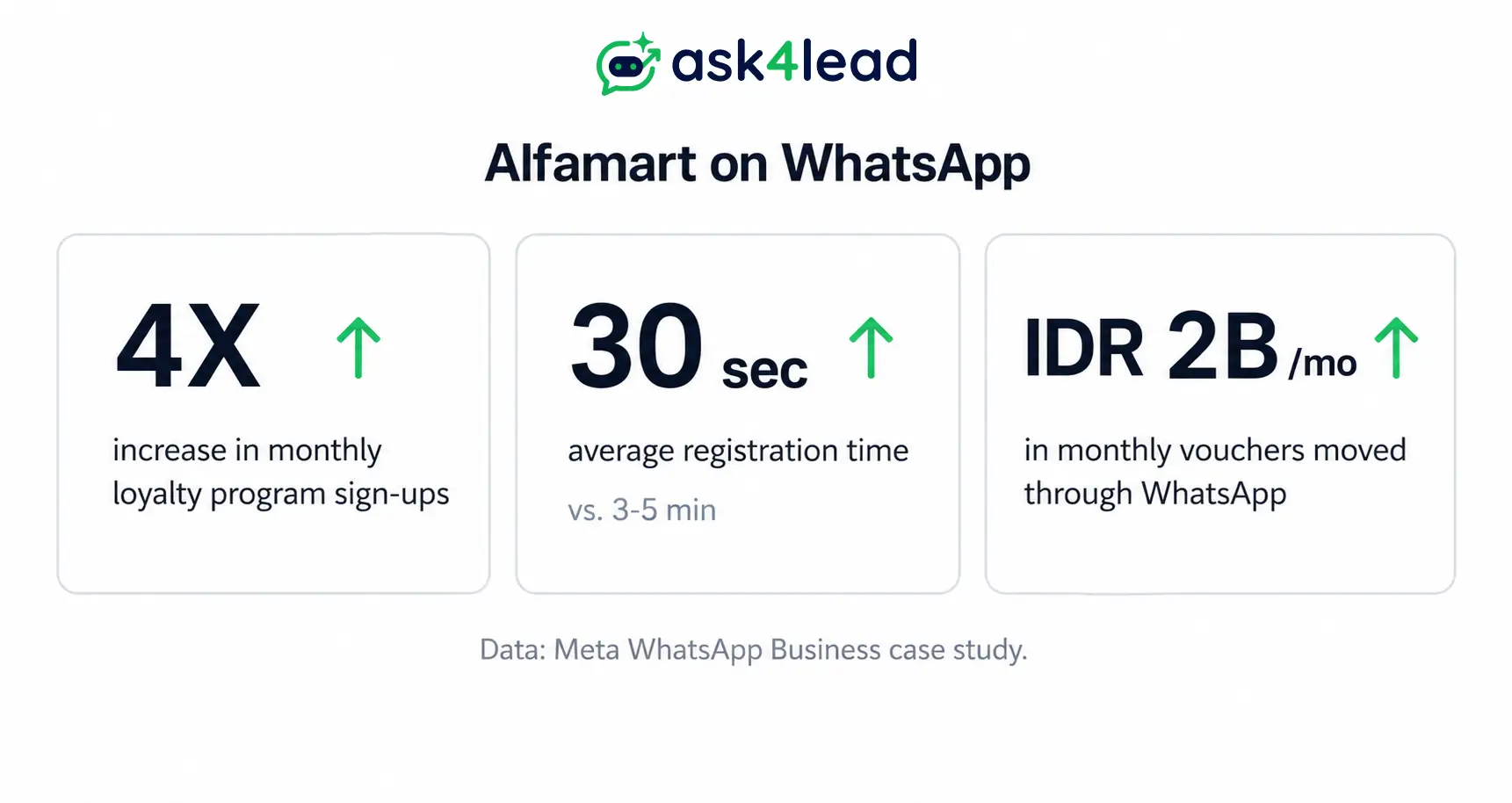
Alfamart, a retailer running over 18,000 stores across Indonesia, moved its Alfagift loyalty program onto WhatsApp for in-store QR registration, according to Meta’s official WhatsApp Business case study.
- Monthly loyalty program sign-ups grew 4X on average through 2023 after switching to WhatsApp.
- Registration time dropped to about 30 seconds, down from 3-5 minutes for the old in-store process.
- The program moved roughly IDR 2 billion in digital vouchers a month through WhatsApp alone.
These figures are self-reported, not independently audited. But they’re tied to a named business and a named partner, which already makes them more checkable than any stat the top-ranking guides on this topic use.
Advanced Retention Tactics Most Guides Skip
The tactics below rarely show up in vendor blog posts because they take more effort than “send a birthday message.” They separate a program that moves the repeat-purchase rate from one that just looks good in a screenshot.
1. Predict Reorder Windows Per Customer, Not Store-Wide
A single, store-wide “customers reorder every 6 weeks” average hides real variation between a weekly buyer and a quarterly one.
More advanced setups score each customer’s own purchase pattern and time that customer’s reminder individually. Ask4Lead’s AI Dashboard is built for exactly this kind of per-customer pattern.
2. Time Messages to Real Events, Not Just the Calendar
A reminder tied to something actually happening beats a scheduled promotional message with no real trigger behind it.
- A restock of the exact product someone bought.
- A fresh batch or new stock arrival.
- A new variant of something they already buy.
The message doesn’t need to be complicated. It needs a genuine reason to exist right now.
3. Migrate Customers Off Third-Party Ordering Apps
If most of your repeat orders come through a delivery marketplace instead of directly, that’s a retention blind spot. Those customers are invisible to your own retention system until they’ve ordered through your own channel once.
A small incentive code included in that third-party order, paired with a quick WhatsApp Flow to capture the opt-in, can move future orders onto a channel you actually own.
Why Most WhatsApp Loyalty Messages Get Ignored
Most loyalty messages fail for one of 3 reasons: they’re generic, badly timed, or sent too often. None of the top-ranking guides on this topic address any of them in real depth.
1. The “You Earned X Points” Mistake
A message that only reports a points balance gives the customer no reason to act right now.
- A small, expiring reward.
- A restock alert on something they actually bought.
- A note tied to a real purchase, not a generic template.
Any of those, paired with the points update, gets far more action than a balance notice on its own.
2. Generic Broadcasts vs. Timed, Relevant Messages
A single broadcast blasted to every past customer on the same day reads as spam, even when the offer is good. That’s true regardless of what they bought or when.
Segment by what someone actually purchased and how long ago. Then send the fewest messages that still cover every real reason to reach out.
3. Frequency Mistakes That Trigger Opt-Outs
Sending too often is the fastest way to lose the channel. A WhatsApp opt-out is harder to reverse than an email unsubscribe.
Meta’s WhatsApp Business Messaging Policy requires businesses to honor every opt-out immediately.
That makes frequency discipline a compliance issue as much as a marketing one.
| Customer segment | Recommended cadence | Why |
| Newly acquired (first 30 days) | 2-3 messages, tied to real events only | Too many too early breaks trust |
| Active repeat buyers | 2-4 a month, never more than 1 promo broadcast a week | Keeps the channel useful, not noisy |
| Dormant or lapsed customers | 1 message a month, with a genuine reason | Limits opt-outs, keeps the door open |
| High-value or VIP customers | Event-triggered only | Precision beats frequency here |
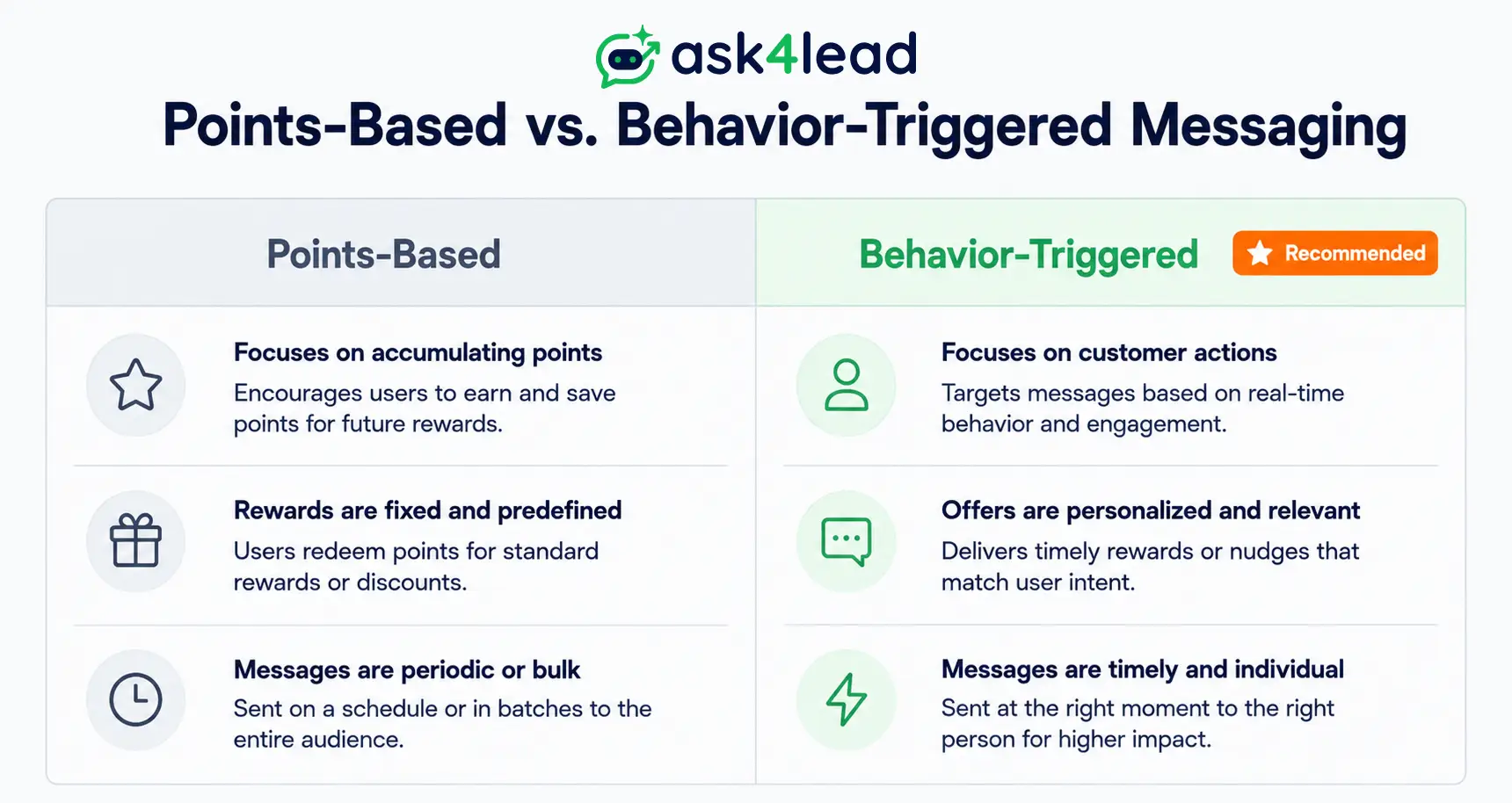
Points-based vs. behavior-triggered retention, side by side:
| Particulars | Points-based loyalty | Behavior-triggered messaging |
| What drives a message | A points threshold or a scheduled date | A real customer action or a data-backed reorder window |
| Setup effort | Higher (needs a points ledger, redemption logic) | Lower (needs order data and message timing) |
| Common failure mode | Customers forget their balance | Messages sent too generically or too often |
| Best fit | Businesses with frequent, low-cost repeat purchases | Almost any repeat-purchase business |
If your own repeat-purchase rate has been flat for months, this table is usually where the fix is hiding: not a bigger reward, a better-timed message.
WhatsApp Compliance Basics Before Sending Loyalty Campaigns
Every loyalty message has to follow Meta’s rules. Getting this wrong can cost a business its number, not just a campaign, which matters more here than for a one-off marketing push since the same customers get messaged for months.
1. Why a Personal Phone Number Risks a Permanent Ban
Sending identical, copy-pasted messages to dozens of contacts a day from a personal number or an unofficial tool is exactly the pattern Meta’s systems are built to catch.
The official WhatsApp Business Platform, still widely called the WhatsApp Business API, exists to send this kind of messaging at scale without that risk. Ask4Lead’s guide on whether WhatsApp will ban you for business automation covers exactly where that line sits.
2. The 24-Hour Rule and Template Messages, Explained
WhatsApp lets a business send any free-form message within 24 hours of a customer’s last reply. Outside that window, only a pre-approved template works.
Ask4Lead’s breakdown of the 24-hour rule for WhatsApp Business explains what counts as “resetting the clock.” A reorder reminder sent 3 weeks later will almost always need a template.
3. What Coexistence Means and When You Need It
Coexistence is Meta’s official feature letting a business use the WhatsApp Business Platform and the regular WhatsApp Business App on the same number at once, per Meta’s onboarding guide for Business App users.
Most loyalty programs need this, since one number ends up handling both automated reminders and a real person replying to questions.
4. Opt-In Rules You Cannot Skip
Before messaging a customer, that customer has to opt in, and Meta requires the opt-in to clearly name the business, per Meta’s official opt-in requirements.
Ask4Lead’s guide to WhatsApp opt-in and consent also covers the practical side for businesses under GDPR or similar regional privacy rules, a compliance angle most loyalty content skips entirely.
| Rule | What it means | Risk if you skip it |
| No personal-number bulk sending | Use the official WhatsApp Business Platform instead | Permanent, unappealable ban |
| 24-hour window | Free-form replies only within 24 hours of the last reply | Message fails outside that window without a template |
| Coexistence | App and Platform can share one number | Automated and manual messaging conflict without it |
| Opt-in required | Customer must clearly agree; business must be named | Falling account health and quality rating, which caps reach |
Pushing past Meta’s broadcast limits is one of the fastest ways to trigger that drop.
How to Build a Repeat-Purchase Campaign, Step by Step
Building a working campaign is a 5-step process. Skipping the first step is why the later ones underperform.
- Map your natural reorder window. Pull your order history and find the median gap between a customer’s first and second purchase.
- Segment customers by purchase and engagement history, not just by name, as shown in the frequency table above.
- Automate the post-purchase-to-reorder sequence so it fires on its own. Ask4Lead’s automated follow-up feature and guide to scheduling WhatsApp messages safely cover this without a developer.
- Personalize with real data, not just a first name. Ask4Lead’s AI Knowledge Profile grounds messages in the business’s actual product catalog.
- Track results and win back cold customers. A missed reorder window is the trigger for a win-back message, covered in Ask4Lead’s guide to WhatsApp win-back campaigns. Reports and analytics show which segments are actually reordering.
How Ask4Lead Supports Repeat-Purchase Campaigns on WhatsApp
Watching a repeat-purchase rate stall is a specific kind of frustrating: the customer already said yes once, and something in the follow-up still isn’t landing. Ask4Lead is a humanized AI WhatsApp chatbot and CRM built for exactly that gap.
It doesn’t run a points ledger. It gives a business what a repeat-purchase program actually depends on: real conversation history, automated timing, and a place for a rep to step in when a message needs a human touch.
Where Retention Fits Into the Sales Pipeline
Ask4Lead’s sales pipeline includes a dedicated Re-Engagement stage at the end of its 9-stage flow. A customer doesn’t disappear after “Closed Won,” the way they would in a pipeline built only for new deals.
Its WhatsApp Shared Team Inbox with one-click human takeover lets a rep step into an automated reorder conversation personally, inside the same thread.
What a Repeat-Purchase Setup Looks Like on Ask4Lead
For businesses running this at volume, especially in e-commerce, a setup on Ask4Lead typically combines 3 pieces:
- The AI Sales Assistant, for plain-English conversation instead of a rigid button menu.
- WhatsApp Campaigns, for compliant, opt-in broadcast sending to segmented lists.
- The Re-Engagement pipeline stage, so lapsed customers stay visible to the sales team instead of falling out of the system.
See it on your own WhatsApp number: sign up for a free trial with 100 AI credits and set up your first post-purchase sequence in the same session.
FAQs
1. What is a WhatsApp loyalty program and how does it work?
It’s a system that rewards repeat customers through WhatsApp chat instead of a separate app. Customers join with a QR code, earn points automatically, and redeem a voucher or discount in the same conversation.
2. Does a WhatsApp loyalty program need a points system?
No. A well-timed reorder reminder or a personalized follow-up tied to something the customer actually bought usually beats a plain points update sent without context.
3. What is the 24-hour rule on WhatsApp?
It’s the window during which a business can send any free-form reply after a customer’s last message. Outside that window, a reminder needs a pre-approved template instead.
4. How do loyalty apps make money?
Most loyalty platforms charge businesses a subscription or a per-message fee, not the customer directly. A WhatsApp-based program also adds Meta’s own per-conversation cost, the way Ask4Lead’s credit-based pricing works.
5. Can I run a loyalty program from my personal WhatsApp number?
Not safely at any real volume. That pattern is exactly what Meta’s systems flag, and it can end in a permanent ban with no appeal.
6. How is a repeat-purchase campaign different from a broadcast?
A broadcast is 1 message sent to many contacts at once, regardless of where each person is in their journey. A repeat-purchase campaign sends different messages, each triggered by a specific event, to the right customer at the right time.
Conclusion
A WhatsApp loyalty program works when it’s built around real customer events, a purchase, a delivery, a typical reorder date, rather than a points balance customers have to remember to check.
Start by finding your own first-to-second-order gap, then build a small number of timed, specific messages around it. Stay inside Meta’s opt-in, 24-hour, and frequency rules so the channel doesn’t get shut down before it pays off.
That’s usually the moment a business realizes the bottleneck was never the reward, it was the follow-up.
A WhatsApp CRM that already tracks the full customer relationship, including what happens after a sale, makes that follow-up automatic. That’s the gap Ask4Lead is built to close.
