
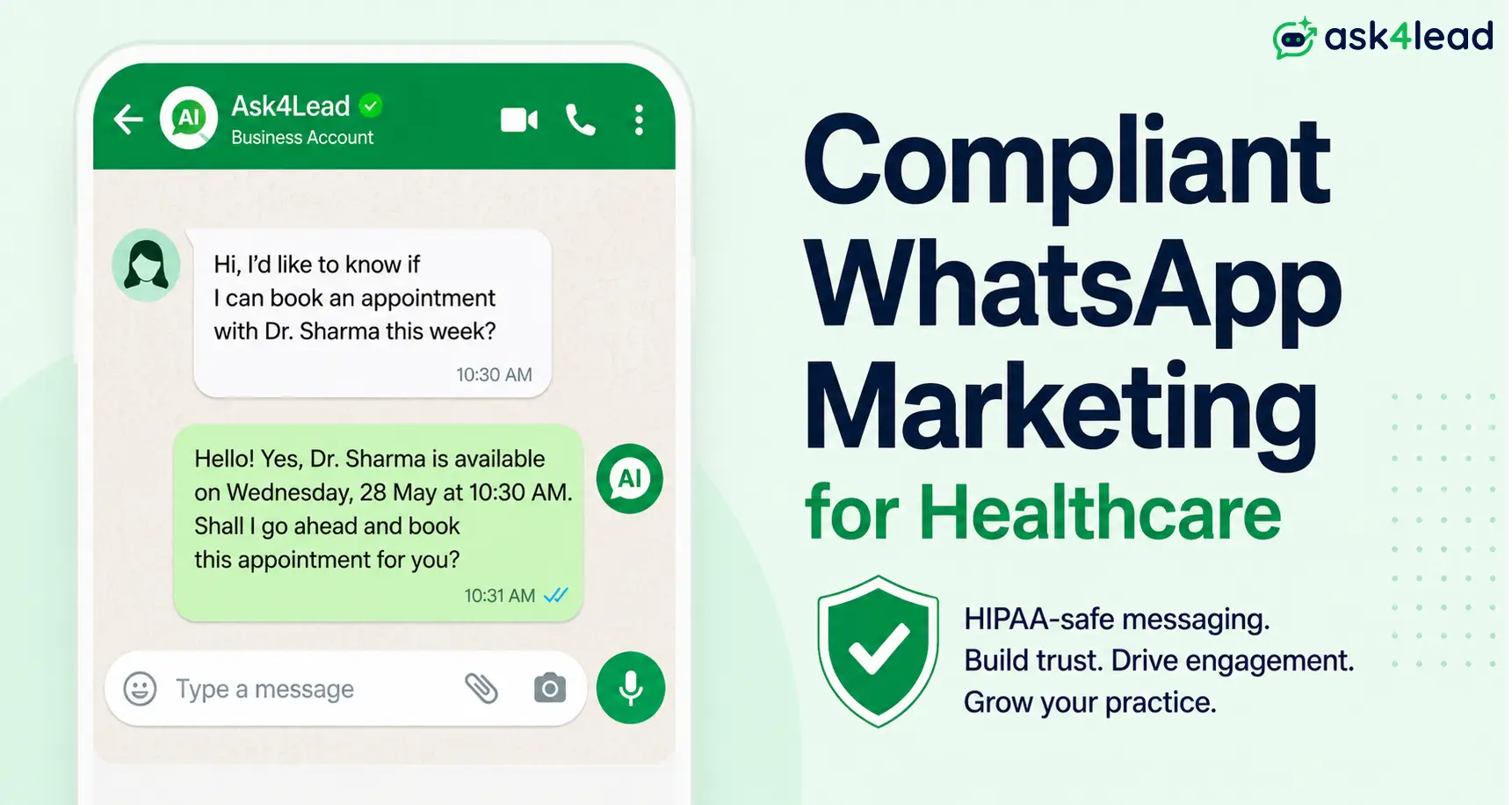
WhatsApp marketing for healthcare means using the official WhatsApp Business API to send appointment reminders, recall messages, and patient updates at scale. It replaces a receptionist’s personal phone with a managed, auditable channel.
Patients already live on WhatsApp, so replies happen in minutes, not days.
The risk sits 1 layer below that benefit. Every automated message either carries protected health information, or it does not. That single distinction decides whether a clinic’s setup is compliant or a liability waiting to surface.
Most guides on this topic lead with the upside and treat compliance as a footnote. This one does the opposite. It covers what HIPAA actually restricts, what India’s and the EU’s data laws add on top, and the operational habits that keep a clinic’s number, and its patients’ data, safe.
Quick answer
- The consumer WhatsApp app is not HIPAA compliant. Meta will not sign a Business Associate Agreement for it, and PHI cannot legally travel through it without one.
- The WhatsApp Business API, run through a provider that signs a BAA and enforces consent and template rules, can carry appointment reminders and other non-clinical patient messages.
- HIPAA is a US law. India’s Digital Personal Data Protection Act, the EU’s GDPR, and regional health authorities each add their own consent and approval requirements on top.
- Automation does not create compliance risk on its own. It multiplies whatever risk already exists in a clinic’s current messaging habits.
Key takeaways
- Treat every patient WhatsApp message as PHI-adjacent until proven otherwise, then route it through a template category and a documented consent record.
- Build a consent ledger, not a checkbox: timestamp, source, and opt-out, with a retention policy you have actually verified.
- Keep clinical content, diagnoses, lab results, treatment notes, out of general WhatsApp automation entirely. Reserve the channel for logistics.
- A restricted WhatsApp number costs a clinic more than a retailer, because the same number carries appointment continuity, not just marketing reach.
What “WhatsApp Marketing for Healthcare” Actually Covers
WhatsApp marketing for healthcare runs through the WhatsApp Business API, never a personal number. It covers a defined set of message types:
- Appointment confirmations and 24-hour or 2-hour reminders.
- Recall notices for overdue checkups.
- Lab-result availability alerts.
- Health-camp and wellness-campaign invitations.
It excludes clinical judgment entirely. No diagnosis, no treatment advice, and no symptom triage belongs in an automated broadcast.
The Real Baseline Most Clinics Start From
Before automating anything, most clinics run patient messaging from a receptionist’s personal WhatsApp. Patient numbers sit saved as regular contacts. Appointment details get typed into whatever chat is already open.
That baseline already carries real risk.
- No audit trail. If the phone is lost, sold, or the employee leaves, every conversation leaves with it.
- No consent proof. “They messaged us first” is not the same as “they agreed to receive marketing.”
- No separation of roles. 1 person’s phone becomes the clinic’s entire communication history.
What Changes the Moment You Automate
Automating an unmanaged process does not invent new risk. It takes that same process and runs it faster, at higher volume, with less human judgment catching mistakes.
A clinic that automates a compliant process gets faster replies and fewer no-shows. A clinic that automates a broken one gets the same violations, delivered to more patients, more consistently.
The fix is not avoiding automation. It is fixing the process underneath it first, which is what the rest of this guide walks through.
Is WhatsApp HIPAA Compliant for Healthcare Providers?
No. The consumer WhatsApp app is not HIPAA compliant. Meta does not sign a Business Associate Agreement for it, and a covered entity cannot legally send or store protected health information over any platform without one.
That restriction applies even to something as simple as confirming a name and appointment time.
1. Why the Consumer App and the Raw API Both Fall Short
HIPAA’s Security Rule (45 CFR §164.308 to §164.312) requires specific technical safeguards that consumer WhatsApp does not provide:
- Logging every access to protected health information.
- Automatically logging out idle sessions.
- Revoking access the moment an employee leaves.
WhatsApp itself offers none of these controls, and its own terms disclaim fitness for organizations with heightened confidentiality needs.
Buying raw access to the WhatsApp Business API does not fix this alone. The API is the messaging pipe, not the compliance program. Compliance depends on who signs the BAA, how consent is logged, and whether clinical records ever pass through that pipe.
2. The Narrow Patient-Request Exception
There is 1 legal carve-out. Under the HIPAA Privacy Rule’s confidential communications provision (45 CFR §164.522(b)), a patient can request to be contacted through a specific channel, including WhatsApp.
If they do, 3 things need to happen:
- Document the patient’s request in writing, with the date.
- Warn the patient, in writing, that WhatsApp is not a HIPAA-compliant channel.
- Apply reasonable safeguards anyway, and keep the documentation on file for an OCR audit.
This exception covers a single patient’s own request. It does not authorize broadcasting reminders to the entire patient list.
3. How a BAA-Backed BSP Changes What You Can Send
A Business Solution Provider (BSP) is a Meta-approved partner that gives a clinic access to the official WhatsApp Business API. Some BSPs will sign a BAA covering messages that flow through their infrastructure.
That BAA is what actually makes template-based reminders usable for a healthcare practice.
Ask4Lead onboards clinics through Meta’s official Embedded Signup, not an unofficial workaround. It also gives the practice account health and sending-policy visibility in 1 dashboard.
Confirming exactly what a BAA covers for PHI-adjacent messages is still a conversation to have directly with your BSP, since coverage terms differ by provider.
Beyond HIPAA: The Global Compliance Map for Healthcare WhatsApp Marketing

“We’re not in the US, so HIPAA doesn’t apply” is technically true and practically dangerous. HIPAA is a US federal law, so a clinic in Mumbai or Dubai is not bound by it directly.
But nearly every functioning digital economy now has its own patient-data law. Most treat health information as a higher-risk category than ordinary personal data.
| Region | Governing law | What it requires for WhatsApp messaging |
| United States | HIPAA | No BAA, no PHI over WhatsApp. Narrow patient-request exception only. |
| India | Digital Personal Data Protection Act, 2023 | Explicit, specific consent before processing health data; withdrawal as easy as opt-in. |
| European Union | GDPR, Article 9 | Health data is a “special category,” processed only with explicit consent or a narrow legal basis. |
| United Arab Emirates | MOHAP / DHA advertising rules | Medical advertising, including promotional service messages, generally needs prior regulatory approval, separate from consent. |
The pattern repeats with different names attached to the same idea. Patient data needs a documented lawful basis before it moves.
Ask4Lead’s EU-focused breakdown covers GDPR’s specific health-data protections in full for clinics with European patients.
India’s DPDP Act Treats Health Data as Sensitive Personal Data
India’s Digital Personal Data Protection Act, 2023 requires clear, specific consent before processing personal data. Health information sits squarely inside its scope.
A clinic broadcasting reminders or health-camp invites without a documented opt-in carries real regulatory exposure under Indian law, HIPAA or not.
WhatsApp Being “Just Messaging” Is Not a Legal Exemption
Regulators in the UAE, the EU, and elsewhere assess intent and content, not the app used to deliver it. A promotional message about a new treatment reads as medical advertising whether it arrives by email, SMS, or a 1-to-1 WhatsApp chat.
Pre-approval requirements follow the message, not the channel it travels through.
The Healthcare Consent Ledger: Beyond a Simple Opt-in Checkbox
A single “opted in: yes/no” field will not survive a real audit. A defensible consent ledger records the timestamp, the source of consent, and every later opt-out, all searchable on demand.
Ask4Lead’s own opt-in guidance covers the general collection mechanics. The healthcare layer on top of it is what follows.
What a Defensible Consent Record Actually Contains
- Patient identifier and consent date: who agreed, and exactly when.
- Consent source: a booking form, a front-desk conversation, or a website checkbox, named specifically.
- Message category consented to: appointment logistics is not the same consent as promotional health-camp invites.
- Opt-out date, if applicable: a patient’s single reply to a reminder does not authorize future marketing on its own.
Why Message History Retention Is the Detail Most Clinics Miss
A consent record only helps if it still exists when someone asks for it. Some platforms cap message history on lower-tier plans and require an upgrade to reach older records.
That is a bad detail to discover mid-audit. Ask4Lead’s audit logs keep a running record of conversation and campaign activity, so a compliance officer has somewhere real to point instead of reconstructing history from memory.
Confirm your platform’s exact retention window before you need it, not after.
Template Categories, the 24-Hour Window, and Why They Matter for Compliance
Meta requires every WhatsApp message template to fall into 1 of 3 categories. Getting this wrong is a compliance problem disguised as a technical one.
| Template category | What it covers | Healthcare example |
| Utility | Follow-up on something the patient already did | Appointment confirmation, reminder |
| Marketing | Promotional or awareness content | Health-camp invite, new-service announcement |
| Authentication | Identity verification only | One-time login codes |
Why Mixing Categories Is the Fastest Way to Get Flagged
An appointment reminder wrapped around a promotional offer reads as marketing to Meta’s template categorization system. That is true regardless of what the clinic intended.
The reclassification raises messaging cost. It can also trigger a review of the entire account, not just 1 template.
Keep WhatsApp campaigns and appointment logistics in separate templates from day one. Ask4Lead’s guide to rejected templates walks through the exact wording patterns that trigger a rejection.
What the 24-Hour Session Window Means for Patient Replies
Outside a 24-hour window from the patient’s last message, a clinic can only send pre-approved templates. Free-form replies are not allowed.
Ask4Lead’s breakdown of the 24-hour rule covers the mechanics in full. For a clinic, the practical effect is simple: a Friday question left unanswered until Monday needs a template to reopen the chat, not a casual reply.
Least-Privilege Automation: What Should Never Touch a Chat Tool
The most common data-exposure pattern in healthcare automation is not a hack. It is a clinic connecting 5 different tools, a CRM, a spreadsheet, an automation platform, a chatbot, to patient data.
Each connection looked harmless on its own. Together, they are 5 separate places PHI can leak.
The Line Between Clinic Operations Data and Clinical Data
Operations data is safe to automate. Clinical data almost never is, because general-purpose messaging tools were not built to store it.
- Safe for WhatsApp automation: appointment times, clinic hours, insurance accepted, location, recall reminders.
- Never route through general tools: x-rays, intraoral or diagnostic photos, lab results, exam findings, treatment notes.
- The real test: ask whether a tool needs this data, not whether it can technically integrate with your system.
Auditing Every Tool Before It Touches a Patient Record
Give staff role-based access instead of 1 shared login everyone uses. An offboarded employee’s access should disappear the same day they leave.
Ask4Lead’s data privacy overview covers exactly what a business can and cannot access once a WhatsApp message reaches its inbox. Most clinics never check this layer.
WhatsApp Business App vs Cloud API vs Coexistence for a Growing Practice
The free WhatsApp Business App works for a single receptionist with near-zero message volume. Once templates, multiple staff logins, or automated reminders become necessary, that app stops being enough.
Ask4Lead’s full App-vs-API comparison breaks down every option in detail.
The 3 Signals That Mean You’ve Outgrown the Free App
- More than 1 person needs to reply from the same number.
- Reminders and recall messages need to run on a schedule, not be typed manually.
- The clinic wants an audit trail it can actually produce on request.
Why Coexistence Removes the “Losing My Number” Fear
Coexistence lets the free Business App and the Cloud API run on the same number at the same time. A clinic can move to the API without abandoning years of patient chat history.
Availability and exact behavior depend on your BSP’s rollout, so confirm the specifics directly with your provider first.
The Compliant Automation Framework for Healthcare WhatsApp
Automating patient messaging without a fixed order of operations is how clinics end up in the mistakes covered next. Use these 5 steps as a checklist every time a new automated flow goes live.
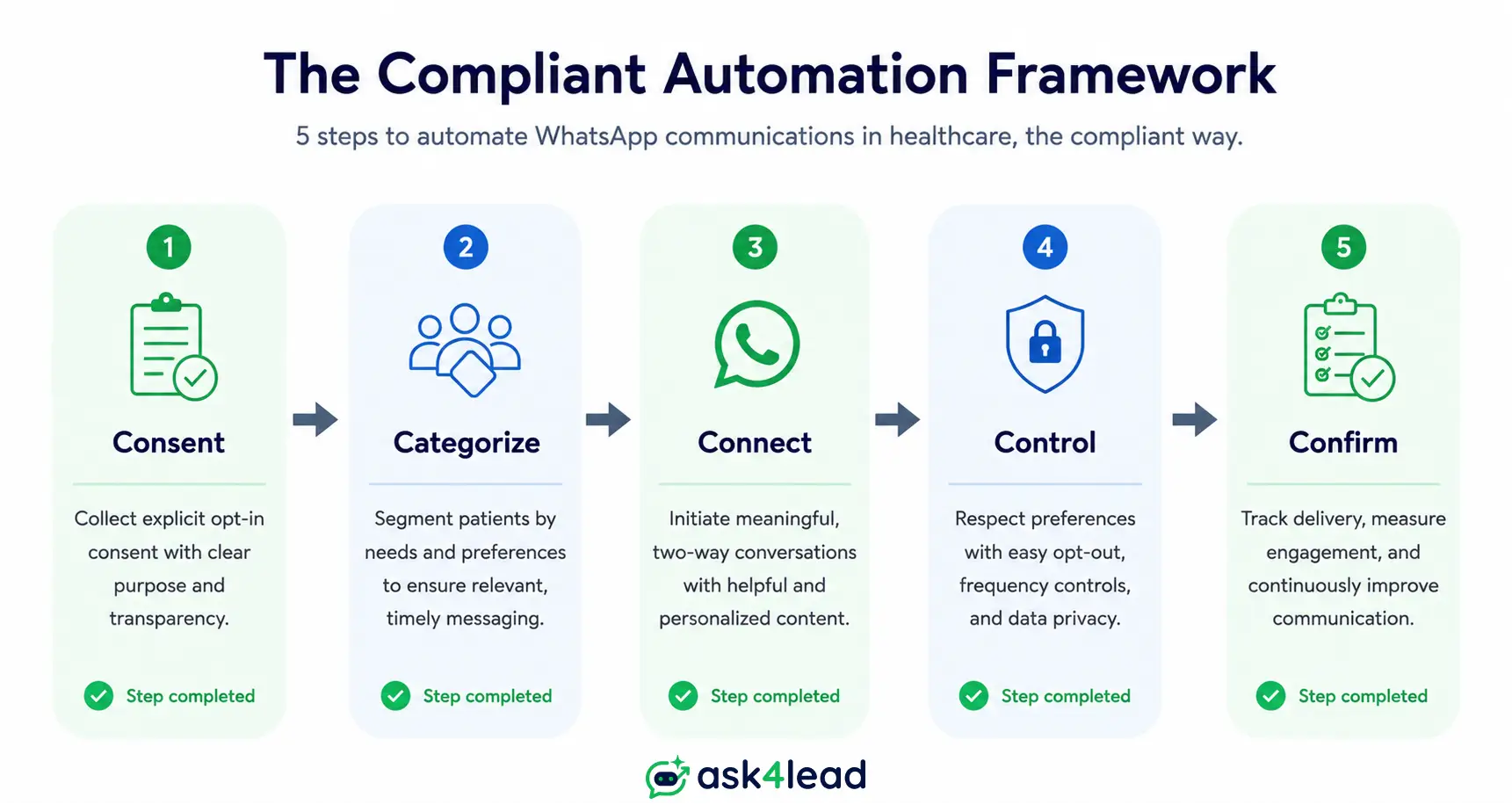
Consent, Categorize, Connect, Control, Confirm
- Consent: confirm and log opt-in before a patient enters any automated flow.
- Categorize: decide upfront whether each message type is utility, marketing, or authentication, and template it accordingly.
- Connect: onboard through an official BSP, never a workaround, and confirm exactly what its BAA covers.
- Control: require human approval on anything AI-drafted before it reaches a patient on a sensitive topic.
- Confirm: keep an audit trail of every message sent, every consent given, and every opt-out recorded.
What to Automate vs What Always Needs a Human Reply
- Safe to automate: confirmations, 24-hour and 2-hour reminders, clinic hours, insurance accepted, recall notices.
- Always routed to a human: anything resembling a symptom description, a diagnosis question, or a billing dispute.
- The middle layer: Ask4Lead’s AI knowledge profile answers routine questions grounded in what the clinic uploads, then hands off automatically. Human approval for AI replies keeps a person reviewing anything the AI is not confident about before it sends.
Mistakes That Get Healthcare WhatsApp Numbers Restricted
Ask4Lead’s broader breakdown of WhatsApp bans covers the general causes: missing consent, unofficial tools, high block-and-report ratios, and volume spikes on new numbers.
Healthcare adds a layer none of those causes fully capture on their own.
The Healthcare-Specific Failure Patterns
- Treating a “HIPAA-eligible” cloud host as full compliance. A cloud provider’s BAA covers its own infrastructure layer only. Consent tracking and message content stay the clinic’s responsibility.
- Blending appointment and promotional content in 1 template. This drops the account’s quality rating and can trigger a review of every template the clinic runs.
- Assuming clinical urgency excuses a documentation gap. An emergency reply still needs the same consent and audit trail as a routine reminder.
Why a Restriction Costs a Clinic More Than a Retailer
A restricted number does not just mean lost marketing reach. It means lost appointment reminders and a documentation gap right when a regulator is most likely to ask questions.
Ask4Lead’s guide to recovering a restricted number is worth bookmarking before you need it, not after.
FAQs
1. Is WhatsApp HIPAA compliant for healthcare providers?
No. Meta will not sign a Business Associate Agreement for the consumer app. The WhatsApp Business API, run through a BAA-backed BSP with consent and template rules enforced, can carry non-clinical patient messages compliantly.
2. Can a clinic legally send appointment reminders over WhatsApp?
Yes, using a pre-approved utility template through the WhatsApp Business API, with documented patient consent on file covering that message category.
3. What happens if a clinic mixes marketing and appointment content in 1 message?
Meta’s review can reclassify the entire template as marketing, which raises cost and puts the account’s quality rating at risk. Keep the 2 categories in separate templates.
4. Does a clinic have to migrate its WhatsApp number to use the Business API?
Not necessarily. Coexistence lets the free app and the Cloud API run on the same number, reducing migration friction, though the exact rollout depends on the BSP.
5. Is WhatsApp compliant if a clinic isn’t based in the US?
HIPAA applies only in the US, but most countries carry their own patient-data laws, such as India’s DPDP Act or the EU’s GDPR, that treat health data as sensitive regardless of which regulator applies.
6. Does a clinic need a Business Associate Agreement to send WhatsApp reminders?
A BAA is the safer default whenever a message could be considered protected health information. Appointment logistics carry lower risk than clinical content, but confirming coverage with your BSP before automating avoids the guesswork.
The Bottom Line
Compliant WhatsApp marketing for healthcare is not a one-time setup task. It is consent that stays logged, templates that stay in their own category, and tools that never touch clinical data.
It is also an audit trail that survives a real regulator’s questions, running quietly in the background of every reminder sent.
That is the operational layer Ask4Lead is built for. Patient reminders and routine questions run through a humanized AI sales assistant grounded in your clinic’s own information, with human-approval controls and audit logs built into the workflow instead of bolted on after a warning letter.
Start free with 100 AI credits and build a patient-messaging setup your compliance officer will actually sign off on, not one you have to explain away.
