
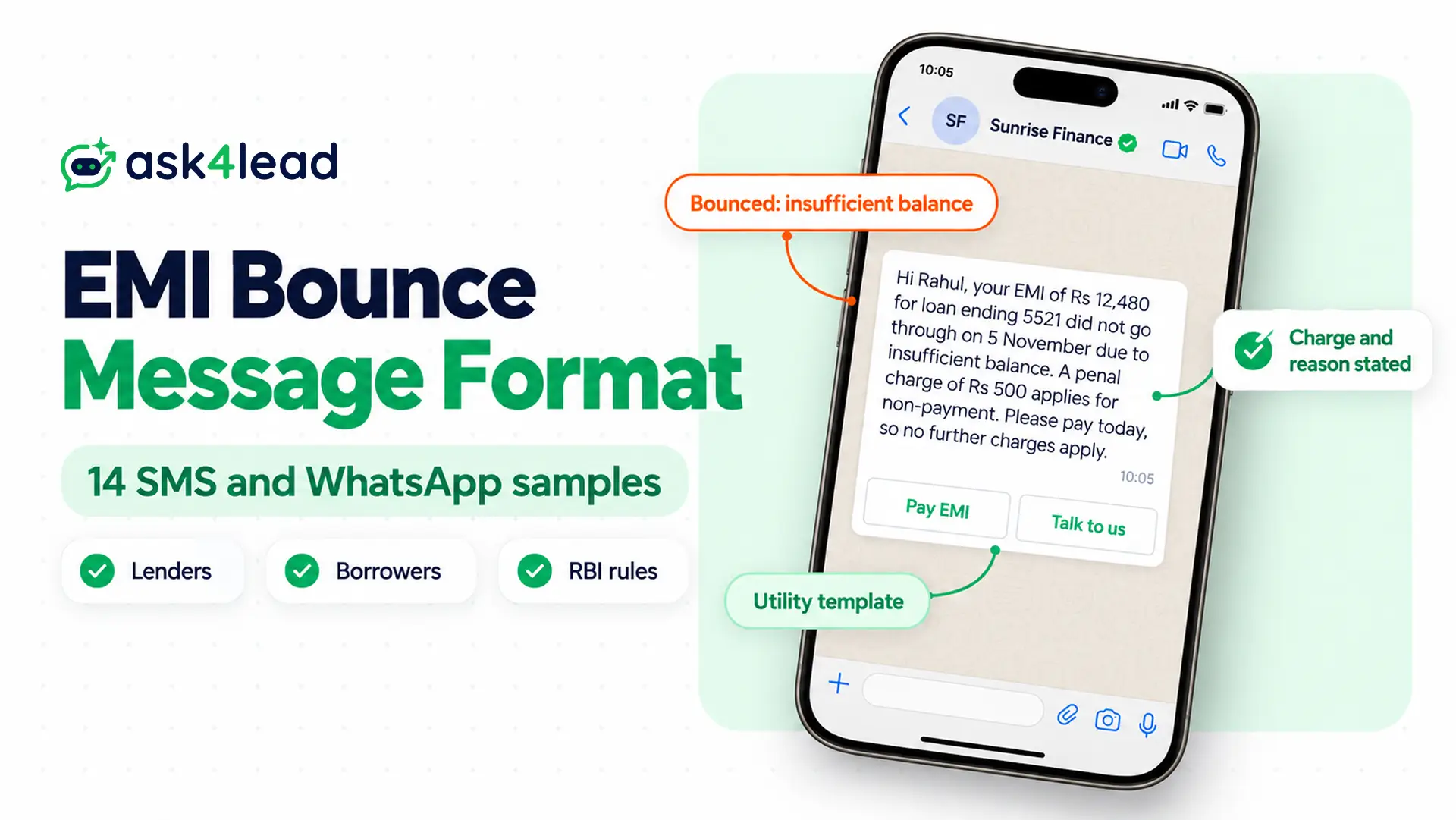
An EMI bounce message format is the standard layout of the alert a lender sends when an automatic EMI debit fails. It names the loan, the amount, the date, the reason for the failure and any charge, so the borrower knows exactly what to fix.
EMI means equated monthly instalment, the fixed amount you repay each month. Below are 14 samples: lender alerts by SMS and WhatsApp, follow-ups, and replies a borrower can send. Lenders who send them on the WhatsApp Business API will also find Meta’s rules for approval.
What an EMI bounce message format contains
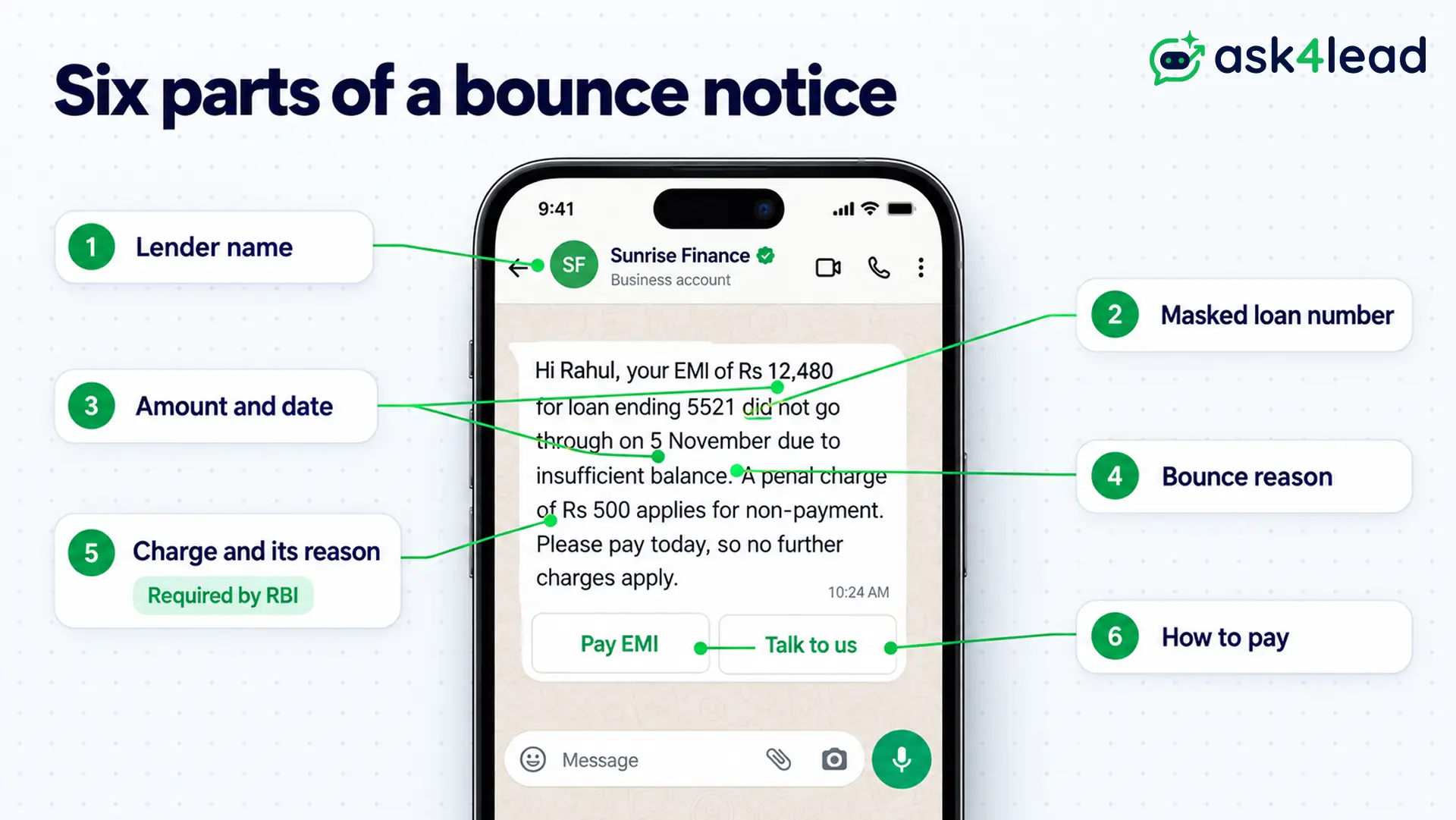
Every EMI bounce message format carries six facts: who sent it, which loan, how much, when the debit failed, why it failed and what it now costs. Your borrower should be able to act without calling you.
The last fact is a legal duty, not a courtesy. Under the RBI’s penal charges circular, every reminder about a missed payment must state the applicable penal charges. In addition, any charge levied must be communicated along with the reason.
| Part of the message | Example | Why it is there |
| Lender name | Sunrise Finance | Shows who is writing |
| Masked loan number | Loan ending 5521 | Identifies the loan safely |
| EMI amount and date | Rs 12,480 on 5 November | Shows what failed |
| Reason for the bounce | Insufficient balance | Tells the borrower what to fix |
| Charge and its reason | Penal charge of Rs 500 for non-payment | Required by RBI |
| How to pay and get help | Pay link and helpline | Ends the problem quickly |
Also, a penal charge is a flat fee now, not extra interest. RBI bars lenders from adding it to the interest rate or charging interest on it.
Common EMI bounce reasons and what each one means
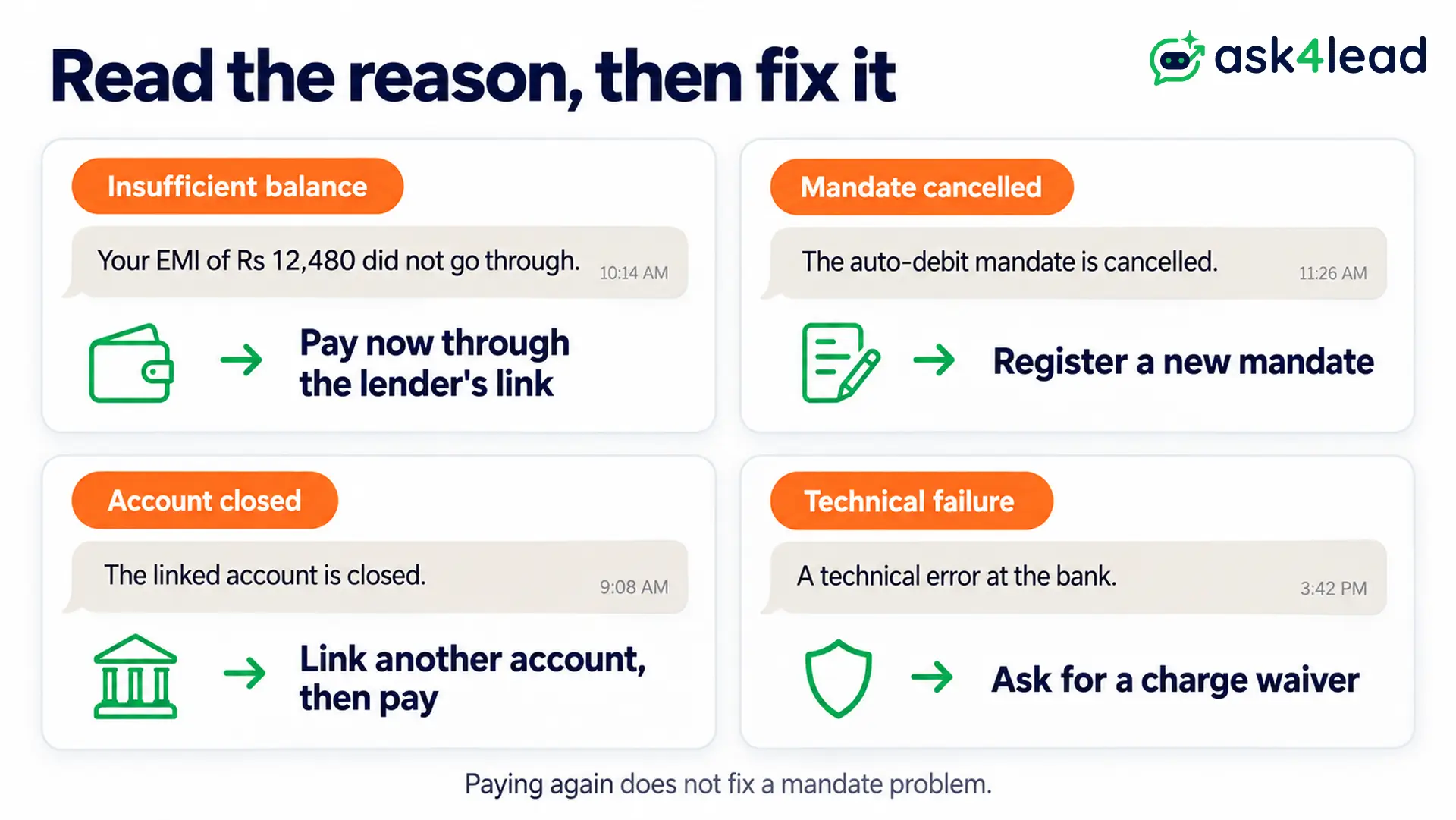
The reason line in an EMI bounce message format decides the fix. A low balance needs money, while a mandate problem needs paperwork, so paying the EMI again does not solve it.
| Reason in the message | What it means | What to do |
| Insufficient balance | The account had less than the EMI on the debit day | Pay now through the lender’s link |
| Mandate not registered or cancelled | The auto-debit instruction (mandate) is missing | Register a new mandate with the lender |
| Account closed or frozen | The bank cannot debit that account | Link another account, then pay |
| Technical failure | The bank or payment network failed | Ask the lender to waive the charge |
For instance, a salary that lands on the 3rd and an EMI that debits on the 1st cause the same bounce every month. In that case, ask the lender to move the EMI date.
EMI bounce SMS format
The EMI bounce SMS format is shorter than WhatsApp, because an SMS has no buttons. Lenders still send it, since it reaches phones without data.
1. EMI bounce SMS from a lender
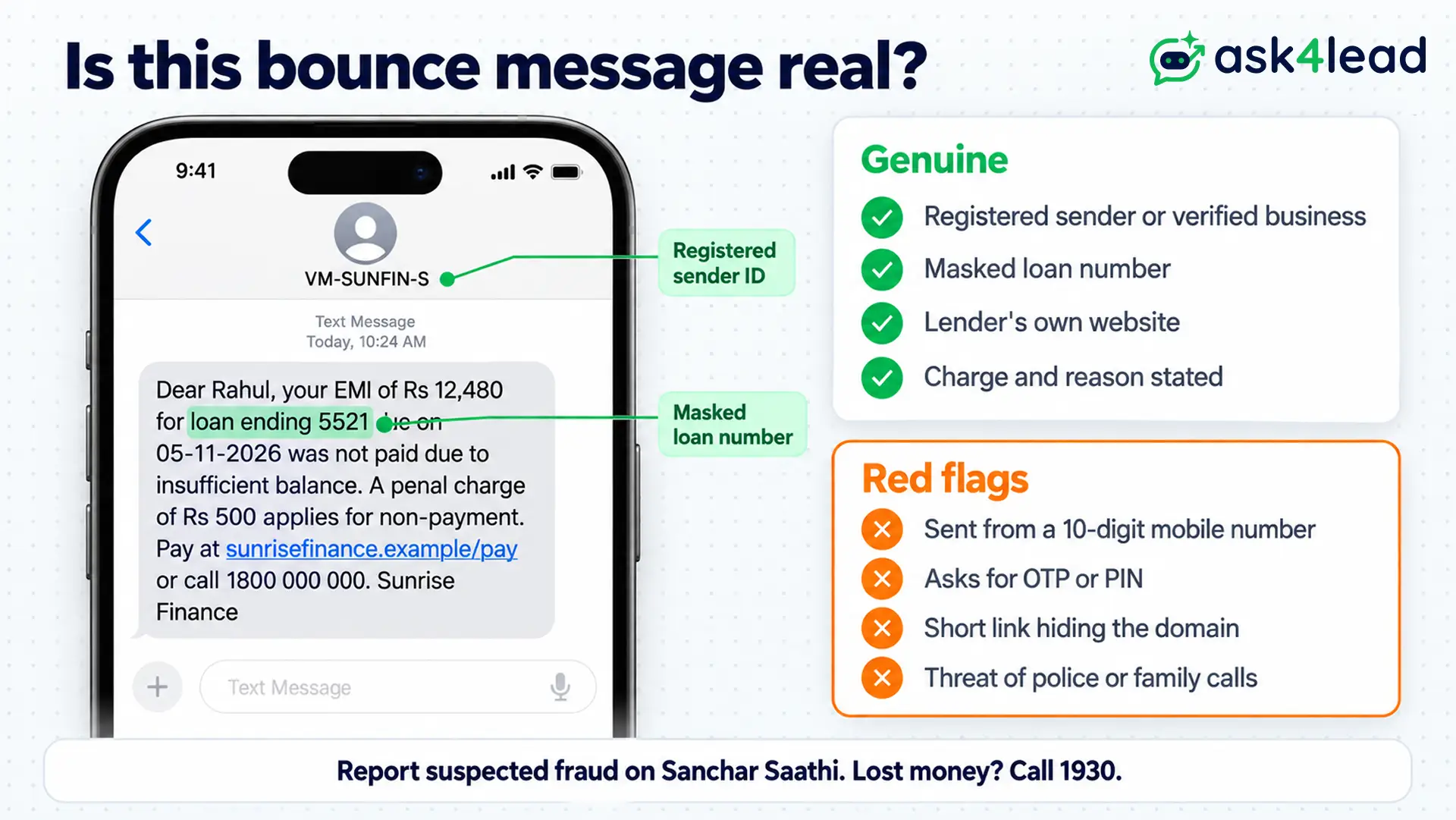
Dear [Rahul], your EMI of Rs [12,480] for loan ending [5521] due on [05-11-2026] was not paid due to [insufficient balance]. A penal charge of Rs [500] applies for non-payment. Pay at [sunrisefinance.example/pay] or call [1800 000 000]. [Sunrise Finance]
A genuine SMS also arrives from a registered sender ID, such as “VM-SUNFIN-S”. Since TRAI’s 2025 rule, that ID ends in -S for service messages or -T for transactional ones. So a bounce alert from a 10-digit mobile number deserves suspicion.
WhatsApp EMI bounce message format by reason
On WhatsApp, the EMI bounce message format adds a button, so the borrower pays in two taps. Meta treats these as utility templates, meaning non-promotional updates about an account the customer holds.
However, a utility template must not include offers. For example, a top-up loan pitch inside a bounce notice turns it into marketing, and Meta’s template categorization bills that at the higher rate.
2. Bounce due to insufficient balance
Hi [Rahul], your EMI of [Rs 12,480] for [loan ending 5521] did not go through on [5 November] due to [insufficient balance]. A penal charge of [Rs 500] applies for non-payment. Please pay today, so no further charges apply.
Buttons: Pay EMI · Talk to us
3. Bounce due to a cancelled mandate
Hi [Sneha], we could not collect your EMI of [Rs 8,200] for [loan ending 3307] on [5 November], because the auto-debit mandate is [cancelled]. Please pay this month’s EMI below. Then register a new mandate, so next month’s EMI goes through.
Buttons: Pay EMI · Set up mandate
4. Bounce due to a closed or frozen account
Hi [Imran], the bank returned your EMI of [Rs 15,600] for [loan ending 9014], because the linked account is [closed]. Please pay this EMI below and link a new account. Until then, future debits will also fail.
Buttons: Pay EMI · Change account
5. Bounce due to a technical failure
Hi [Lakshmi], your EMI of [Rs 6,750] for [loan ending 4418] did not go through on [5 November] due to a [technical error at the bank]. Since the failure was not yours, [no penal charge applies]. We will retry the debit on [7 November].
Quick replies: OK · Pay now instead
Sample 5 depends on your loan policy. So only promise a waiver if your Key Fact Statement (the summary sheet a borrower signs) allows it.
EMI reminder messages that prevent a bounce
The cheapest EMI bounce message is the one you never send. An EMI reminder message a few days earlier gives the borrower time to move money, and it follows the same EMI bounce message format without the reason or the charge.
6. EMI due in three days
Hi [Rahul], your EMI of [Rs 12,480] for [loan ending 5521] will be debited on [5 November]. Please keep enough balance in your [account ending 7710] by then.
Button: View loan details
7. EMI debit tomorrow
Hi [Sneha], tomorrow, [5 November], we will debit [Rs 8,200] for your [loan ending 3307]. If your balance is low, you can pay today instead.
Buttons: Pay today · Balance is fine
Follow-up messages after an EMI bounce
Follow-ups reuse the EMI bounce message format, and they now sit under two rulebooks. First, RBI’s recovery rules for commercial banks, in force from 1 January 2027, restrict contact to between 08:00 and 19:00. They also ban excessive messaging, threats and “inappropriate messages” on mobile or social media.
Second, Meta’s template review rejects content that threatens legal action or public shaming. Meanwhile, WhatsApp’s Business Messaging Policy lists debt collection as a prohibited financial service, “irrespective of” any licence you hold.
8. Second reminder, still unpaid
Hi [Rahul], your EMI of [Rs 12,480] for [loan ending 5521] is still unpaid after the bounce on [5 November]. A penal charge of [Rs 500] was added for non-payment. Please pay below, or reply HELP if something has changed.
Quick replies: Pay EMI · I need help · Already paid
9. Payment received after a bounce
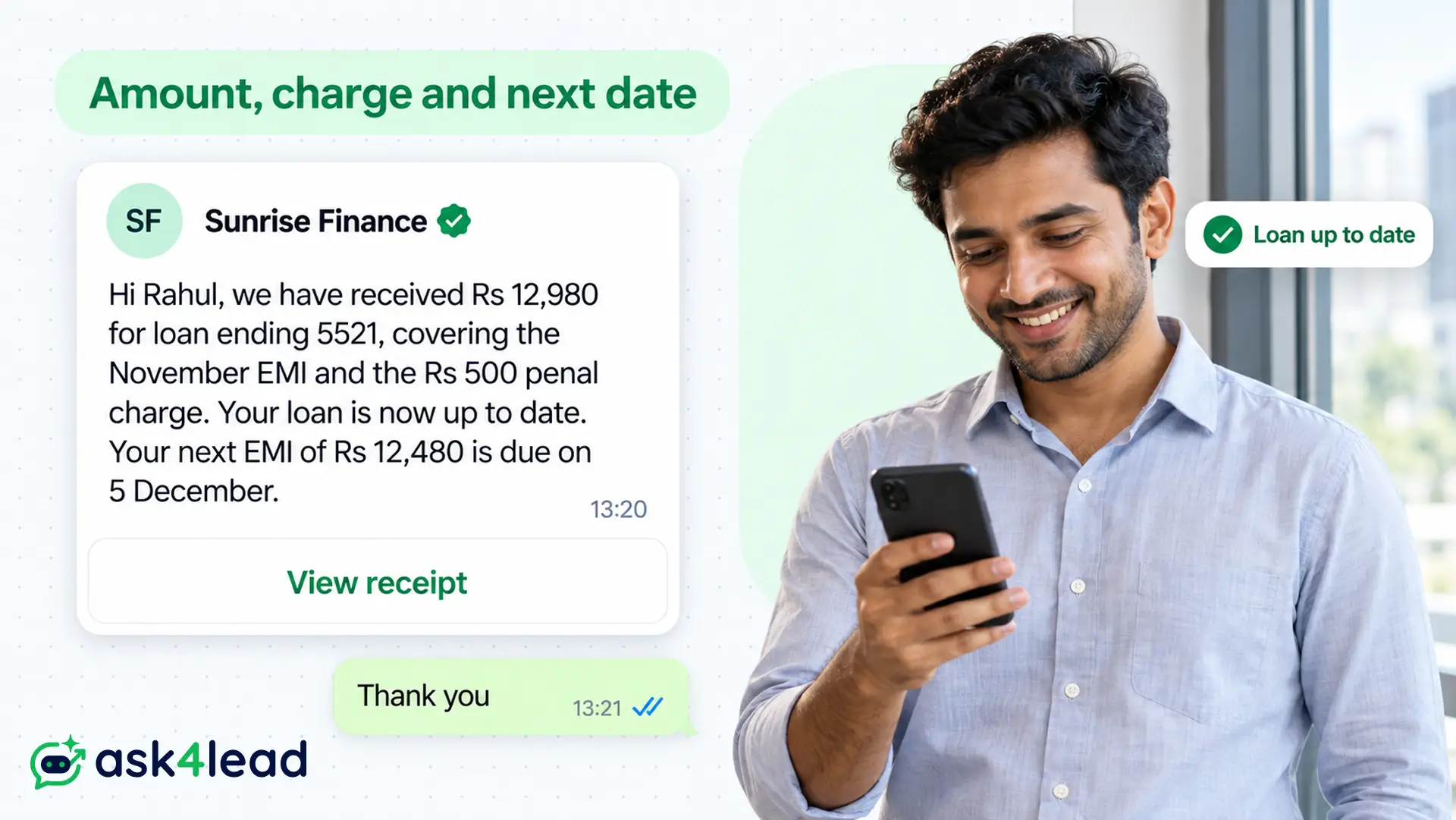
Hi [Rahul], we have received [Rs 12,980] for [loan ending 5521], covering the [November EMI and the Rs 500 penal charge]. Your loan is now up to date. Your next EMI of [Rs 12,480] is due on [5 December].
Button: View receipt
10. Offer to talk about repayment
Hi [Imran], we noticed two missed EMIs on your [loan ending 9014]. If your income has changed, our team can talk through your options. Reply CALL, and someone will ring you between [10 am and 6 pm].
Quick replies: Call me · Pay now
Notice what samples 8 to 10 leave out: no “final notice”, no “legal action” and no threat to tell family. Therefore, keep WhatsApp for reminders to your own borrowers, and keep collection agency work off it. Otherwise, you risk a WhatsApp Business policy violation that restricts or bans the number.
Messages a borrower can send after an EMI bounce
Borrowers search for an EMI bounce message format too, usually to reply to their lender. The three samples below are short, factual and easy to forward to customer care.
11. Borrower confirming payment
Hello, my EMI of Rs [12,480] for loan ending [5521] bounced on [5 November]. I paid it today by UPI, reference [UPI 6281 4470 9921]. Please confirm and update my account.
12. Borrower asking for a charge waiver
Hello, my EMI for loan ending [4418] bounced on [5 November] due to a [technical error at my bank]. My balance was sufficient, as the attached statement shows. So please waive the penal charge of Rs [500].
13. Borrower asking to change the EMI date
Hello, my salary is credited on the [3rd], but my EMI for loan ending [5521] is debited on the [1st]. As a result, it has bounced twice. Please move my EMI date to the [5th] of each month.
Also, act fast. Since 1 January 2025, lenders report to credit bureaus every fortnight under an RBI circular, so an unpaid EMI can reach your credit report within weeks.
Instalment bounce message for small businesses
Small businesses run instalments too, such as coaching fees or gym memberships paid by UPI AutoPay. Their bounce message follows the same EMI bounce message format, with a friendlier tone and no penal language unless the contract allows it.
14. Instalment payment failed
Hi [Kavya], the [October] instalment of [Rs 3,500] for [Ananya’s maths coaching] did not go through on [5 October]. Could you pay through the link below by [10 October]? Then classes continue as usual.
Button: Pay instalment
For more fee messages, see these WhatsApp messages for tuition classes.
How to spot a fake EMI bounce message
Fraudsters copy the EMI bounce message format because it creates panic. A genuine alert shows only a masked loan number, links to the lender’s own domain and never asks for an OTP, PIN or full card number.
- Check the sender: a registered SMS header or a verified WhatsApp business name, not a personal number
- Check the loan: open the lender’s app and confirm the bounce before you pay
- Check the link: pay only on the lender’s own website or app
- Report it: flag suspected fraud on the government’s Sanchar Saathi portal, and call 1930 if you lost money
What sending EMI bounce messages costs, with two worked examples
Meta bills each WhatsApp message in this EMI bounce message format per delivery. In India, its rate card from 1 October 2026 charges Rs 0.115 per utility message and Rs 0.8631 per marketing message. In addition, Meta’s pricing page shows that utility templates inside an open chat became billable on 1 October 2026.
1. Worked example: one month of bounce messages
Suppose an NBFC sees 4,000 bounces a month and sends samples 2, 8 and 9 to each borrower.
- Utility messages: 12,000 × Rs 0.115 = Rs 1,380 a month
- Same messages with a top-up loan offer: 12,000 × Rs 0.8631 = Rs 10,357.20 a month
- Difference: Rs 8,977.20 every month, before volume discounts
2. Worked example: a bounce calendar for a 5 November EMI
| Date | Message | Rule that applies |
| 2 November | Sample 6, EMI due in three days | Plain reminder, no charge yet |
| 4 November | Sample 7, debit tomorrow | Plain reminder |
| 5 November | Sample 2, bounce notice | State the charge and its reason |
| 8 November | Sample 8, still unpaid | Send between 08:00 and 19:00 |
| On payment | Sample 9, receipt | Confirm the amount and next due date |
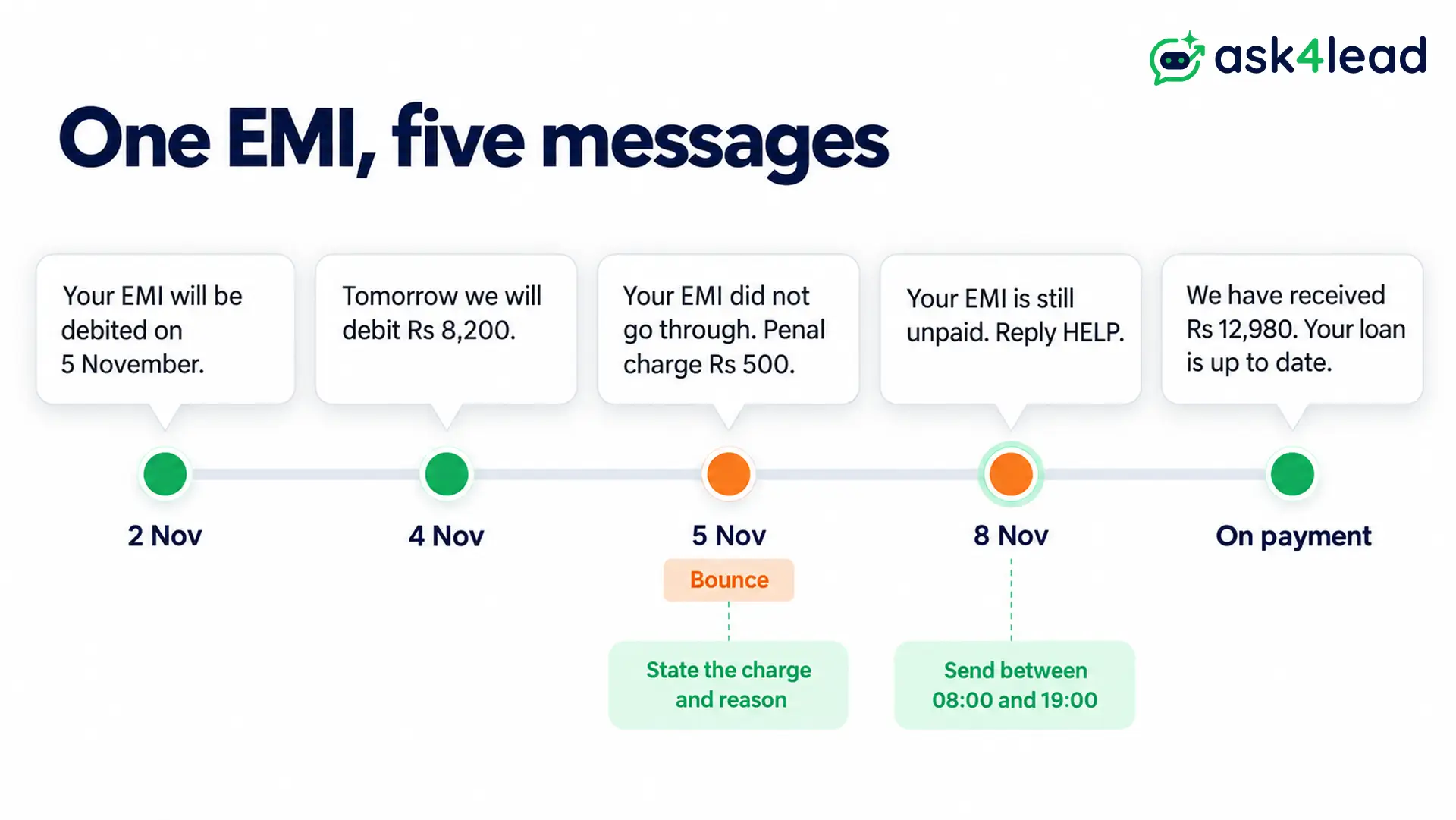
To run this calendar, Ask4Lead’s WhatsApp campaigns filter contacts by tag or pipeline stage and schedule an approved template for a set time. So a borrower tagged “paid” drops out before sample 8 goes out.
How lenders should handle replies to an EMI bounce message
Every EMI bounce message invites replies such as “I already paid” or “why was I charged?”. Those replies open the 24-hour customer service window, and slow answers inside it turn a bounce into a complaint.
Route disputes and waiver requests to a person
Waiver requests like sample 12 need a human decision, because you set the charge policy. So an EMI bounce message format that invites replies needs a clear owner for them. A shared team inbox for WhatsApp lets one agent claim the chat, so two staff never send conflicting answers.
Let AI answer routine loan questions
Questions like “when is my next EMI?” repeat every month. Ask4Lead’s AI Knowledge Profile answers them only from documents you upload, such as your charges schedule.
This does not suit every lender, though. A large bank will wire these templates into its own loan system instead.
FAQs
1. What is the EMI bounce message format?
It is the standard alert for a failed EMI debit. It shows the lender, a masked loan number, the amount, the date, the reason and any penal charge.
2. Does an EMI bounce message always include a charge?
It should, if a charge applies. RBI requires lenders to state the applicable penal charge in reminders and to explain any charge levied.
3. What should I do after an EMI bounce message?
Pay the EMI through the lender’s app or link the same day, then fix the cause, such as a low balance or a cancelled mandate.
4. Can lenders send EMI bounce messages on WhatsApp?
Yes. Lenders can use the same EMI bounce message format as utility templates to their own borrowers, without offers or threats. However, WhatsApp prohibits debt collection, so collection agency work belongs elsewhere.
5. How do I know an EMI bounce message is real?
Check that it comes from a registered sender or verified business, shows a masked loan number and never asks for an OTP or PIN.
Conclusion
A good EMI bounce message format is plain and complete: the loan, the amount, the reason, the charge and the fix. Lenders who state all five get paid faster and face fewer complaints, while borrowers who read all five know exactly what to do.
Before you send your next bounce notice, check that it has:
- A masked loan number, never the full account number
- The bounce reason, so the borrower knows what to fix
- The penal charge and its reason, as RBI requires
- No offers or threats, so Meta approves the template
- A send time between 08:00 and 19:00 for follow-ups
After that, the real work is answering replies before the next debit date.
Send EMI reminders and bounce notices without the manual chasing
Manual bounce notices go out late, and replies pile up across phones. So Ask4Lead fixes the parts you control:
- Template tracking: see each WhatsApp template move from Pending to Approved or Rejected
- Scheduled campaigns: send each reminder to a tagged segment on the right date
- Shared inbox: assign waiver requests and “already paid” replies to one person
- Grounded AI replies: answer loan questions only from your own documents
For lending setups, see how Ask4Lead works for finance teams.
