
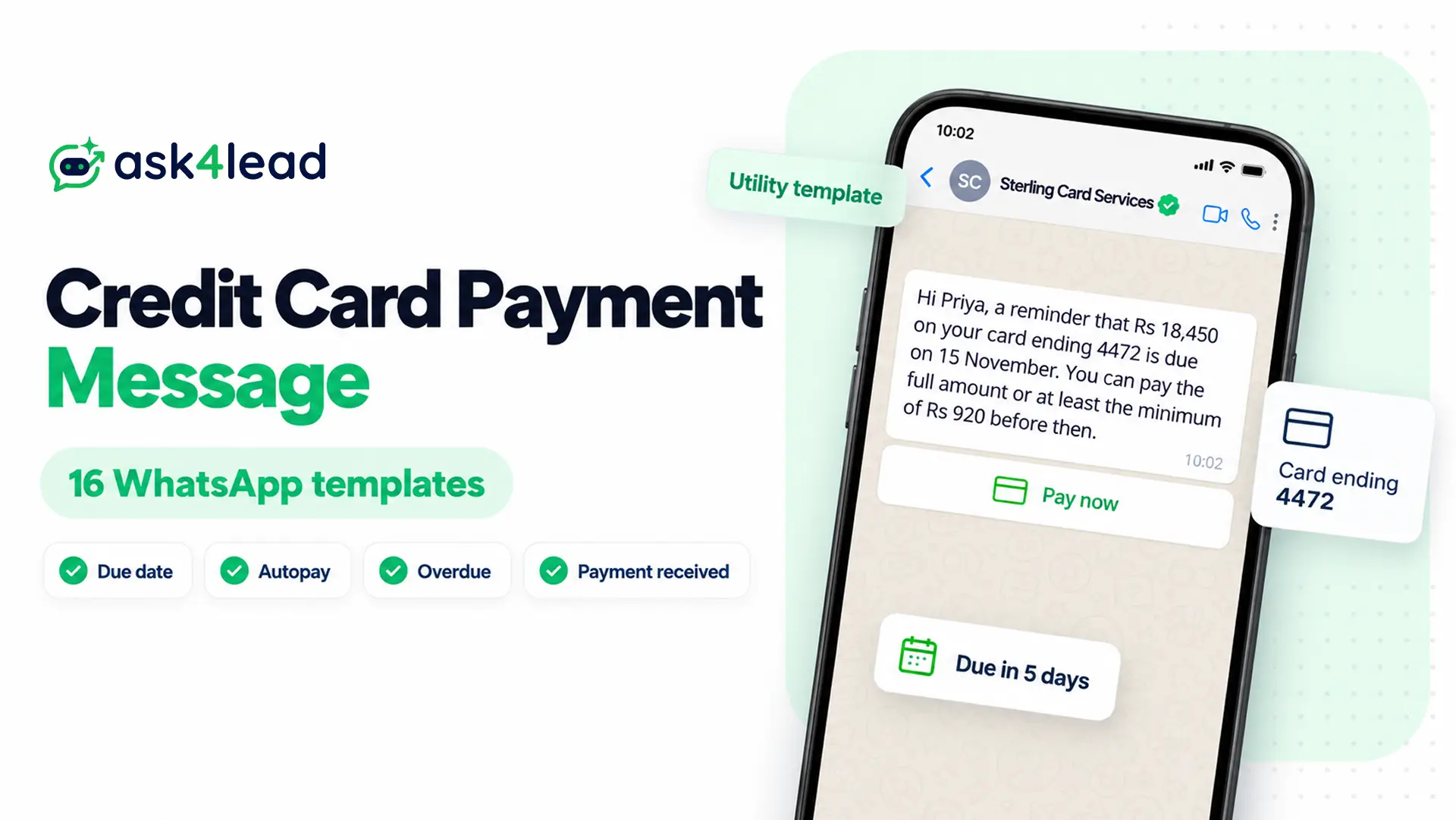
A credit card payment message tells a cardholder what they owe, by when and how to pay, or confirms that a payment arrived. Below are 16 WhatsApp templates to copy, so you can cover every step from the statement day to the receipt.
Card issuers, NBFCs (non-banking finance companies) and fintech apps send them on the WhatsApp Business API, Meta’s paid messaging system. In addition, one group covers small businesses that ask customers to pay an invoice by card.
What a credit card payment message must include
A credit card payment message needs five facts: the card’s last four digits, the total due, the minimum due, the due date and one way to pay.
Meta also files a bill reminder as a utility template, meaning a non-promotional update about an account the customer already holds.
For example, Meta’s template categorization page lists a monthly payment reminder as a utility example. However, utility messages must not include offers, so one cashback line turns the whole message into marketing.
| Include | Never include |
| Card ending: last 4 digits, such as 4472 | The full 16-digit card number |
| Total due and minimum due in rupees | A request for CVV, OTP or PIN |
| Due date with the day and month | Threats of legal action or shaming |
| One payment button to your own site | Offers, cashback or upgrade pitches |
| Helpline printed on the card | Short links that hide the domain |
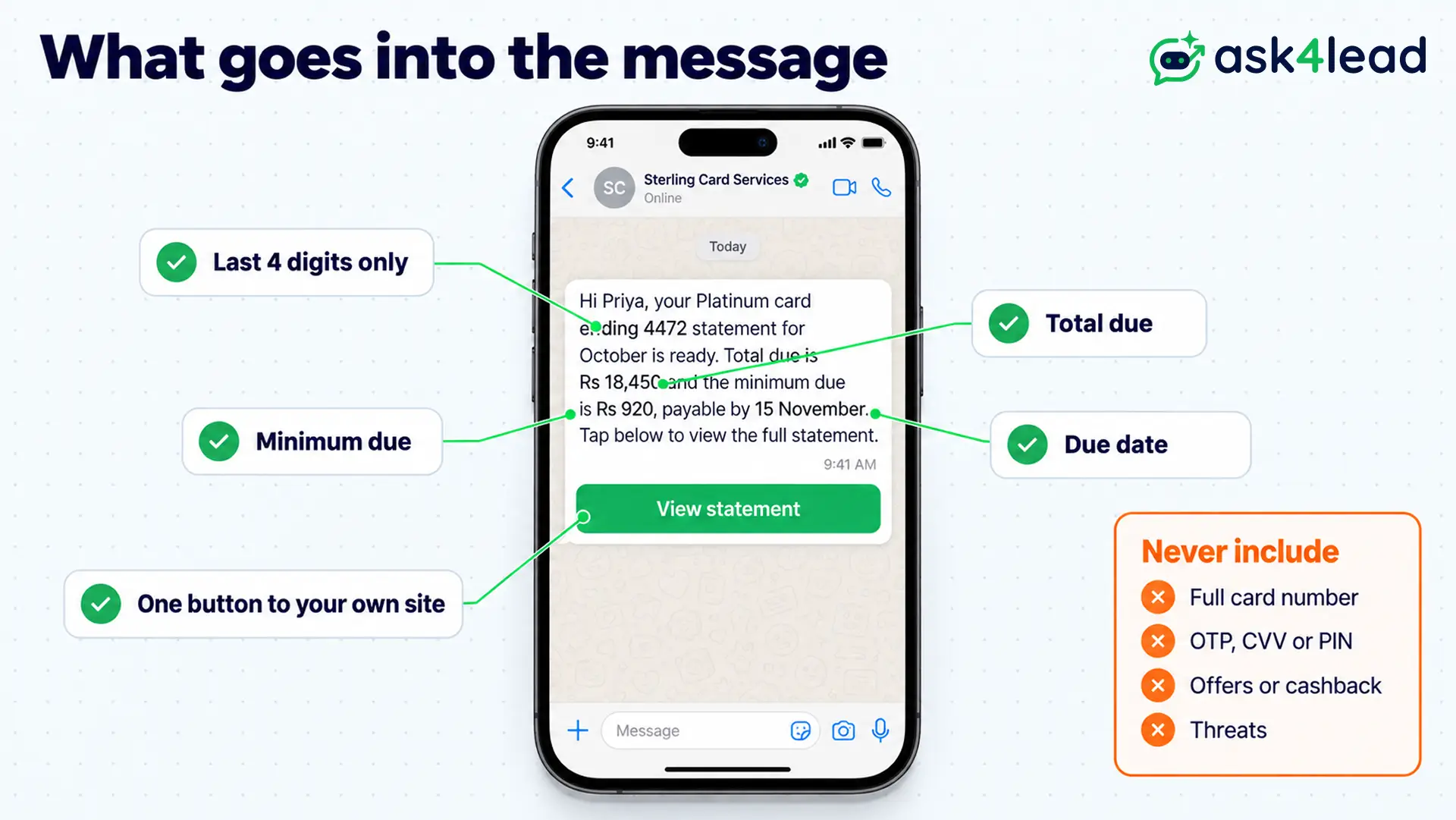
Also, the right column is a rule. WhatsApp’s Business Messaging Policy bans asking for full card numbers, although partial ones are fine.
Variables in each credit card payment message
Each sample uses brackets, such as [Priya], for details you replace. When you build the template, swap each bracket for a numbered variable, such as {{1}}, and then your software fills it in.
| Variable | Holds | Example |
| {{1}} | First name | Priya |
| {{2}} | Card name and last 4 digits | Platinum card ending 4472 |
| {{3}} | Total amount due | Rs 18,450 |
| {{4}} | Minimum amount due | Rs 920 |
| {{5}} | Due date | 15 November |
Next, start and end every body with fixed words. Otherwise, Meta’s template review rules reject it, because they do not allow a body that begins or ends with a variable.
Statement and due date reminder messages
Statement and due date reminders go out before anything is late, so the tone stays neutral. Send one on the bill date, one a few days before the due date, and one on the day.
Because each credit card payment message here is a utility template, it stays cheap and avoids Meta’s stricter marketing limits.
1. Statement generated message
Hi [Priya], your [Platinum card ending 4472] statement for [October] is ready. Total due is [Rs 18,450] and the minimum due is [Rs 920], so please pay by [15 November]. Tap below to see the full statement.
Button: View statement
2. Five-day credit card payment message
Hi [Priya], a reminder that [Rs 18,450] on your [card ending 4472] is due on [15 November]. Before then, you can pay the full amount or at least the minimum of [Rs 920].
Button: Pay now
3. Payment due tomorrow
Hi [Rohan], your [card ending 9031] payment of [Rs 6,200] is due tomorrow, [15 November]. If you have already paid, please ignore this message, because payments can take a day to show.
Button: Pay now
4. Minimum due explained
Hi [Anita], your [card ending 2210] bill is [Rs 42,000] and the minimum due is [Rs 2,100]. Paying only the minimum keeps the card active, but interest applies to the rest. So pay the full amount by [15 November] if you can.
Quick replies: Pay full amount · Pay minimum · Talk to us
In fact, sample 4 echoes an RBI rule: every statement must warn that paying only the minimum stretches repayment “over months / years”.
Autopay and payment received messages
Autopay and receipt messages confirm money movement, so they need exact amounts and a reference number. Otherwise, customers call your helpline to check.
For UPI and bank transfer receipts, see these money received message samples.
5. Autopay scheduled
Hi [Meera], autopay will debit [Rs 18,450] from your [savings account ending 1187] on [15 November] for your [card ending 4472]. So please keep enough balance in the account by then.
Button: Manage autopay
6. Autopay failed
Hi [Meera], the autopay of [Rs 18,450] for your [card ending 4472] did not go through on [15 November], due to [insufficient balance]. Please pay by another method today, so the account stays up to date.
Button: Pay now
7. Credit card payment received message
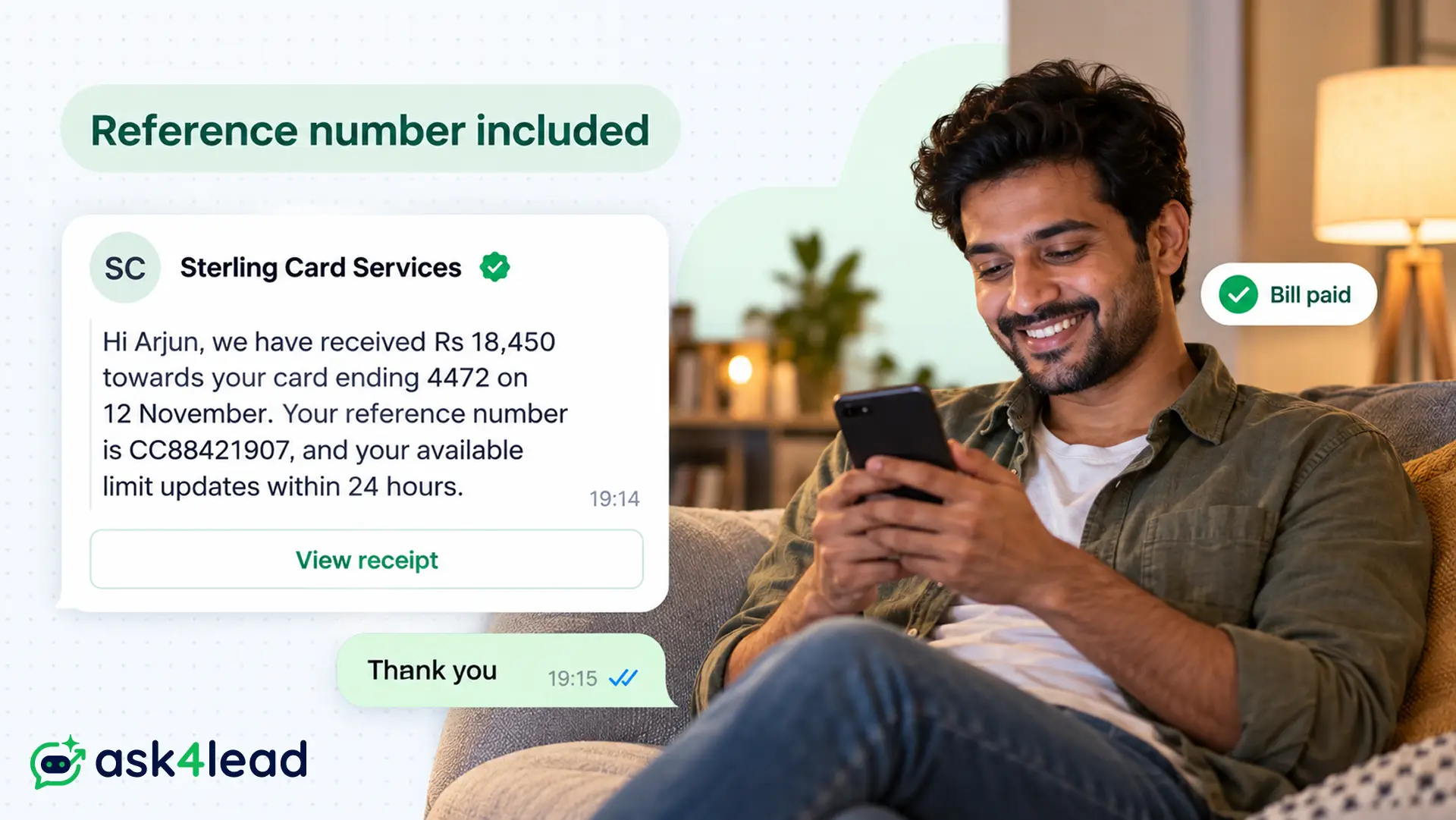
Hi [Arjun], we have received [Rs 18,450] towards your [card ending 4472] on [12 November]. Your reference number is [CC88421907], and your available limit updates within [24 hours].
Button: View receipt
8. Partial payment received
Hi [Kavita], we have received [Rs 5,000] towards your [card ending 6603]. However, the balance of [Rs 13,450] is still due on [15 November], and interest applies to any unpaid amount.
Button: Pay balance
Overdue credit card payment message rules and samples
An overdue credit card payment message must respect two rulebooks: RBI on what you can charge, and Meta on what you can say. If you get either wrong, you lose money, a template or the number itself.
RBI’s three-day rule for late fees
Under the RBI’s credit card directions, an issuer can charge late fees only when a card stays “past due” for more than three days. The same rule applies to credit bureau reporting, and late fees fall only on the unpaid amount.
So a reminder on day one should never say “late fee applied”. Instead, it should say the payment has not reached you yet, as sample 9 does.
Meta’s rules on tone and debt collection
Meta’s template review rejects content that threatens legal action or public shaming. Meanwhile, WhatsApp’s policy lists debt collection among prohibited financial services, “irrespective of” any licence you hold.
Therefore, use WhatsApp for reminders about a customer’s own account, and keep collection agency work off it. Otherwise, you risk a WhatsApp Business policy violation, which can restrict or ban the number.
9. Payment not received, within three days
Hi [Rohan], we have not yet received the [Rs 6,200] due on [15 November] for your [card ending 9031]. If you paid in the last day, please ignore this message. Otherwise, you can pay below.
Button: Pay now
10. Past due, with help offered
Hi [Rohan], your [card ending 9031] payment of [Rs 6,200] is now past due. Late charges apply only to the unpaid amount, as your next statement will show. If something has changed, reply HELP, and our team will talk you through your options.
Quick replies: Pay now · I need help · Already paid
11. Payment plan follow-up
Hi [Rohan], thank you for speaking with us about your [card ending 9031]. As agreed, [Rs 2,000] is due on [20 November] and [Rs 4,200] on [5 December]. Tap below to pay the first part.
Button: Pay first part
Notice that sample 10 skips “final notice” and “legal action”, because those phrases get templates rejected. Also, user blocks lower your WhatsApp quality rating, which then limits how many people you can message.
Card payment request messages for small businesses
Small businesses send a different credit card payment message: a request to pay an invoice by card. For instance, clinics, coaching centres and agencies use it to ask for payment without sounding pushy.
Since an invoice is an account update, it also goes as a utility template, as long as you keep offers out.
12. Invoice with a card payment link
Hi [Sameer], your invoice [INV-2041] for [Rs 12,500] from [Bright Smile Dental] is ready. You can pay by credit card, debit card or UPI through the secure link below by [10 November].
Button: Pay invoice
13. Gentle invoice reminder
Hi [Sameer], a quick reminder that invoice [INV-2041] for [Rs 12,500] was due on [10 November]. If you have already paid, thank you, so please ignore this note.
Quick replies: Pay now · Already paid · Send invoice again
Security and card block messages
A security credit card message protects the card and shows customers what a genuine message looks like. For example, RBI requires issuers to block a lost card at once and then confirm the block immediately.
14. Card block confirmation
Hi [Neha], as you requested, we blocked your [card ending 7720] on [21 October at 9:42 pm]. After this, no new transactions can go through on it. Reply REPLACE to order a new card.
Quick replies: Replace card · Talk to us
15. Transaction you may not recognise
Hi [Neha], someone used your [card ending 7720] for [Rs 24,999] at [an online store] on [21 October]. If this was not you, tap below to block the card. Also, we will never ask for your OTP, CVV or PIN.
Buttons: Block card · It was me
16. Safety note for any credit card message
Hi [Neha], a safety note about your [card ending 7720]. Our messages always show only the last 4 digits, and they link only to [yourbank.example]. So never share your OTP, CVV or PIN with anyone who asks.
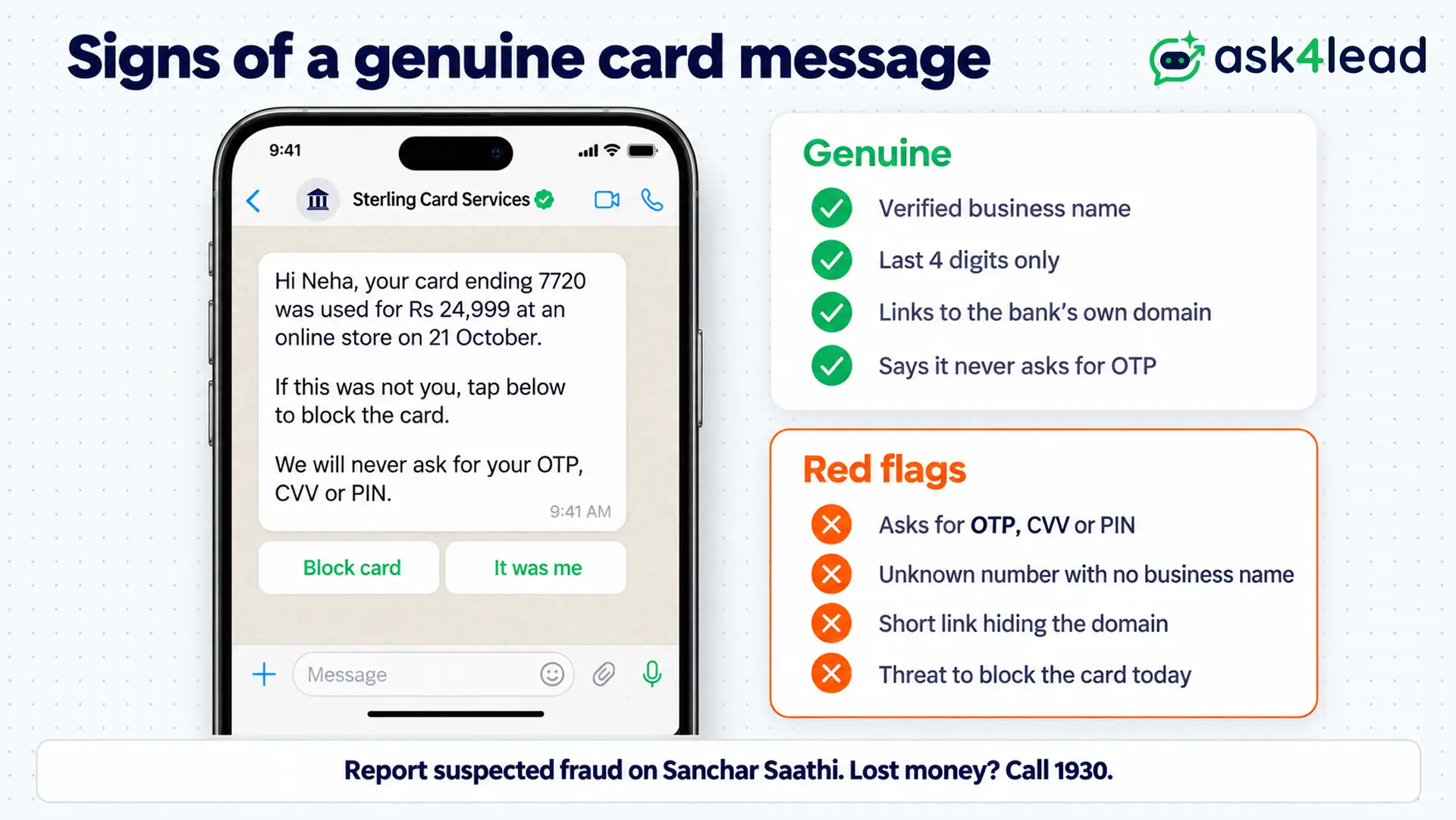
In short, a genuine credit card message never asks for an OTP. Customers can report suspected fraud on the Sanchar Saathi portal, and anyone who lost money should call 1930.
Why a credit card payment message gets rejected
Most rejections of a credit card payment message come from five fixable causes. Meta usually decides within 24 hours, so each rejection delays your reminders by at least a day.
| Cause | Rejected wording | Approved fix |
| Threatening tone | “Pay today or face legal action” | “If something has changed, reply HELP” |
| Sensitive identifier | “Confirm your card number to pay” | “Pay your card ending 4472 below” |
| Offer inside a utility | “Pay now and get 5% cashback” | Send the offer as a separate marketing template |
| Dangling variable | Body that ends in “{{5}}” | “…payable by {{5}}. Tap below to pay.” |
| Too many emojis | A money emoji on every line | Plain text, with bold only for the amount |
If a template still fails, this guide to a rejected WhatsApp template walks through the appeal.
What a credit card payment message costs
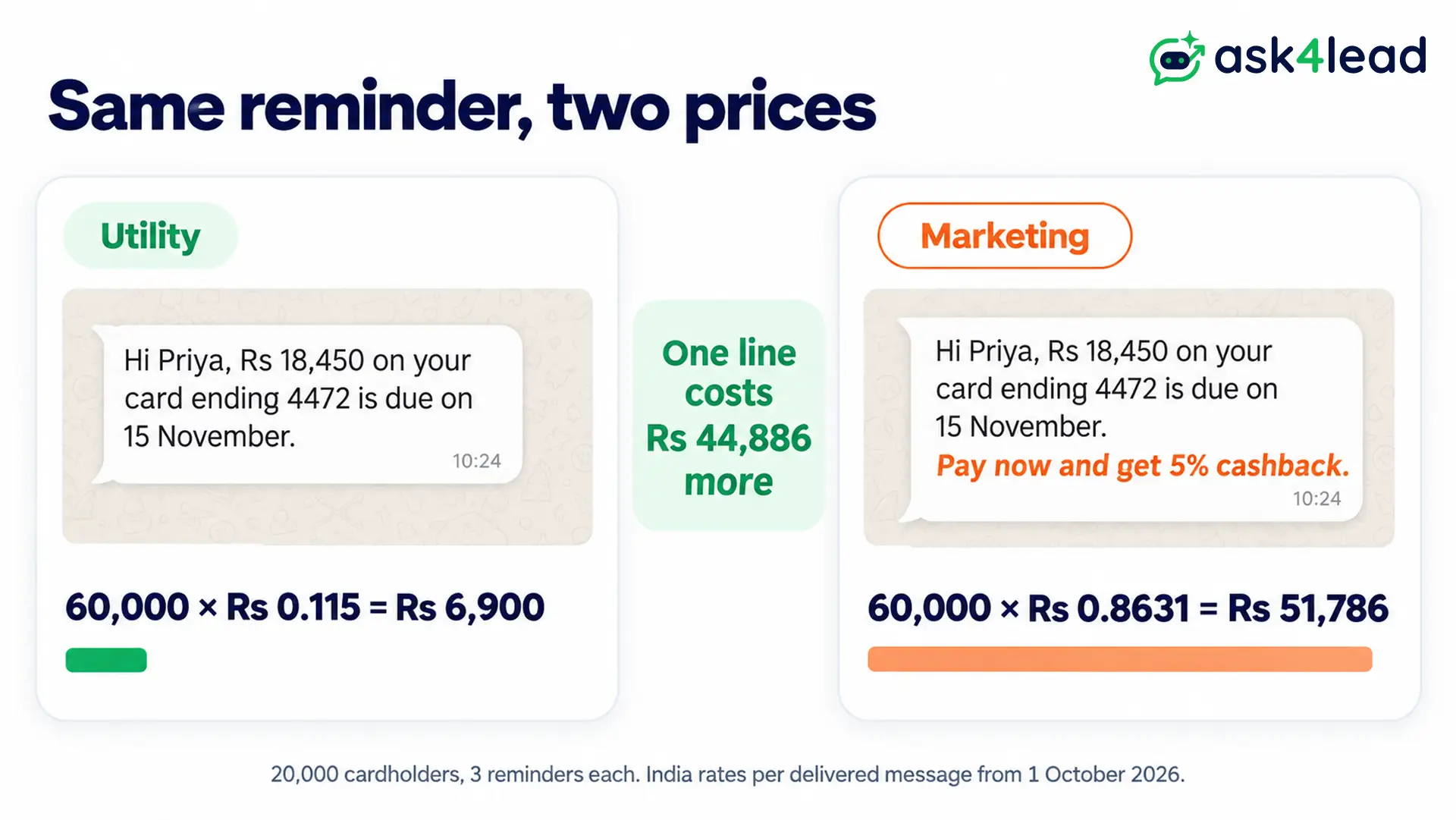
Meta charges each credit card payment message per delivery, and the category sets the price. In India, the rate card from 1 October 2026 lists Rs 0.115 per utility message and Rs 0.8631 per marketing message.
Also, Meta’s pricing page shows that utility templates inside the open 24-hour window became billable on 1 October 2026.
Worked example: the cost of one cashback line
Suppose an NBFC has 20,000 cardholders and sends three credit card payment reminders each cycle: samples 2, 3 and 9.
- Utility reminders: 60,000 × Rs 0.115 = Rs 6,900 a cycle
- Same reminders with a cashback line: 60,000 × Rs 0.8631 = Rs 51,786 a cycle
- Difference: Rs 44,886 every billing cycle, before volume discounts
Worked example: a reminder calendar for a 15 November due date
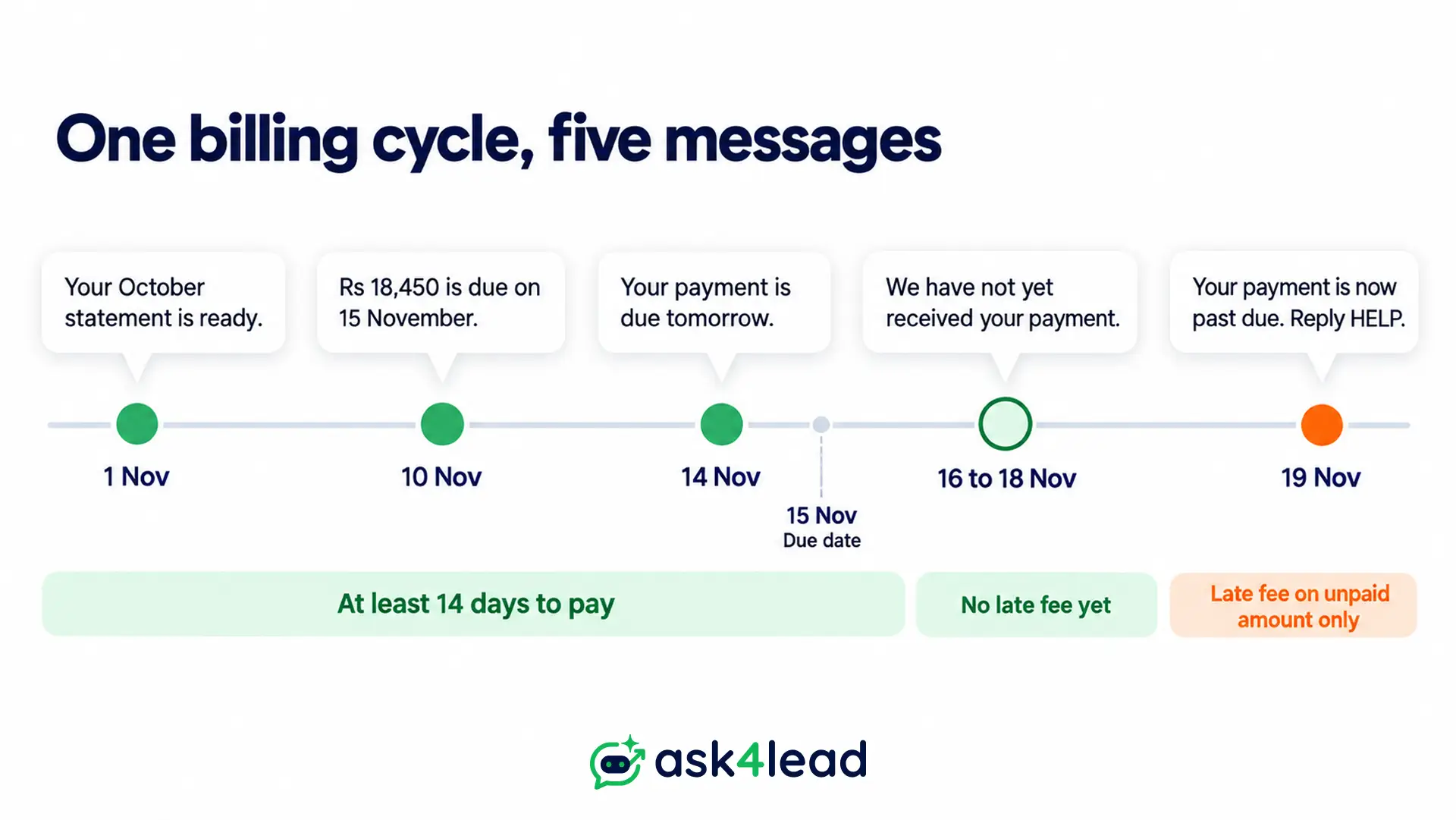
RBI requires at least a fortnight between the bill and the due date. After that, the three-day rule decides when a late fee can start.
| Date | Message | What RBI allows |
| 1 November | Sample 1, statement ready | Bill sent at least 14 days before the due date |
| 10 November | Sample 2, due in five days | Reminder only |
| 14 November | Sample 3, due tomorrow | Reminder only |
| 16 to 18 November | Sample 9, not received yet | No late fee and no bureau report yet |
| 19 November | Sample 10, past due with help | Late fee on the unpaid amount only |
However, interest still follows your card terms from the due date.
To send each step to the right people, Ask4Lead’s WhatsApp campaigns filter contacts by tag or pipeline stage. Then they schedule an approved template for a set date and time, so a cardholder tagged “paid” drops out of the next send.
How to handle replies to a credit card payment message
Every credit card payment message invites replies such as “I already paid”. Those replies open the 24-hour customer service window, and slow answers inside it turn a reminder into a complaint.
Send “already paid” and disputes to a person
Disputes need a human, because RBI bars charges on a transaction disputed as fraud until it is resolved. For that reason, a shared team inbox for WhatsApp lets one agent claim the chat, so two staff never send conflicting answers.
Let AI answer routine billing questions
Questions like “what is the minimum due?” come back every cycle. Ask4Lead’s AI Knowledge Profile answers them only from documents you upload. Meanwhile, human approval for AI replies holds low-confidence drafts until an agent checks them.
This does not suit every sender, though. A large bank will wire these templates into its own core banking system.
FAQs
1. What is a credit card payment message?
A credit card payment message is a note from a card issuer about a bill. It gives the amount due, the due date and a way to pay, or it confirms a payment.
2. Is a credit card payment reminder a utility or marketing template?
It is utility, as long as it contains no offer. However, cashback, an upgrade or a new card pitch makes it marketing.
3. When should I send a credit card payment reminder?
Send one when the statement is ready, one about five days before the due date and one the day before. Then send a gentle note if the payment does not arrive.
4. Can a bank ask for my card number on WhatsApp?
No. WhatsApp’s policy bars businesses from asking for full card numbers, and a genuine bank never asks for your OTP, CVV or PIN.
5. Can I send overdue reminders on WhatsApp?
Yes, for your own customers’ accounts and in a polite tone. However, WhatsApp prohibits debt collection, so collection agency work belongs elsewhere.
Conclusion
A good credit card payment message is short and exact: four digits, two amounts, one date and one button. Behind it sit two rulebooks, RBI for the money and Meta for the words.
Before you submit your templates, check that you have:
- Last four digits only, never the full card number
- No offers inside any reminder or receipt
- No threats, even in the past due message
- Fixed words at the start and end of every body
- A schedule that respects the fortnight and the three-day rule
After that, the hard part is answering the replies quickly.
Send credit card payment reminders without the manual chasing
Manual reminders go out late, and replies pile up across phones. So Ask4Lead fixes the parts you control:
- Template tracking: see each WhatsApp template move from Pending to Approved or Rejected
- Scheduled campaigns: send each reminder to a tagged segment on the right date
- Shared inbox: assign “already paid” and dispute replies to one person
- Grounded AI replies: answer billing questions only from your own documents
For sector-specific setups, see how Ask4Lead works for finance teams.
