
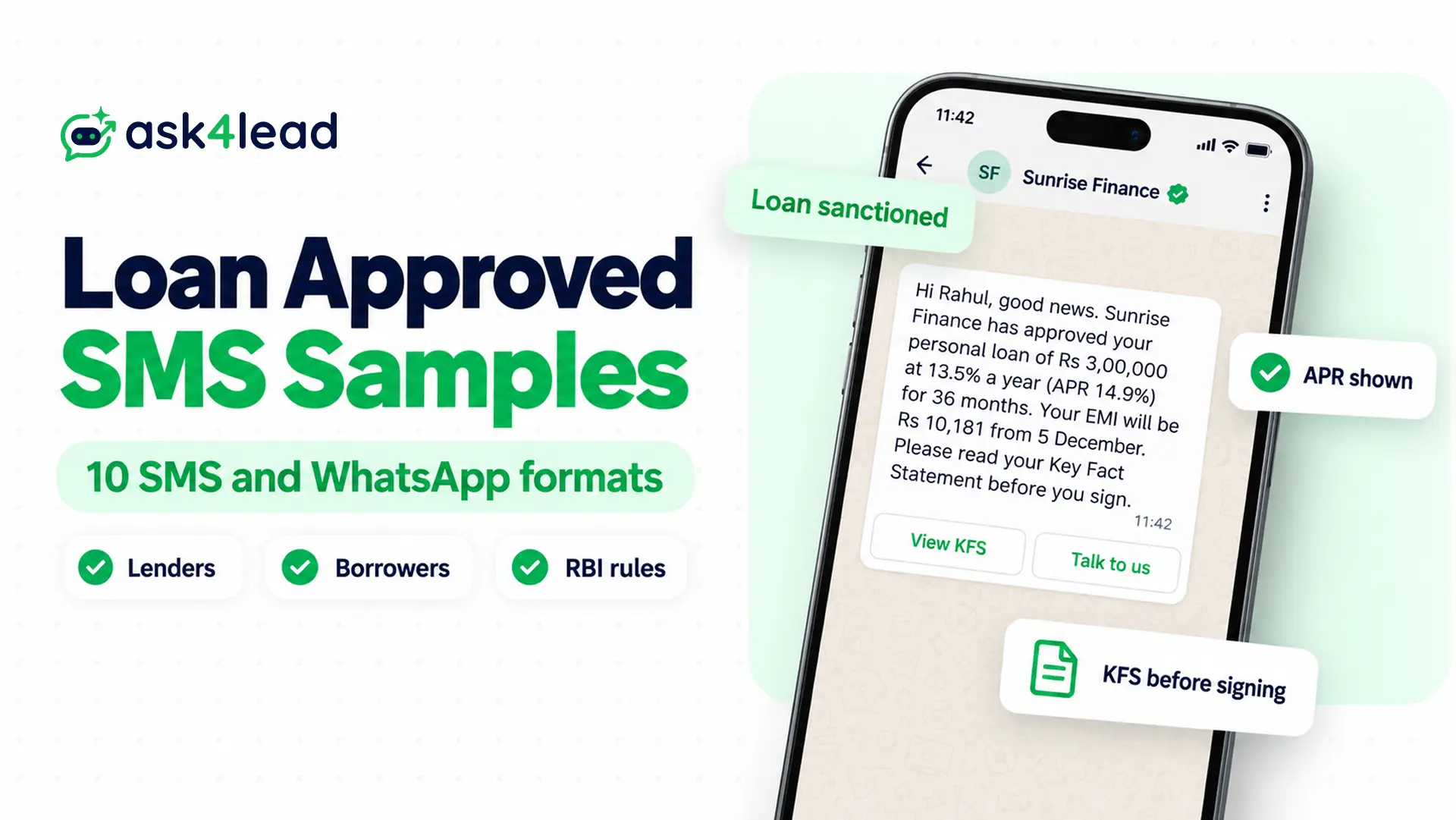
A loan approved SMS is the text a bank or NBFC (non-banking financial company) sends when it sanctions your loan. A genuine one names the lender, amount, rate, tenure and next step, and it points you to the Key Fact Statement first.
Below are 10 samples for lenders, by SMS and on the WhatsApp Business API. If you received a loan approval message and did not apply, skip to the five-step check for fake texts.
What a genuine loan approved SMS contains
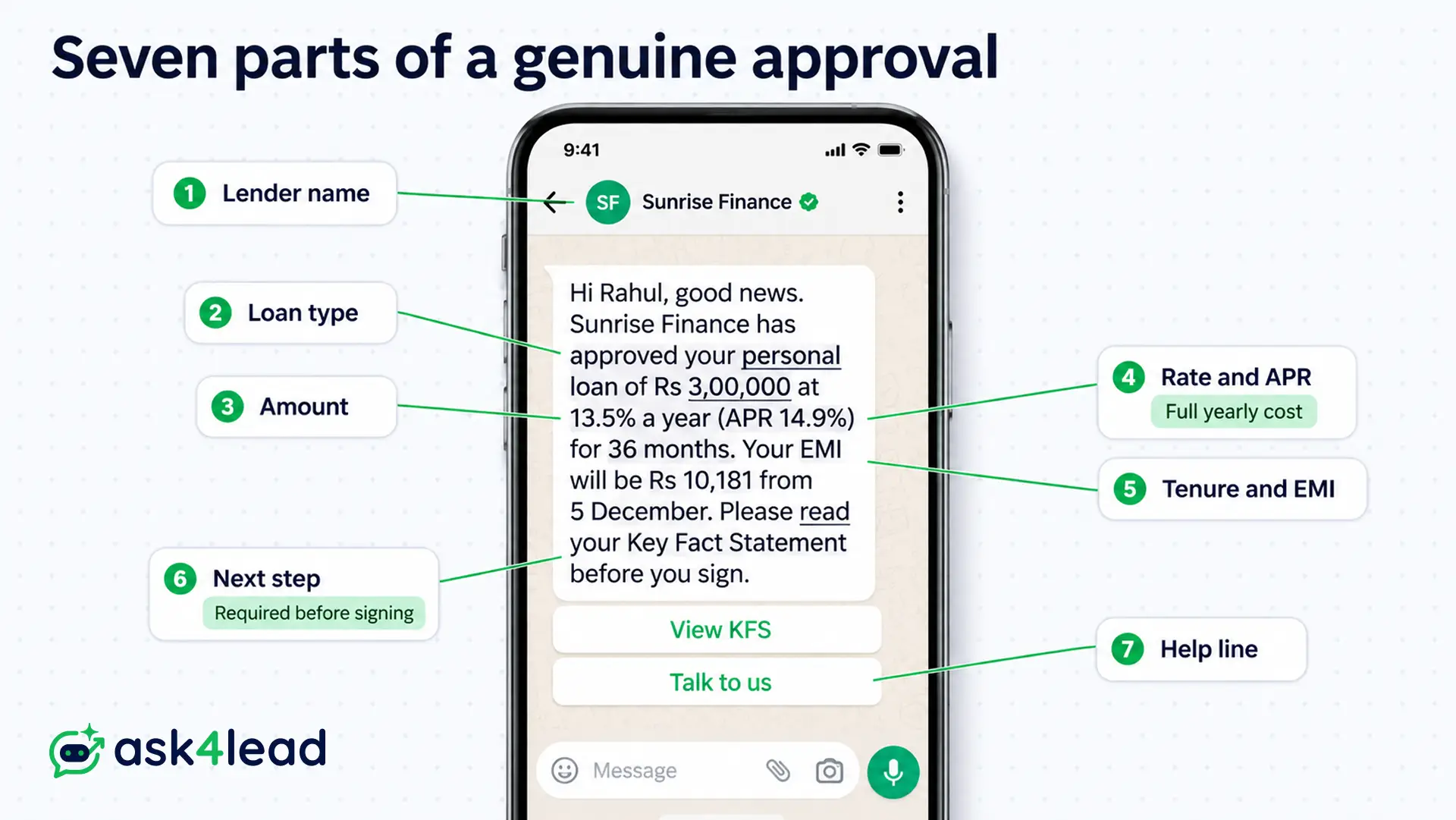
A genuine loan approved SMS carries seven facts, from the lender’s name to one next step. So you can check every number against the paperwork.
That paperwork is the Key Fact Statement (KFS), a short summary of the loan’s cost. Under the RBI’s KFS circular, lenders must give you a KFS before you sign. The rule covers retail and MSME term loans sanctioned from 1 October 2024.
| Part of the message | Example | Why it is there |
| Lender name | Sunrise Finance Ltd | Because the borrower must know who lends |
| Loan type and reference | Personal loan, ref ending 4821 | So the borrower can match it to the application |
| Amount | Rs 3,00,000 | Since it is the sanctioned principal |
| Interest rate and APR | 13.5% a year, APR 14.9% | Because APR shows the full yearly cost |
| Tenure and EMI | 36 months, EMI Rs 10,181 | So the borrower can plan the repayment |
| Next step | Read the KFS, then e-sign | Because nothing binds the borrower before signing |
| Help line | Grievance contact | So complaints have a route |
APR means annual percentage rate, the yearly cost of credit including fees. In addition, the circular says a lender cannot charge any fee that is not in the KFS, at any stage.
Approved, sanctioned or disbursed: what your loan message means
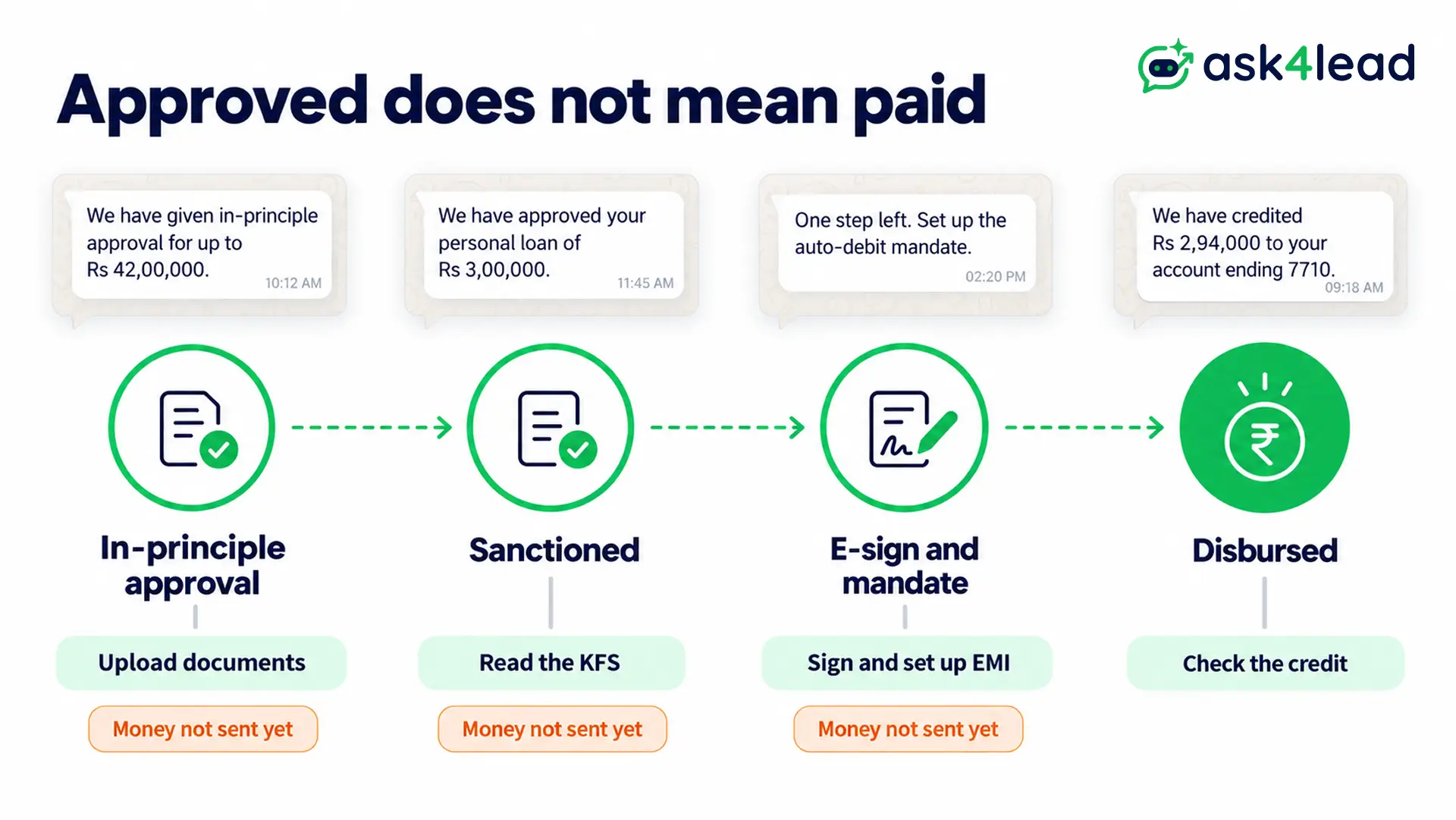
Not every loan message means the money is ready. Lenders send a different loan message at each stage, so read the stage before you spend money that has not arrived.
| Stage in the message | What it means | What the borrower does next |
| In-principle approval | The lender likes the profile, but checks continue | Upload the pending documents |
| Sanctioned or approved | The lender has fixed the amount and terms | Read the KFS, then accept or decline |
| E-sign and e-mandate | The agreement and auto-debit setup wait for you | Sign, then set up the EMI mandate |
| Disbursed | The money has reached your account | Check the credit and the first EMI date |
For example, a home loan often gets in-principle approval weeks before the property checks finish. Therefore, a lender that writes “approved” too early creates angry calls when the final terms change.
Loan approved SMS format for banks and NBFCs
The loan approved SMS format is short, because a text has no buttons. In addition, each Indian SMS must match a template on DLT (the telecom content registry).
1. Personal loan approved SMS
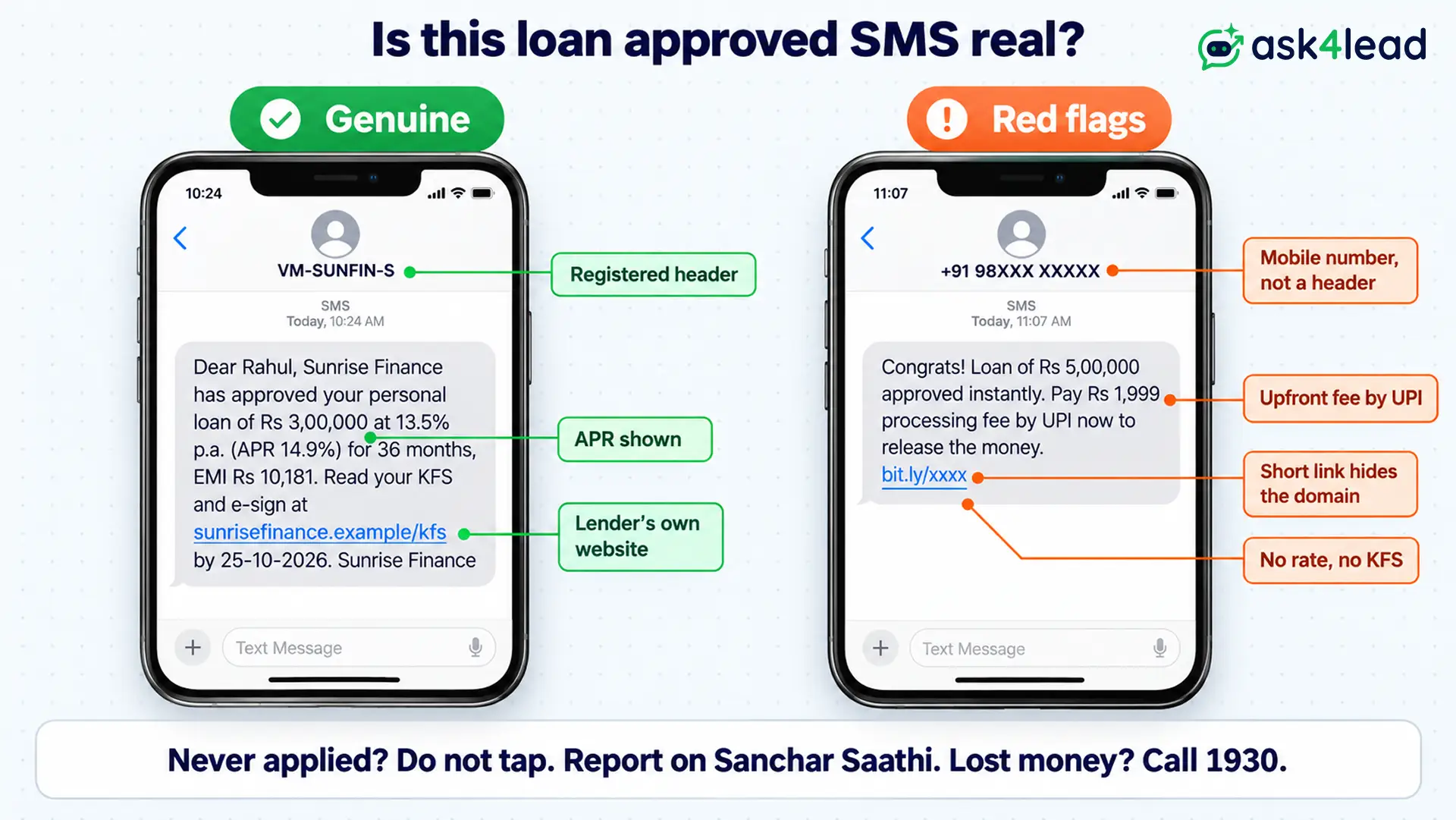
Dear [Rahul], Sunrise Finance has approved your personal loan of Rs [3,00,000] at [13.5]% p.a. (APR [14.9]%) for [36] months, EMI Rs [10,181]. Read your KFS and e-sign at [sunrisefinance.example/kfs] by [25-10-2026]. [Sunrise Finance]
2. Loan sanction SMS with a document step
Dear [Priya], we have sanctioned your home loan ref [ending 7310] for Rs [42,00,000]. Your sanction letter and KFS are in your registered email. Upload your property papers at [sunrisefinance.example/docs] to continue. [Sunrise Finance]
The sender ID helps too. Since TRAI’s 2025 rule, a header ends in -S for service, -T for transactional or -P for promotional texts. So a loan approved SMS from “VM-SUNFIN-S” looks right, while one from a 10-digit mobile number does not.
WhatsApp loan approval message templates
On WhatsApp, a loan approval message travels as a utility template, meaning a non-promotional update about something the customer started.
However, the template must not carry an offer. Meta’s template categorization treats any promotional line as marketing, and marketing costs more per message.
3. Personal loan approval message
Hi [Rahul], good news. [Sunrise Finance] has approved your personal loan of [Rs 3,00,000] at [13.5% a year] (APR [14.9%]) for [36 months]. Your EMI will be [Rs 10,181] from [5 December]. Please read your Key Fact Statement before you sign.
Buttons: View KFS · Talk to us
4. Home loan in-principle approval
Hi [Priya], [Sunrise Finance] has given in-principle approval for a home loan of up to [Rs 42,00,000]. Final terms depend on the property and legal checks. Please upload [the sale agreement] to move to sanction.
Buttons: Upload documents · Call me
5. Business loan sanction message
Hello [Arjun], we have sanctioned a business loan of [Rs 15,00,000] for [Arjun Traders] at [16% a year] (APR [17.2%]), EMI [Rs 52,734] for [36 months]. We have attached the sanction letter and KFS. Please sign by [28 October].
Header: PDF document · Button: Sign now
6. E-sign and e-mandate pending
Hi [Rahul], one step left on your loan [ending 4821]. Set up the auto-debit mandate for your EMI of [Rs 10,181] from your [account ending 7710], and then we release the money.
Buttons: Set up mandate · Need help
7. Loan disbursed message
Hi [Rahul], we have credited [Rs 2,94,000] to your [account ending 7710] for loan [ending 4821], after the [Rs 6,000] processing fee in your KFS. Your first EMI of [Rs 10,181] is due on [5 December].
Button: View loan details
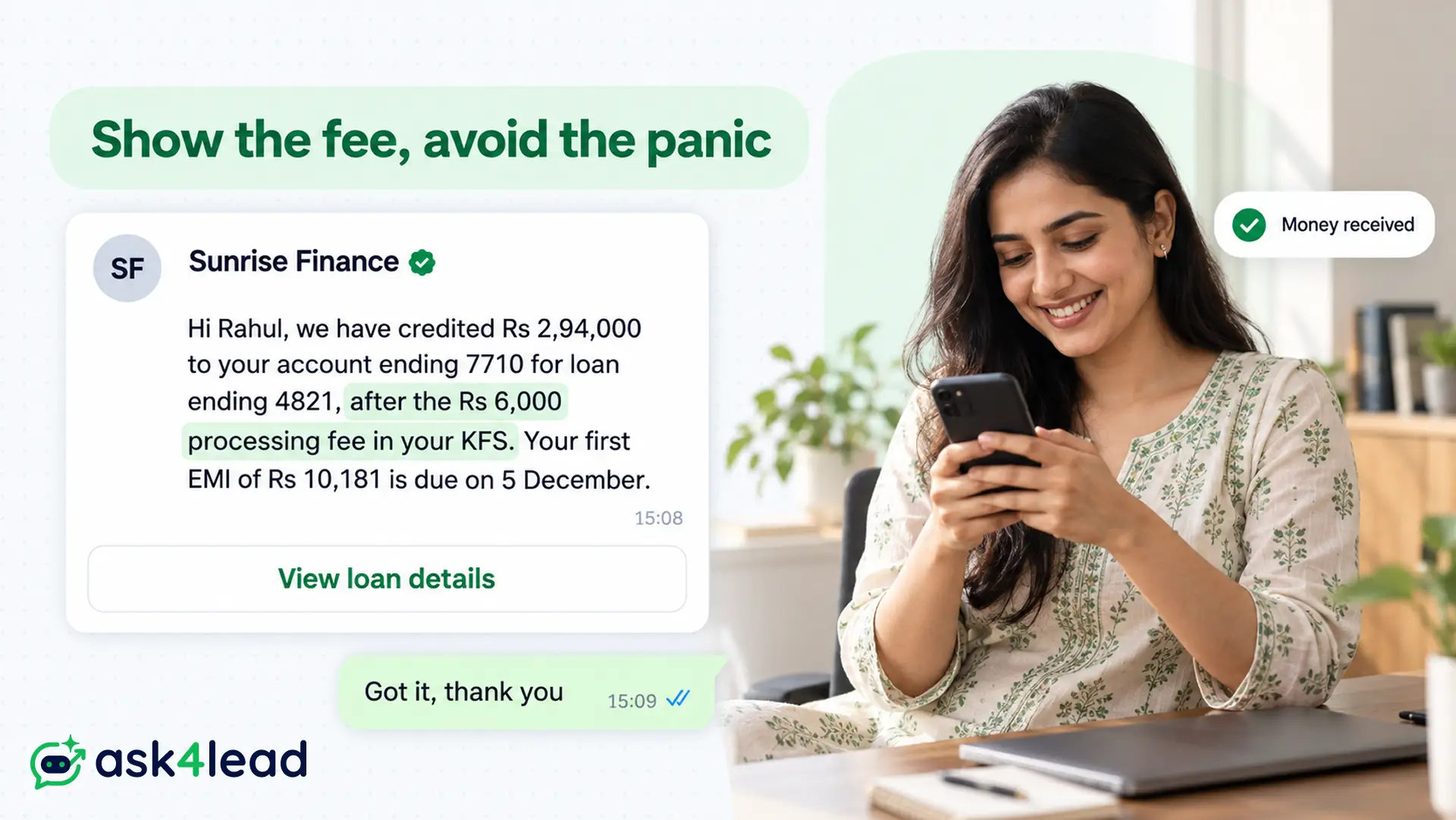
Sample 7 shows the fee, because the borrower otherwise sees Rs 6,000 less than the SMS promised and assumes fraud. For the matching bank credit alert, see these money transfer message formats.
Related loan messages: documents, rejection and offers
Approval sits in a longer chain, so these three cover the steps around it.
8. Documents pending
Hi [Sneha], to continue your loan application [ending 2290], please upload [your last 3 salary slips]. We never ask for an OTP or PIN on this chat.
Button: Upload now
9. Loan rejection message
Hi [Imran], thank you for applying to [Sunrise Finance]. We cannot approve application [ending 6614] at this time, mainly because of [the current income level]. You can reapply after [3 months], or reply HELP to reach our grievance officer.
10. Pre-approved top-up offer (marketing)
Hi [Rahul], as an existing borrower you are eligible for a top-up loan of up to [Rs 1,00,000]. Reply YES and our team will share the terms and the KFS.
Buttons: Show me · Not now
Sample 10 is a marketing template, so the borrower must have opted in. Also, RBI’s digital lending rules ban any automatic increase in a credit limit unless the borrower asks for it explicitly. After disbursal, the next message in the chain is usually an EMI reminder or bounce notice.
How to check if a loan approved SMS is real
Fraudsters copy the loan approved SMS format because “approved” lowers your guard. So if you received a loan approval message out of the blue, run these five checks before you tap anything.
1. Ask whether you applied
A genuine loan approved SMS follows an application you made. If you never applied, do not open the link, because it probably leads to a scam or an unregistered app.
2. Check the sender
A real lender texts from a registered header ending in -S or -T, or from a verified WhatsApp business account. In contrast, a personal number deserves suspicion.
3. Check the app on the RBI list
Since 1 July 2025, RBI has published a directory of digital lending apps under Citizen’s Corner on its website. However, lenders supply that list themselves, so a listing proves the link to a lender, not that the lender is good.
4. Refuse upfront fees and credential requests
A genuine lender lists every fee in the KFS and cannot charge one outside it. Therefore, a demand for a “processing fee” by UPI before disbursal is a red flag. So is any request for your OTP, PIN or Aadhaar photo.
5. Report it
Flag a fraud text on the government’s Sanchar Saathi portal. Report an unauthorised lender on RBI’s Sachet portal, and call 1930 at once if you lost money.
Also, a “pre-approved” text from your own bank can be real. It is a marketing message, though, so a header ending in -P is normal, and you owe the bank nothing.
Meta and RBI rules for loan approval messages on WhatsApp
A loan approval message on WhatsApp answers to both Meta and the RBI. Breaking either rulebook costs a rejected template, a restricted number or a regulator complaint.
Meta’s rules for loan templates
WhatsApp’s Business Messaging Policy bans payday loans, paycheck advances, peer-to-peer lending and debt collection, “irrespective of” your licences. So a regular bank or NBFC can send loan updates, while a payday lender cannot use WhatsApp at all.
Meta also rejects templates for these causes, so check yours before you submit:
- Offers inside a utility template: a top-up line makes it marketing
- Full account or card numbers: mask them as “ending 4821”
- Pressure language: “accept in 1 hour or lose it” reads as a threat
- A variable at the start or end: Meta wants fixed text around each variable
- No sample values: reviewers need examples such as Rs 3,00,000
If a template still fails, this guide to a rejected WhatsApp template maps each reason to a fix. Repeated violations can also lead to a WhatsApp Business policy violation that restricts the number.
RBI’s rules for what the message says
The RBI’s Digital Lending Directions, 2025 shape the wording of every digital loan approval message:
- KFS first: the borrower gets a KFS before signing, in a language they understand
- KFS validity: at least three working days for loans of seven days or more
- Cooling-off period: the borrower can exit a digital loan without penalty for at least one day, paying principal and proportionate APR
- Disbursal: money goes into the borrower’s own bank account
- Sanction documents: the signed KFS, sanction letter and terms reach the borrower’s verified email or SMS at signing
Variables for a loan approval message template
WhatsApp templates use numbered variables such as {{1}}, which your system fills for each borrower. So hold the send when an amount or date is blank.
| Variable | What it holds | Example value |
| {{1}} Name | Borrower’s first name | Rahul |
| {{2}} Lender | The regulated lender | Sunrise Finance |
| {{3}} Amount | Sanctioned principal | Rs 3,00,000 |
| {{4}} Rate and APR | Interest and full yearly cost | 13.5%, APR 14.9% |
| {{5}} Tenure | Repayment period | 36 months |
| {{6}} EMI and date | Instalment and first due date | Rs 10,181 from 5 December |
| {{7}} Reference | Masked loan number | ending 4821 |
Two worked examples: APR and message costs
Numbers make a loan approved SMS trustworthy, so check them before you send. Here is the arithmetic behind the samples.
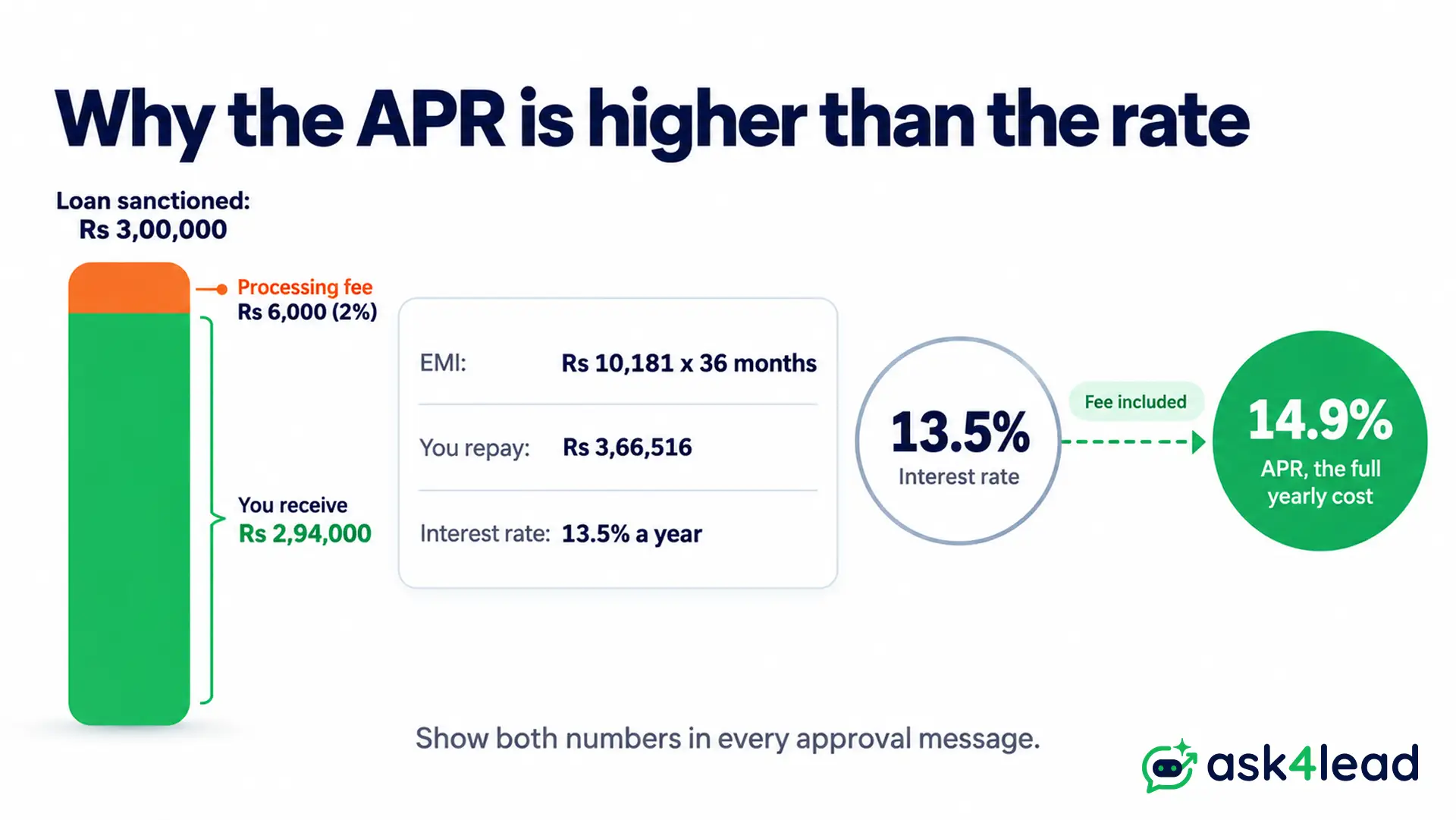
Worked example: why the APR is higher than the rate
Take sample 3: Rs 3,00,000 at 13.5% a year for 36 months.
- EMI: Rs 10,181 a month, so Rs 3,66,516 over 36 months
- Processing fee: 2%, or Rs 6,000, deducted at disbursal
- Money received: Rs 2,94,000, while the EMIs stay the same
- APR: about 14.9%, because the borrower repays on Rs 3,00,000 but receives Rs 2,94,000
That 1.4-point gap is why a message that shows only “13.5%” misleads, even when every number is true.
Worked example: one month of approval messages
Suppose an NBFC approves 2,000 loans a month and sends samples 3, 6 and 7 to each borrower. From 1 October 2026, Meta’s India rate is Rs 0.115 per utility message and Rs 0.8631 per marketing one.
- As utility templates: 6,000 × Rs 0.115 = Rs 690 a month
- With a top-up line in each: 6,000 × Rs 0.8631 = Rs 5,178.60 a month
- Difference: Rs 4,488.60 every month, before GST and volume discounts
Also, Meta’s pricing page shows that utility templates sent inside an open chat became billable on 1 October 2026.
How lenders should handle replies to a loan approval message
A loan approval message invites questions like “why did I get less money?”. Each reply opens the 24-hour customer service window, and a slow answer can lose you the borrower.
Route sign-off questions to one person
Questions about rates and fees need a loan officer, because the answer binds you. A shared team inbox for WhatsApp lets one officer claim the chat, so two staff never quote different numbers.
Answer routine questions from your own documents
“Where is my KFS?” and “when is my first EMI?” repeat every day. Ask4Lead’s AI Knowledge Profile answers them only from the documents you upload, such as your fee schedule.
This setup does not suit every lender, though. A large bank will send these templates from its own loan system. Smaller NBFCs and DSAs (direct selling agents) gain most.
FAQs
1. What is a loan approved SMS?
It is the text a bank or NBFC sends when it sanctions your loan. A genuine one shows the lender, amount, rate, APR, tenure, EMI and a next step.
2. Why am I getting loan approval texts when I never applied?
Most are marketing texts or scams. Do not open the link, check the sender, and report fraud on Sanchar Saathi.
3. Does a loan approved SMS mean the money is coming?
Not yet. You still need to read the KFS, sign the agreement and set up the EMI mandate before disbursal.
4. Is a loan approval message a utility or marketing template?
It is a utility template when it updates a loan the customer applied for. A pre-approved or top-up offer is a marketing template.
5. Can a lender ask for a fee after a loan approved SMS?
Only a fee listed in the KFS. RBI rules bar lenders from charging any fee that the KFS does not mention.
Conclusion
A good loan approved SMS states the stage, the full cost and one next step. When you write all three, borrowers trust the message. And when borrowers check all three, a fake loan approved SMS loses its power.
Before you send your next approval message, check that it has:
- The lender’s own name, even when an agent or app sends it
- The APR beside the rate, so the cost is complete
- A KFS link or attachment, before any signature
- A masked reference, never the full account number
- No offer inside a utility template, so the category stays right
Next, plan the messages that follow approval, because most borrower questions arrive after disbursal.
Send loan updates without chasing every borrower by hand
Manual approval texts go out late, and replies scatter across staff phones. So Ask4Lead covers the parts you control:
- Template tracking: watch each WhatsApp template move from Pending to Approved or Rejected
- Pipeline stages: move each applicant through a sales pipeline from new lead to closed
- Shared inbox: assign fee and EMI questions to one officer
- Grounded AI replies: answer loan questions only from your own documents
For lending setups, see how Ask4Lead works for finance teams.
