
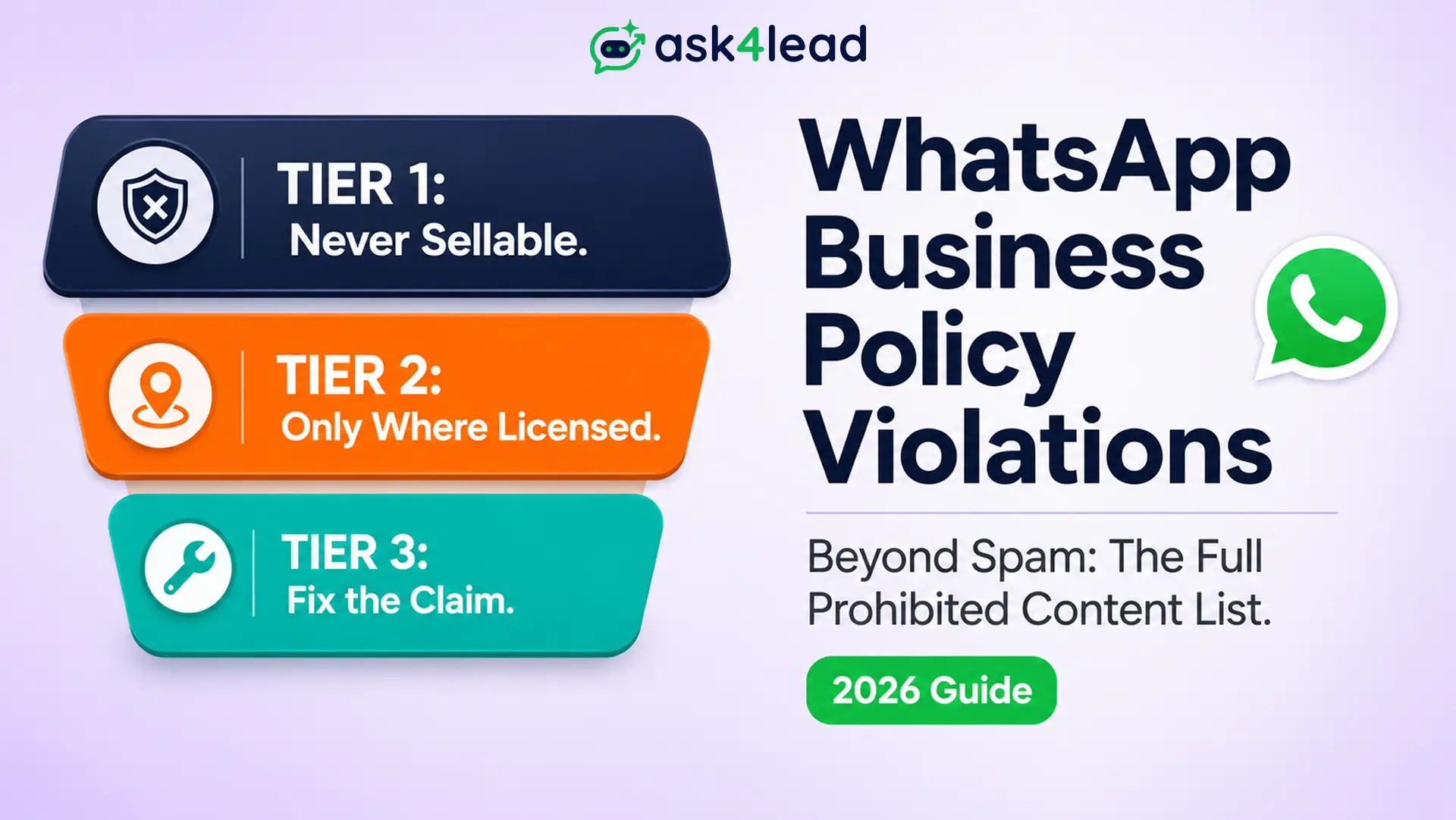
A WhatsApp Business policy violation doesn’t always come from spam-like behavior. Sending too fast or skipping opt-in is one category of risk, and Ask4Lead’s guide on automation and bans covers it in full.
There’s a second category most guides skip: restricted content and banned products. What you sell or say, not how you send it.
Quick answer: a content-based violation happens when your product falls into a banned category (weapons, drugs, adult content), a country-restricted one (alcohol, gambling), or a fully sanctioned country.
None of these are fixed by better opt-in or slower sending.
Key Takeaways
- Content-based violations are separate from spam-based ones. A clean opt-in list doesn’t fix a prohibited product category.
- Meta names 5 high-risk categories directly: adult content, alcohol and tobacco, drugs, gambling, and unsafe supplements.
- Restrictions escalate: a warning, a short block, a longer block, then an indefinite account lock only an appeal lifts.
- Some violations skip the ladder entirely and go straight to permanent removal.
- A declared business category can get a WhatsApp Business API application denied before 1 message is sent.
- Sanctioned countries (Cuba, Iran, North Korea, Syria, Russian-occupied Ukraine) block WhatsApp messaging entirely, regardless of the product.
- A completely legal business can get flagged for a category it was never in, since Meta’s scanner reads pattern similarity, not intent.
Why “Beyond Spam” Is a Different Compliance Problem
Most WhatsApp ban advice focuses on sending behavior. That’s right for most accounts, but it misses a second, independent enforcement system.
Behavior-Based Violations vs Content-Based Violations
| Factor | Behavior-based violation | Content-based violation |
| What triggers it | Volume, missing opt-in, block or report ratio | The product, service, or topic itself |
| Fixable by | Slowing down, cleaning the list | Changing what the account messages about |
| Does a clean opt-in list avoid it | Yes | No |
| Covered in | Automation and ban guide (linked above) | This guide |
Why a Clean, Zero-Complaint Account Can Still Get Restricted
An account can do everything right on the behavior side and still get restricted the moment a template mentions a Tier 1 or Tier 2 category.
Content review runs independently of spam detection. Ask4Lead’s opt-in and consent guide fixes the behavior system only, not this one.
The 3-Tier Content Risk Model
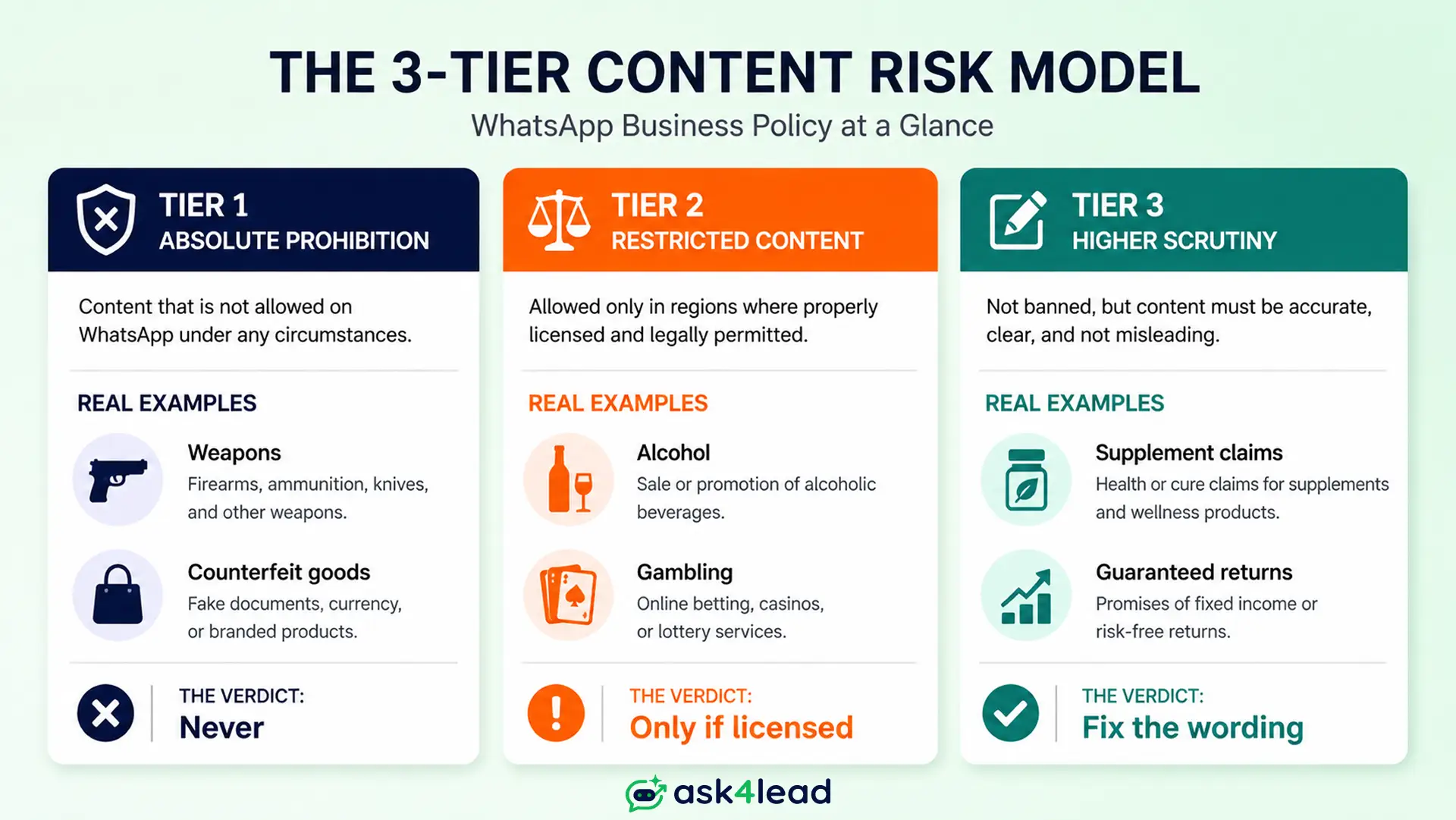
Meta splits its rules across 2 documents, the Business Messaging Policy and the Commerce Policy, with no combined master list. This model sorts the real risk level at a glance.
| Tier | What it means | Ever sellable on WhatsApp? |
| Tier 1: Absolute prohibition | Banned everywhere, no market fixes it | No |
| Tier 2: Jurisdiction-gated | Legal only where licensed | Only with local licensing and approval |
| Tier 3: Claim-gated | The product is legal, the framing isn’t | Yes, once the claim is removed |
Tier 1: Absolute Prohibition, No Exceptions Anywhere
Not a green tick, not years of clean history, not a license fixes a Tier 1 category.
- Illegal drugs and paraphernalia
- Weapons, ammunition, explosives, hazardous materials
- Counterfeit goods, stolen goods, real or fake currency
- Endangered species, wildlife trafficking, illegal live-animal sales
- Human body parts or fluids
- Hate speech, violent extremist content, terrorism promotion
- Fraud, scams, deceptive schemes
- Payday loans, debt collection, bail bonds, and MLM, no license fixes these either
Meta’s own developer documentation confirms severe cases here bypass every warning stage. Child exploitation, terrorism, and scam content trigger immediate removal.
Tier 2: Jurisdiction-Gated, Legal Only Where Licensed
- Alcohol
- Tobacco and vapes
- Real-money gambling and betting
- Cannabis and CBD
- Adult content and sexual services
- Dating and matchmaking services
Meta’s own compliance summary confirms these sit in its highest-risk bracket: “adult content, sale of alcohol and tobacco, drugs, gambling and unsafe supplements,” per WhatsApp’s Business Platform policy enforcement documentation.
Tier 3: Claim-Gated, the Product Is Fine, the Wording Isn’t
A protein supplement is fine. “Cures joint pain in 3 days” is what gets flagged.
- Health supplements making medical claims
- Financial products promising guaranteed returns
- Medical devices sold directly instead of described
Crypto sits at the Tier 2/3 boundary. Informational content tends to survive; trading, ICOs, or binary options get treated as Tier 1.
Ask4Lead’s healthcare and financial services compliance guides cover this tier, industry by industry.
The Geography-Wide Block Most Guides Miss: Sanctioned Countries
Every category above is about WHAT you sell. This one is about WHERE your recipient lives, and it overrides every tier already covered.
The Countries Meta Blocks Regardless of What You’re Selling
Meta operates under US sanctions and export-control law, not just its own Commerce Policy.
- Cuba
- Iran
- North Korea
- Syria
- Russian-occupied Ukraine (Crimea, Donetsk, Luhansk)
This comes from US Treasury OFAC sanctions programs, enforced the same way every US-based platform does.
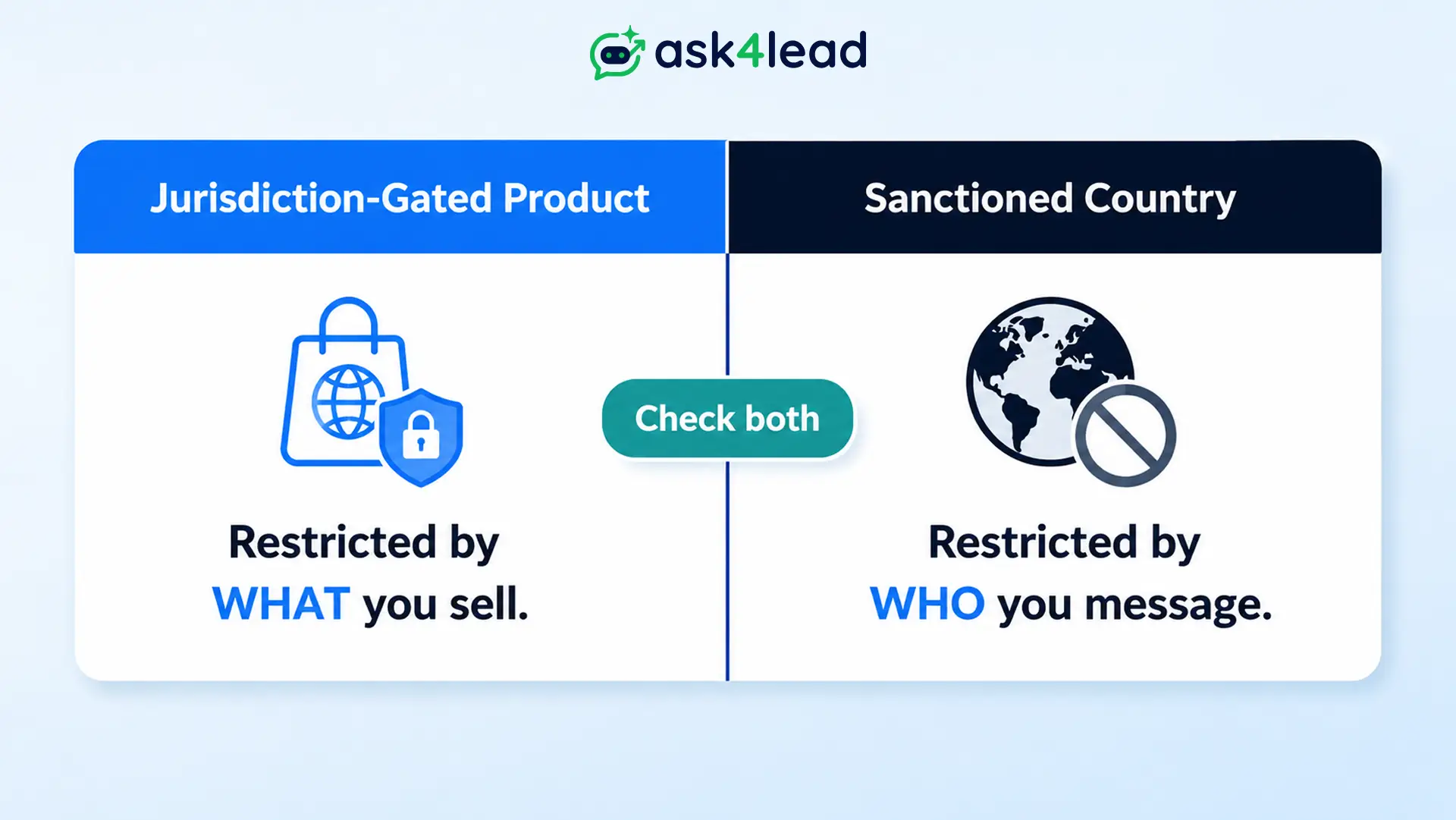
Sanctioned Country vs Jurisdiction-Gated Product
| Particulars | Restricted because of | Fixable by |
| Jurisdiction-gated product (Tier 2) | WHAT you’re selling | Local licensing, or a market where it’s legal |
| Sanctioned country | WHO you’re messaging | Nothing. No product description changes it |
Most guides fold this into a single “restricted geographies” bullet. It deserves its own check.
The Escalating Restriction Ladder for High-Risk Content
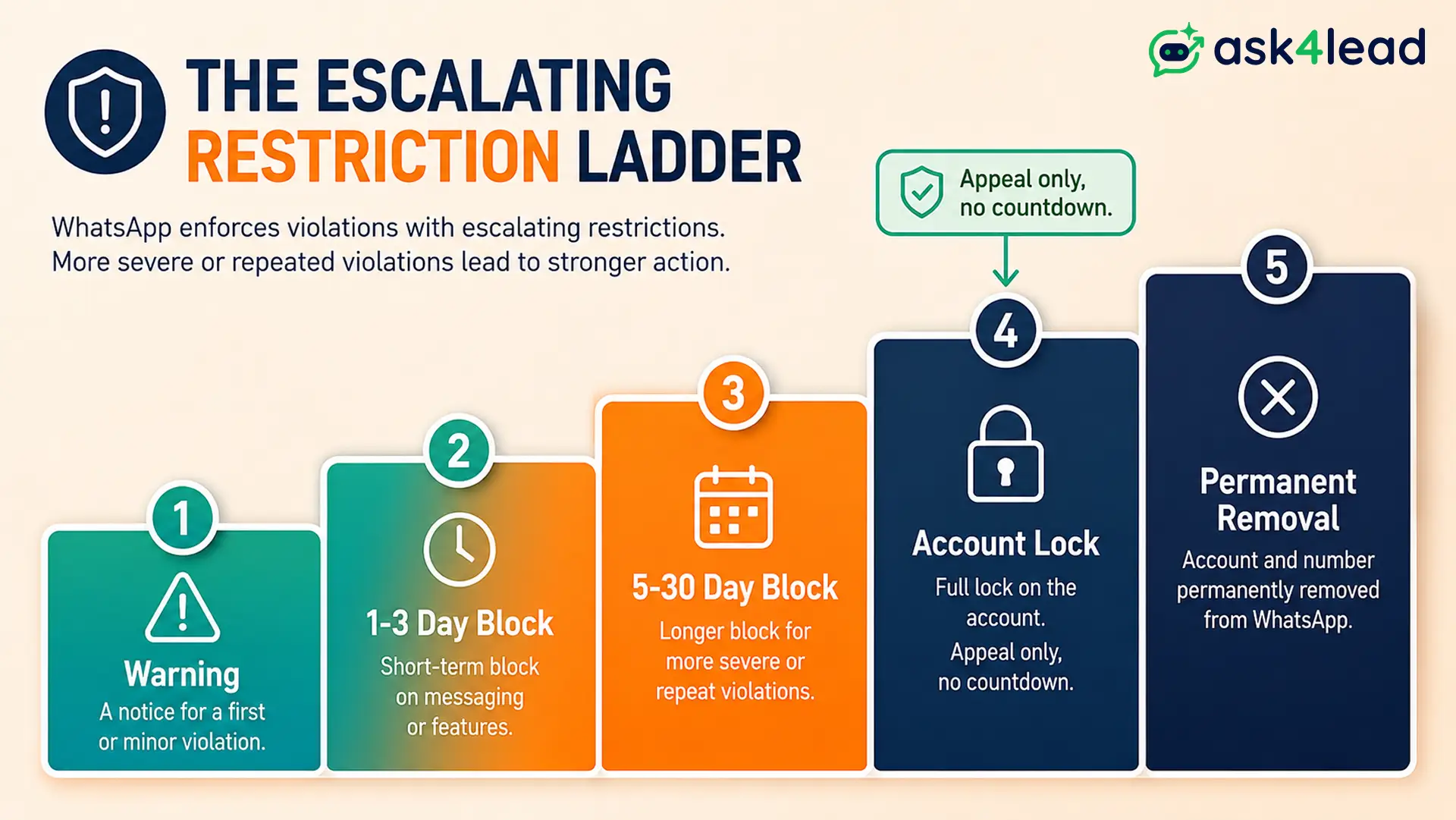
Meta rarely jumps straight to a ban. An account moves through a staged ladder, and knowing which stage you’re on changes what helps.
| Stage | What happens | Typical duration |
| Warning | Account receives details on the violation | Immediate |
| First restriction | Messaging blocked | 1 to 3 days |
| Repeat restriction | Messaging blocked again | 5 to 30 days |
| Account lock | Indefinite block on sending any message | Until a successful appeal |
| Permanent removal | Business removed from the platform | No appeal path |
What an Account Lock Actually Means
Meta’s own documentation defines it directly: “an indefinite block on sending any messages; can only be removed via an appeal.”
That needs a formal appeal, not a waiting period. Ask4Lead’s quality rating guide covers how a rating drop feeds this same ladder.
The Violations That Skip the Ladder Completely
Child exploitation, terrorism, and large-scale scam operations trigger immediate offboarding with no staged warning at all. Meta also notes “not all spam violations might be appealed.”
Why the Official API Denies Access to Certain Industries First
Meta’s Business Verification process and BSP underwriting (Business Solution Provider, a Meta-approved partner) screen your declared industry before you send anything.
1. Industries Screened Out at the Application Stage
- Gambling operators
- Adult content platforms
- Unlicensed pharmacies
- Weapons dealers
- Unlicensed cryptocurrency exchanges
- High-interest or payday lending services
2. Gray-Zone Industries Approved, Then Restricted Later
- Wellness and nutraceutical brands
- Forex or trading-signal services
- Debt consolidation businesses
- General health and fitness coaching
These pass the application stage since the industry field alone doesn’t name a prohibited category. The restriction lands later, once a template reveals a guaranteed-return or medical claim.
3. Why a Legal Business Can Get Flagged for a Category It’s Not Even In
Meta’s scanner reads pattern similarity, not intent, and that produces real false positives.
A common industry-observed case: a product-authentication service where customers reply with a barcode to verify a product is genuine.
Meta’s scanner misreads that pattern as a lottery mechanic, and the account lands a gambling restriction despite selling nothing like it.
Ask4Lead’s AI Knowledge Profile reduces this specific risk. Every AI reply stays grounded in the business’s own catalog, so it can’t drift into wording that pattern-matches a category it was never part of.
Regional Variation: Same Product, Different Verdict by Country
Meta checks the law where your recipient lives, not where your business is registered.
Gambling, Alcohol, and Cannabis: Geography Decides the Verdict
| Category | Compliant example market | Restricted example market |
| Gambling | UK, several US states | Most of India, most of the Gulf |
| Alcohol | Most countries broadly | Gujarat and Bihar (India), several Gulf states |
| Cannabis/CBD | Canada, Thailand, growing US states | India, most of the Middle East |
How to Check Your Market Before Launching a Campaign
- Confirm the product is legal where the recipient lives, not the business.
- Check whether Meta names the category as an outright Tier 1 prohibition.
- Verify licensing and age-gating requirements for that country.
- Segment campaigns by country inside your CRM, never 1 global template.
- Keep Tier 2 categories out of any AI reply not scoped to a single approved market.
The 4-Question Content Check Before You Send Anything
- Is this legal specifically in the recipient’s country? Not the business’s home market.
- Does Meta’s policy name this category outright? A yes means stop, no market fixes Tier 1.
- Are you making a claim, not describing a feature? Health outcomes and guaranteed returns move it into Tier 3.
- Would a stranger reading this out of context assume it’s a scam? If yes, rewrite it, even if compliant.
What to Do If Your Product Sits in a Gray Zone
Run all 4 questions per market, not once for the whole business. Default to informational-only messaging until every question clears.
Why This Check Matters More for AI-Generated Replies
A human rep instinctively hedges a claim; an unsupervised AI agent doesn’t. Human approval before an AI-drafted reply sends puts a person on this same check before every Tier 2 or Tier 3 message.
How to Stay Compliant While Selling Regulated Products
A regulated product doesn’t rule out WhatsApp entirely. It calls for a narrower, more deliberate setup.
The Compliant Workaround for Borderline Categories
- Keep Tier 2/3 messaging informational: availability, hours, general information.
- Never run a direct in-chat sale or a guaranteed outcome for these categories.
- Route the actual transaction to a licensed website, not a WhatsApp checkout.
- Age-gate that landing page before the WhatsApp link ever appears.
Where Ask4Lead Fits Into This Compliance Process
Ask4Lead’s WhatsApp Business API integration runs through Meta’s own Embedded Signup, the same verification path covered above.
WhatsApp Account Health surfaces a category flag as a dashboard warning before it becomes a restriction.
Ask4Lead’s shared team inbox lets a human take over a Tier 2 conversation instantly. The audit trail logs every review decision automatically.
For the templates that carry any of these categories, Ask4Lead’s guide to fixing rejected templates covers the exact category-mismatch errors this tier system triggers.
Common Myths About Content-Based Violations, Corrected
| Myth | What’s actually true |
| If nobody reports my message, the content doesn’t matter | Meta scans content proactively; research cited in Ask4Lead’s recovery guide found 25 to 30% of bans happen before any complaint |
| A green tick protects a regulated business from restriction | Verification confirms identity, not category compliance |
| A product legal where my business is registered can be messaged anywhere | Meta checks the recipient’s country, not the sender’s |
| The free Business App enforces content policy less strictly than the API | Both run on the same Business Messaging Policy, as covered in Ask4Lead’s app vs API comparison |
| Explaining a restricted topic is as risky as selling it | Enforcement targets facilitating a transaction far more than neutral information |
FAQs
1. Can I sell alcohol or tobacco on WhatsApp Business?
Only in markets where it’s legal, and even then Meta treats both as high-risk categories with stricter template review.
2. Is CBD or cannabis allowed on WhatsApp Business?
Only where cannabis is fully legal. Treat it as Tier 2 and verify before every regional campaign.
3. Can financial services or crypto businesses use the WhatsApp Business API?
Yes, with informational, non-promissory messaging. Guaranteed-return claims and unlicensed crypto trading get treated as high-risk regardless of verification.
4. What happens if I accidentally send one prohibited-content message?
Usually a warning or short block, not an immediate permanent ban, unless it’s a Tier 1 category like weapons or drugs.
5. Does WhatsApp ban the whole account for one violation?
Usually not on a first instance for lower-severity categories. Tier 1 categories and repeat violations move through the ladder faster.
6. Are dating services allowed on WhatsApp Business?
Dating and matchmaking sit in Meta’s restricted category and generally aren’t permitted for direct facilitation, even where the business operates legally.
7. Can healthcare businesses market supplements on WhatsApp?
Yes, as long as the messaging avoids curing, treating, or guaranteeing results. Ask4Lead’s tools for healthcare clinics cover a compliant setup.
8. Does this policy apply to the free WhatsApp Business App too?
Yes. The Business Messaging Policy applies platform-wide, not only to API accounts.
9. Can I message a customer traveling in a sanctioned country?
No. Meta checks the number’s registered country, and Cuba, Iran, North Korea, Syria, and Russian-occupied Ukraine are blocked regardless of travel status.
Conclusion
A WhatsApp Business policy violation isn’t only a spam problem. It’s often a content problem hiding behind a clean sending pattern.
No opt-in discipline fixes a Tier 1 or Tier 2 category on its own.
Sort every product through the 3-tier model, run the 4-question check per market, and rule out sanctioned countries first.
The businesses that get this wrong most often aren’t the ones knowingly selling something banned. They’re the ones with a legal product who never checked, and find out mid-campaign when a warning notice lands.
Ask4Lead builds that check into the platform itself:
- The official Cloud API through Meta’s Embedded Signup
- AI replies grounded in your own approved catalog
- Human approval on every sensitive send
- An audit trail that answers a compliance question long after the conversation ends
Sign Up Free: 100 AI Credits and connect a WhatsApp number built to catch a content violation before it reaches a customer, not after.
