
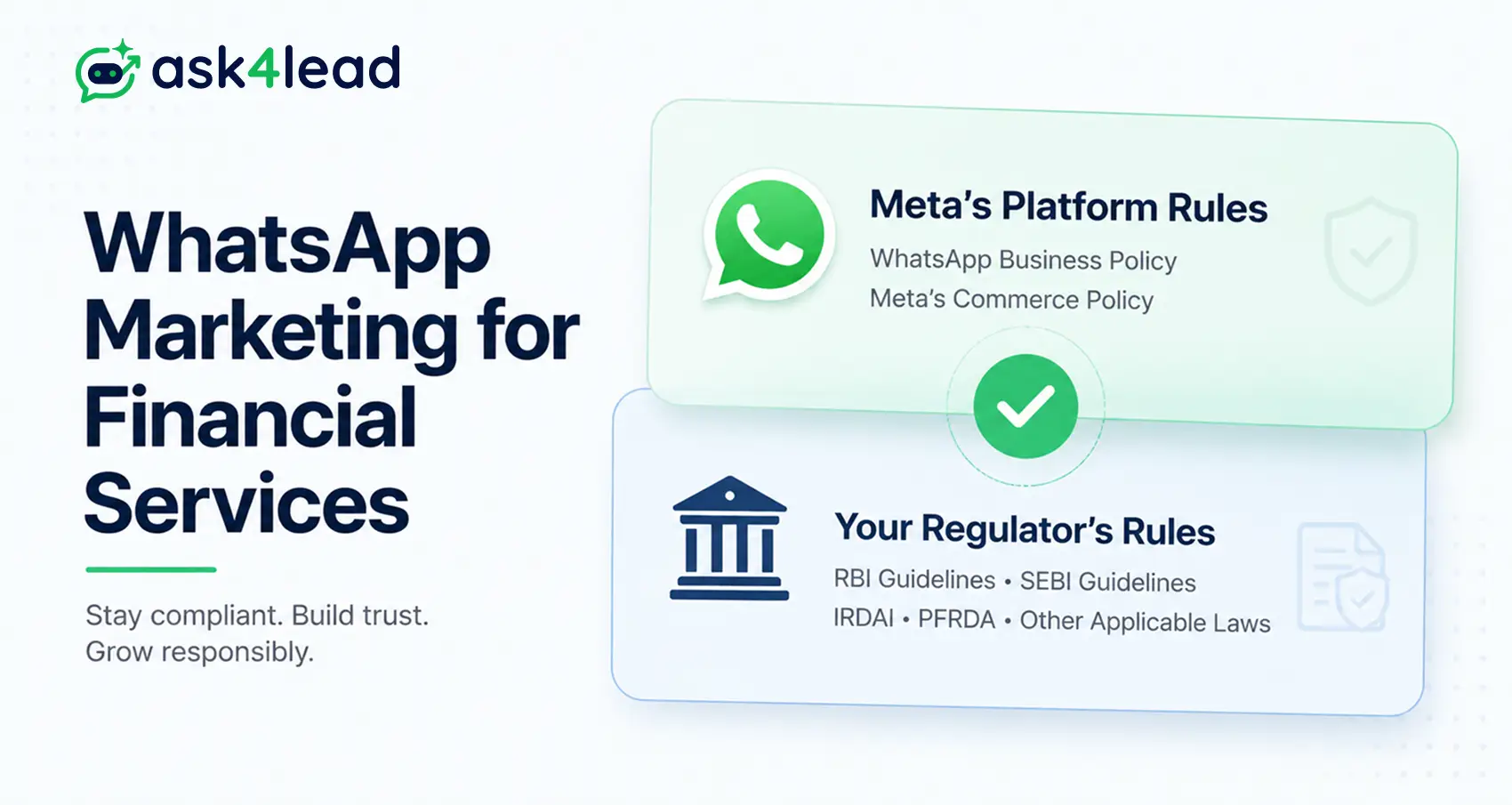
WhatsApp marketing for financial services is legal, but only through the official WhatsApp Business Platform (Meta’s own name for the WhatsApp Business API), with logged consent and correctly categorized templates.
Banks, NBFCs (non-banking financial companies that lend without a full banking license), insurers, and advisors use it because finance customers reply on WhatsApp faster than email.
Finance runs on 2 separate rulebooks at once, and most guides only cover 1. Meta enforces its own opt-in and template rules.
Your regulator, RBI, SEBI, IRDAI, the SEC, the FCA, or a data-protection law, enforces a second one on the same message. A template Meta approves can still be illegal where your customer lives.
This guide covers both layers, plus 4 changes from the last 12 months most compliance content hasn’t caught up to.
Quick answer: WhatsApp marketing works for regulated financial services, but only on the official Business Platform, never a personal number. Meta’s opt-in and your regulator’s consent are separate checks; passing one never satisfies the other.
Recordkeeping failures, not message content, cause the biggest fines here. Wells Fargo alone paid $200 million in 2023 for unarchived text and WhatsApp chats.
Key takeaways
- Treat every WhatsApp message about a financial product as regulated communication first, marketing second.
- Consent is channel-specific and purpose-specific: email, KYC, and marketing consent are 3 separate records.
- Meta’s mid-2025 pricing shift and its quality-rating system now compound each other’s cost.
- The regulator changes by country. The discipline, consent, categorization, records, escalation, stays identical everywhere.
What “WhatsApp Marketing for Financial Services” Means
It covers any business-initiated message promoting a product or rate: a loan offer, a policy renewal push, a mutual fund NFO (new fund offer), a credit-card upgrade. It excludes replies a customer starts themselves.
The Four Message Types Meta Recognizes
| Message type | What it covers | Financial services example |
| Marketing | Promotional content | Loan offer, policy push, rate alert |
| Utility | Follow-up on a customer action | EMI (equated monthly installment) reminder, KYC document request |
| Authentication | Identity verification only | One-time login or transaction code |
| Service | Free-form reply inside 24 hours of a customer message | Answering an account question |
Only Marketing needs the full consent-ladder treatment below. Ask4Lead’s 24-hour rule breakdown covers exactly when a Service reply must switch to a paid template.
Why Finance Carries Extra Rules
- A bad broadcast about a loan can trigger a mis-selling complaint, a privacy violation, and a securities breach in 1 message.
- Regulators treat financial promotions as higher risk because the downside is a customer’s money, not just their attention.
- That is why lending, insurance, and investment advice each answer to their own regulator on top of general privacy law.
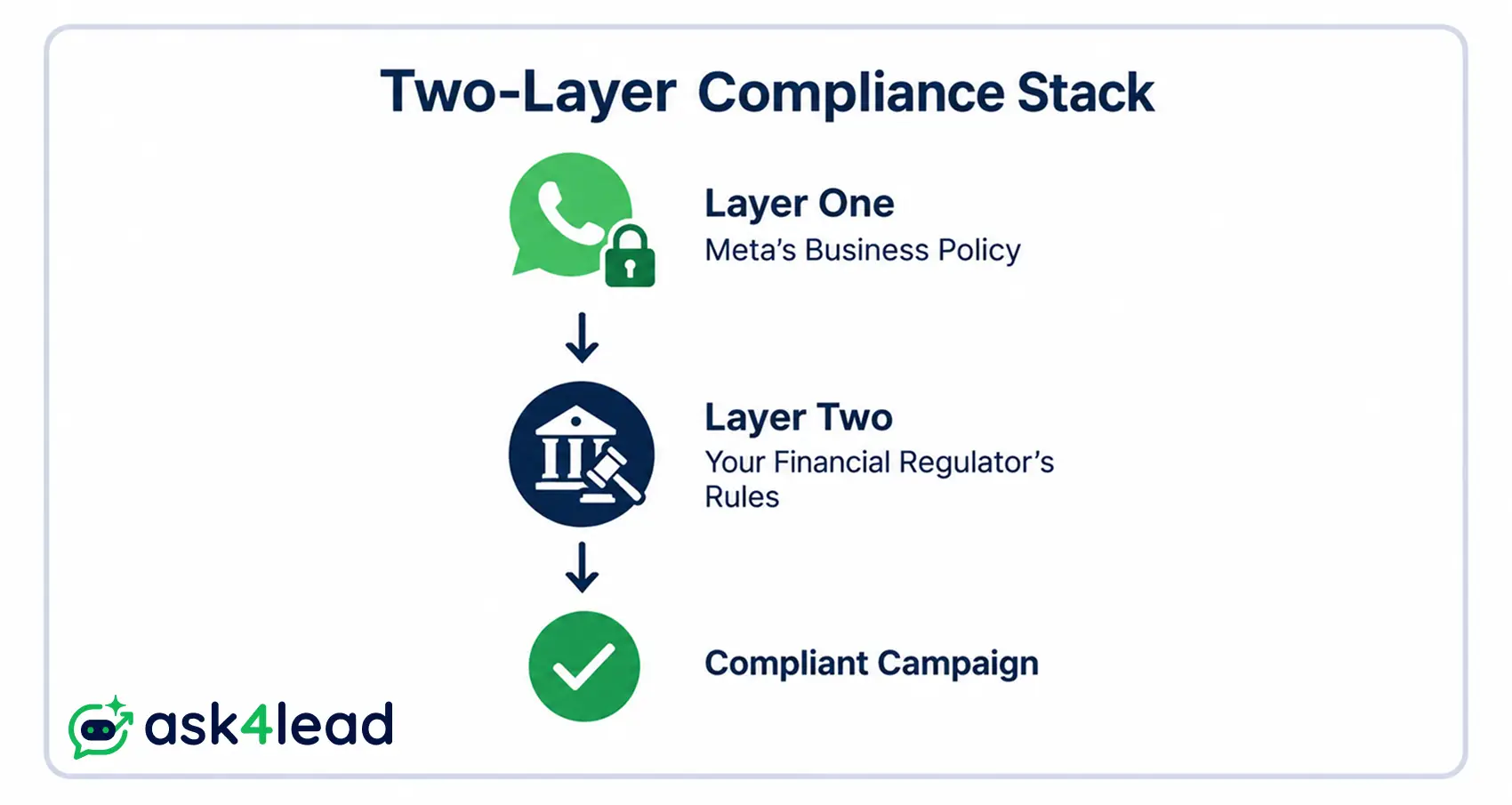
The Two-Layer Compliance Stack
Nearly every compliance article blends Meta’s rules and government law into 1 list. That is the biggest source of confusion in this space; they are 2 independent stacks.
| Layer | Who enforces it | What it decides |
| Platform | Meta’s WhatsApp Business Policy | Whether your template gets approved and stays live |
| Regulatory | Your central bank, securities regulator, insurance regulator, or data law | Whether contacting that customer was legal at all |
Passing Meta’s review only clears the platform layer. It says nothing about whether sending it was legal where your customer lives. Ask4Lead’s opt-in guidance covers the baseline mechanics both layers sit on top of.
India’s Regulatory Layer: RBI, SEBI, IRDAI, and DPDP
India stacks more regulators on WhatsApp marketing than anywhere else: the central bank (RBI), the securities regulator (SEBI), the insurance regulator (IRDAI), and a data-protection law (DPDP).
| Regulator or law | Latest rule | What it requires |
| RBI | Digital Lending Directions, 2025 (8 May 2025) | Auditable consent trail, Key Fact Statement before disbursal |
| SEBI | Circular, 26 Feb 2026 | Registration number disclosed on WhatsApp content, from 1 May 2026 |
| IRDAI | Insurance Advertisements and Disclosure Regulations | Board-level ad review before any policy-related message ships |
| DPDP Act | 2023 Act, core sections live since Nov 2025 | Purpose-specific, revocable consent per phone number |
Many guides still cite RBI’s 2022 lending guidelines. Those were repealed. The SEBI circular is barely 6 months old and names WhatsApp directly, alongside YouTube and Instagram.
A number collected for KYC (know your customer) verification cannot be silently reused for a loan campaign. That is a second purpose, needing its own consent.
This caution is not new. Long before DPDP existed, Indian customers were already handing merchants fake or landline numbers just to dodge unconsented bank texts.
A customer burned once hides their real number from every business after, including yours.
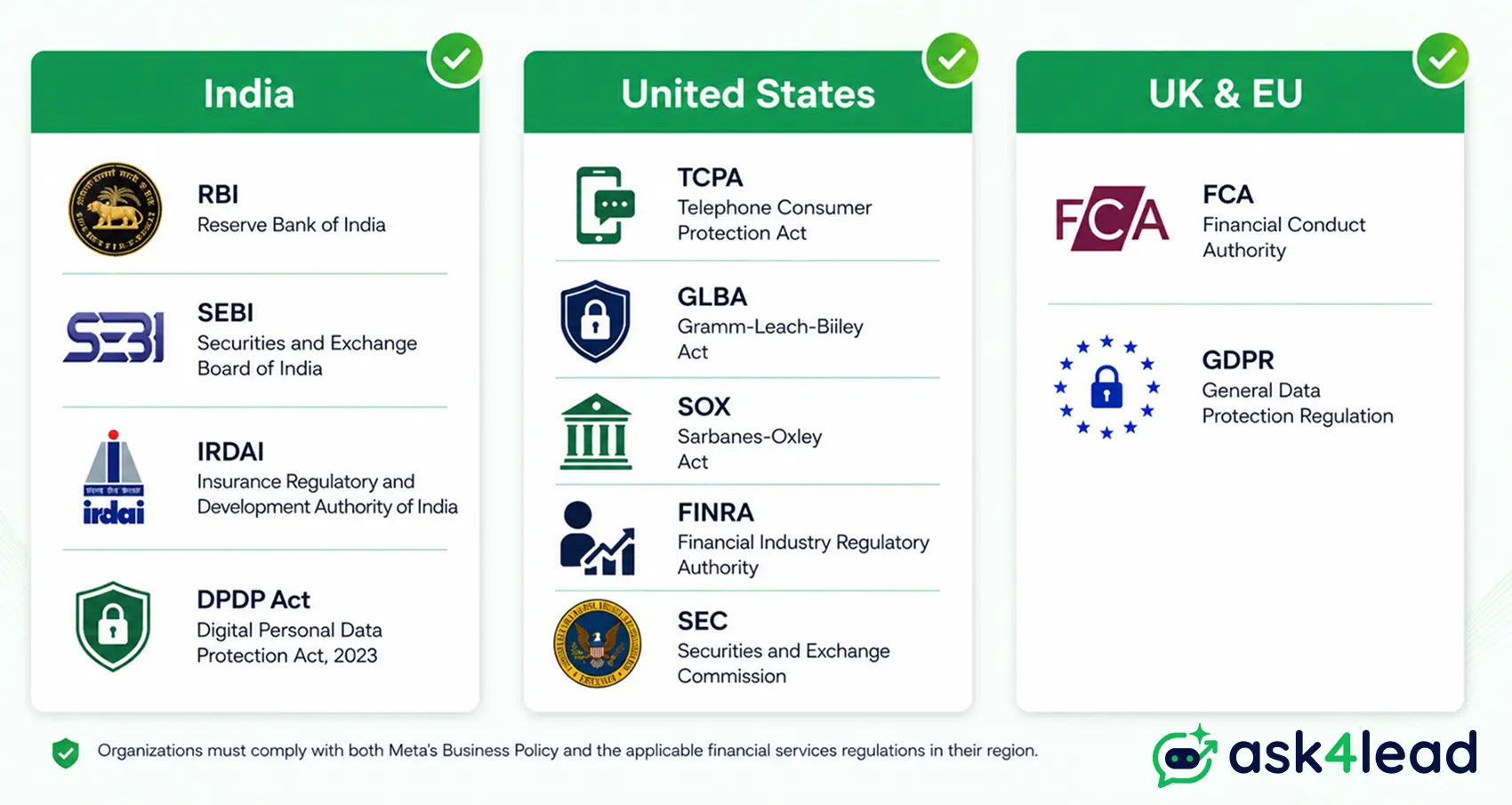
The United States Layer: TCPA, GLBA, SOX, FINRA, and SEC
The US layers a telemarketing-consent law (TCPA) and a financial-privacy law (GLBA) on top of 2 conduct regulators, FINRA and the Securities and Exchange Commission (SEC), plus a public-company recordkeeping law, SOX.
| Law or regulator | Requirement | Real consequence |
| TCPA | Prior express written consent per sender | 1-to-1 Consent Rule; a 2026 court split narrows it in 3 states |
| FINRA / SEC | Rule 4511 / Rule 17a-4 recordkeeping | Wells Fargo $125M + $75M, HSBC $15M, Scotia Capital $7.5M in 1 sweep |
| SOX Section 802 | 7-year retention on audit-relevant records | Destroying a record mid-investigation is a federal crime |
| GLBA | Restricts sharing nonpublic personal information | Notice and opt-out required before any external disclosure |
FINRA confirmed in Regulatory Notice 17-18 that any messaging app used for business must be archivable under Rule 4511. Fines for unarchived chats have crossed $1.5 billion since 2021, almost entirely for missing records, not message content.
Almost no compliance guide connects SOX to WhatsApp. Yet a public lender’s loan-decision thread can become an audit record the moment a regulator asks for it.
The UK and EU Layer: FCA and GDPR
The UK’s Financial Conduct Authority (FCA) requires firms, under SYSC 10A, to record client-order communications for 5 years, extendable to 7, and to stop staff using devices the firm cannot record.
Under Article 6 of the EU’s General Data Protection Regulation (GDPR), EU firms need documented, specific consent before a WhatsApp promotional message.
A common misread: encryption does not equal compliance. It protects a message in transit, but the moment it lands in your CRM, your business holds the plaintext, not Meta.
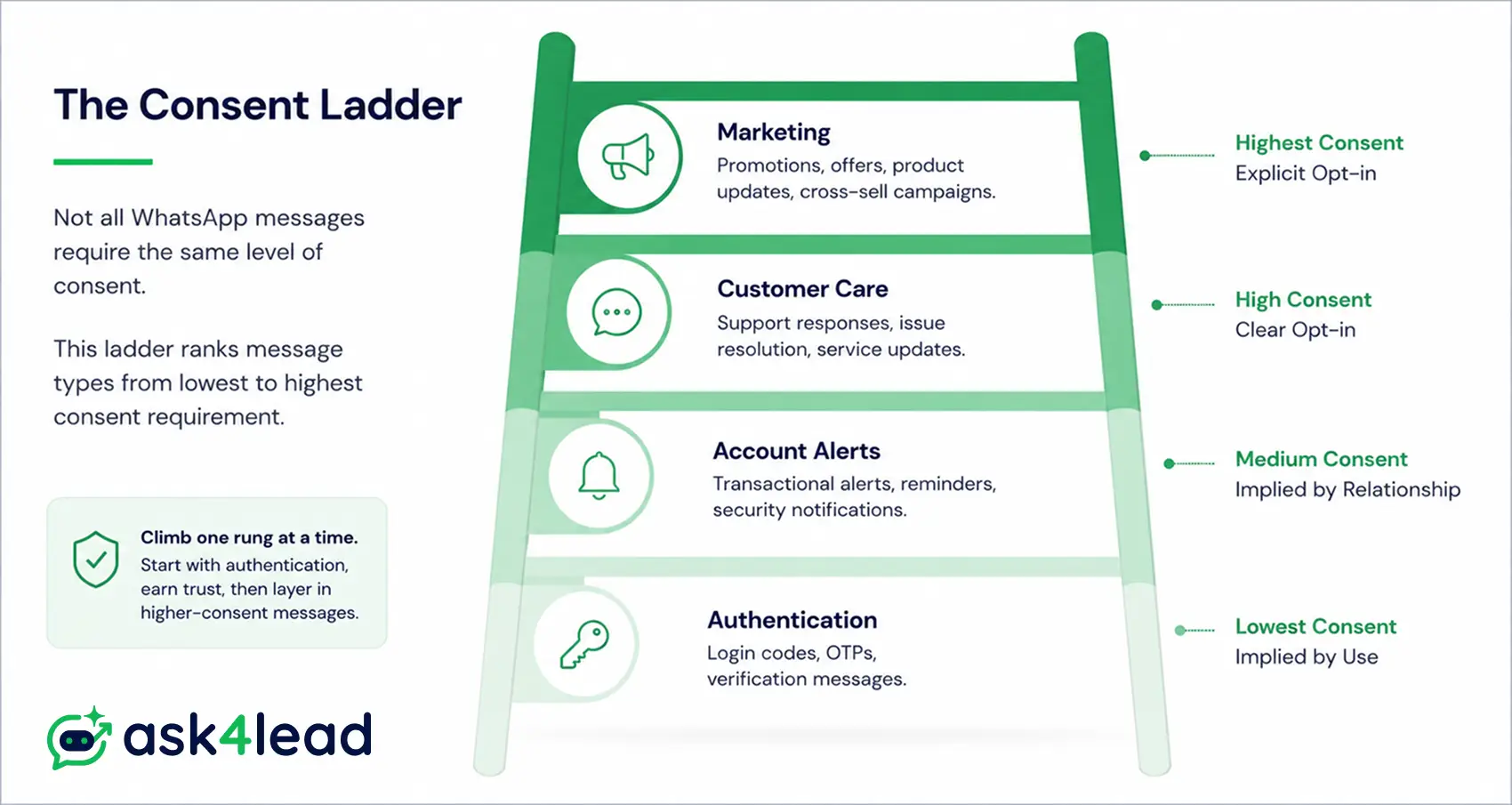
The Financial Services Consent Ladder
| Rung | Message type | Consent needed |
| 1 | Authentication | Implied by the transaction |
| 2 | Utility | Existing customer relationship |
| 3 | Service | The customer’s own message, within 24 hours |
| 4 | Marketing | Explicit, documented, revocable opt-in |
A campaign that blends rungs inherits the highest one it touches. An EMI reminder that ends with a cross-sell line is now a Marketing message wearing a Utility template.
What Changed in 2025 and 2026 for Financial Campaigns
Per-Message Pricing Replaced Conversation Pricing
From 1 July 2025, Meta switched to per-message pricing for templates. Send 3 marketing templates to the same borrower in a day, and that is 3 billable messages, not 1 conversation.
Utility templates sent inside an already-open service window still stay free.
Your Quality Rating Gates Volume, and Language Adds Friction
| Tier | Daily unique recipients |
| New, unverified | 250 |
| Tier 1 | 1,000 |
| Tier 2 | 10,000 |
| Tier 3 | 100,000+ |
Meta’s messaging-limit system scores this rating on the phone number, not the template. Rotating 50 message variants will not save a tier that recipients are already blocking.
Rating checks now run roughly every 6 hours, down from every 24 to 48. Ask4Lead’s quality rating walkthrough covers the mechanics in full.
A less obvious detail: Hindi and regional-language templates face stricter Meta review than the same message in English. NBFCs and insurers sending in Hindi should build extra approval buffer into every launch.
Building a Compliant WhatsApp Marketing Workflow
1. Separate Regulatory Consent From Meta’s Opt-in
Meta’s opt-in confirms a customer agreed to WhatsApp messages. Your regulator’s consent confirms they agreed to marketing about a specific product.
Ask4Lead’s audit logs keep both timestamped and searchable, so a compliance officer never has to reconstruct history from memory.
2. Get Templates Approved for the Right Category
Ask4Lead’s WhatsApp Templates feature keeps Marketing and Utility templates separate by design, and Ask4Lead’s guide to rejected templates covers the exact phrasing Meta flags most.
3. Keep an Audit Trail Nobody Can Quietly Edit
This is exactly how careful financial advisors already work outside WhatsApp: dedicated compliant-texting tools route every client conversation into that client’s own CRM record, so a reviewer never has to trust an advisor’s memory of what was said.
4. Build In a Human Escalation Point
Nothing resembling investment advice or a guaranteed return should leave an automated flow unreviewed.
- Human approval for AI replies keeps a person reviewing anything AI-drafted on a sensitive topic.
- The AI knowledge profile grounds routine answers in your own approved product information.
- A shared team inbox with role-based access keeps every reply attributable, and revokes access the day someone leaves.
5. Set Frequency Guardrails by Product Line
A lending campaign, a renewal push, and a wealth update carry different weight and should never share 1 cadence.
Ask4Lead’s automated follow-ups handle EMI and KYC reminders correctly scoped, instead of manual messages sent ad hoc.
Common Mistakes That Trigger Penalties
- Reusing a KYC number for marketing without fresh, purpose-specific consent: a DPDP and GDPR violation on its own.
- Blending Utility and Marketing content in 1 template, the fastest route to a Meta reclassification.
- Running client chats from a personal phone, the exact pattern behind every fine above.
- Broadcasting to a stale list. Re-engaging a dormant lead without confirming consent is still active risks a TCPA and DPDP violation at once.
- Treating Coexistence as routine IT work. DIY migrations have left numbers stuck between the app and API for days, with chat history caught in between.
- Outrunning your tier. Ask4Lead’s guide to bulk sending without a ban covers safe volume pacing.
WhatsApp Business App vs Cloud API vs Coexistence
Why the Free App Fails a Regulated Business
- No template categorization, so Marketing and Utility mix by default.
- No role-based access; every advisor shares 1 login.
- No audit export a compliance officer can hand a regulator.
Ask4Lead’s full App vs Cloud API vs Coexistence comparison walks through every option.
Migrate Through a Guided Path, Not a DIY One
Ask4Lead onboards through Meta’s official Embedded Signup, specifically to avoid the stuck-number failure mode above.
Availability still depends on your provider, so confirm specifics before migrating a live, regulated number.
A Pre-Launch Compliance Checklist
Confirm the message type and template it in that category only.
Confirm regulatory consent exists for that specific purpose, separate from Meta’s opt-in.
Check Meta’s Business Policy for your product category and any required prior approval.
Verify the audit trail shows who consented, when, and to what.
Confirm a human reviews anything reading as advice or a guarantee.
Check opt-out status for every contact, not only the ones who complained.
Confirm your quality tier can absorb the campaign’s volume.
Confirm retention meets the longest rule that applies: 7 years under SOX or FCA, 6 under FINRA.
FAQs
1. Is WhatsApp marketing legal for banks and financial services?
Yes, on the official Business Platform with documented consent and correctly categorized templates. A personal number is not compliant anywhere covered here.
2. Do I need separate consent if a customer already consented by email?
Yes. TCPA, GDPR, and the DPDP Act all treat consent as channel-specific. Email consent does not carry over to WhatsApp.
3. Can investment advisers send stock tips over WhatsApp under SEBI rules?
Only through a registered channel carrying the disclosures SEBI’s February 2026 circular requires. Unregistered “finfluencer” tips are exactly what it targets.
4. What happens if a firm doesn’t record WhatsApp conversations with clients?
In the US and UK, that alone violates FINRA Rule 4511, SEC Rule 17a-4, or FCA SYSC 10A, regardless of what was said.
5. Does the RBI’s 2022 digital lending guidance still apply?
No. The RBI (Digital Lending) Directions, 2025 repealed it, effective 8 May 2025.
6. Can an NBFC send EMI reminders over WhatsApp?
Yes, as a Utility message, provided it stays factual with no promotional pitch attached. Ask4Lead’s finance and loan automation guide covers how lenders structure this correctly.
7. Is WhatsApp marketing GDPR compliant for financial services?
It can be, with a documented lawful basis and consent specific to marketing, kept separate from servicing or KYC consent.
8. Does end-to-end encryption make WhatsApp automatically compliant?
No. It protects transit, not what happens once the message reaches your CRM, where your business carries the consent and retention obligations, a distinction Ask4Lead’s data privacy overview covers in full.
The Bottom Line
Compliant WhatsApp marketing for financial services is consent logged by purpose, templates in the right category, a human reviewing anything sensitive, and records a regulator can retrieve years later.
If your current setup is a receptionist’s or advisor’s personal phone, that is exactly where every fine in this guide started.
Ask4Lead closes that gap: a humanized AI sales assistant grounded in your own approved information, with consent tracking, template governance, and human approval built in from day 1, not bolted on after a warning letter.
Start free with 100 AI credits and hand your compliance officer a setup they approve on the first look, not one they discover during an audit.
