
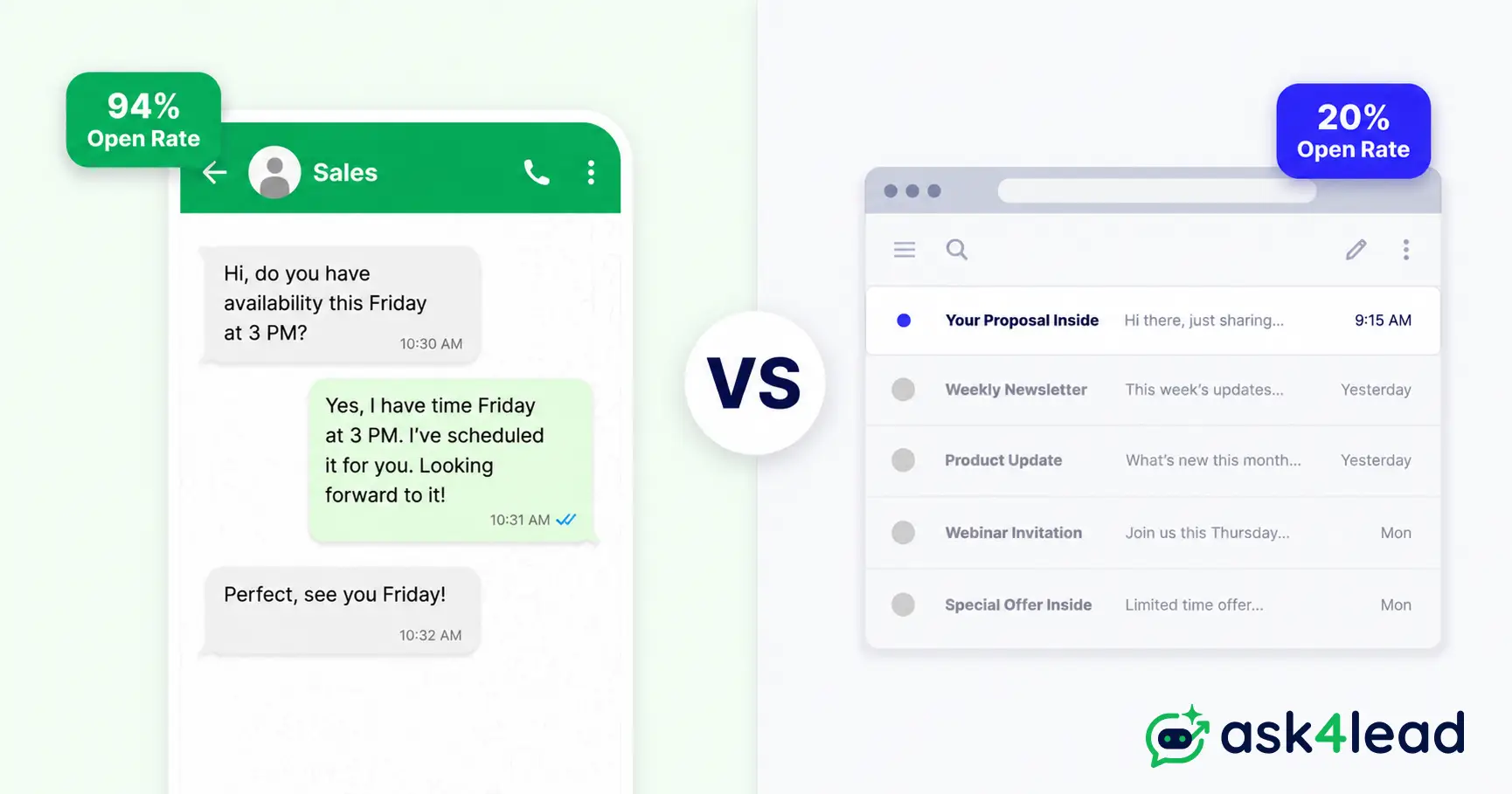
WhatsApp marketing typically beats email marketing on open rate, click-through rate, and reply speed. Email still wins on cost per send and full list ownership.
The right channel depends on what you want the recipient to do next.
Quick answer: WhatsApp converts better for urgent, time-sensitive messages. Email wins on cost and reach for newsletters and cold nurture. Past a few hundred contacts, most businesses stop picking a side.
Key Takeaways
- WhatsApp open rates run 90-98%; verified email opens sit closer to 15-25% once you strip out Apple’s auto-open inflation.
- WhatsApp’s 35-40% reply rate beats email’s 0.1-1% by roughly 400x.
- Email still returns real ROI, commonly cited near $36-42 per $1 spent.
- Region decides more than either metric: WhatsApp dominates in India, Brazil, and the Middle East; email and SMS still lead in the US.
- Businesses winning in 2026 run both channels from 1 pipeline instead of debating which one to kill.
WhatsApp Marketing and Email Marketing, Defined
WhatsApp marketing is any message sent through the WhatsApp Business Platform, Meta’s official system for business messaging at scale.
Email marketing is any message sent to a subscriber’s inbox through an email service provider. The real difference is not the words in the message. It is where that message lands.
1. What Counts as WhatsApp Marketing
WhatsApp marketing covers opt-in broadcasts sent through approved message templates, automated replies, and live agent follow-up. 2 message types drive it:
- A template message starts a conversation or reaches someone outside the 24-hour reply window.
- A session message is a free-form reply allowed inside that window, once the customer messages first.
Every recipient must opt in before you send. Skipping this is the fastest way to lose your number.
2. What Counts as Email Marketing
Email marketing covers newsletters, drip sequences, and re-engagement campaigns sent through a platform like Brevo, Mailchimp, or Klaviyo.
There is no approval step per message, and no hard length cap. That is why email still wins for anything needing paragraphs or screenshots.
WhatsApp vs. Email Marketing: The Verified 2026 Benchmark Numbers
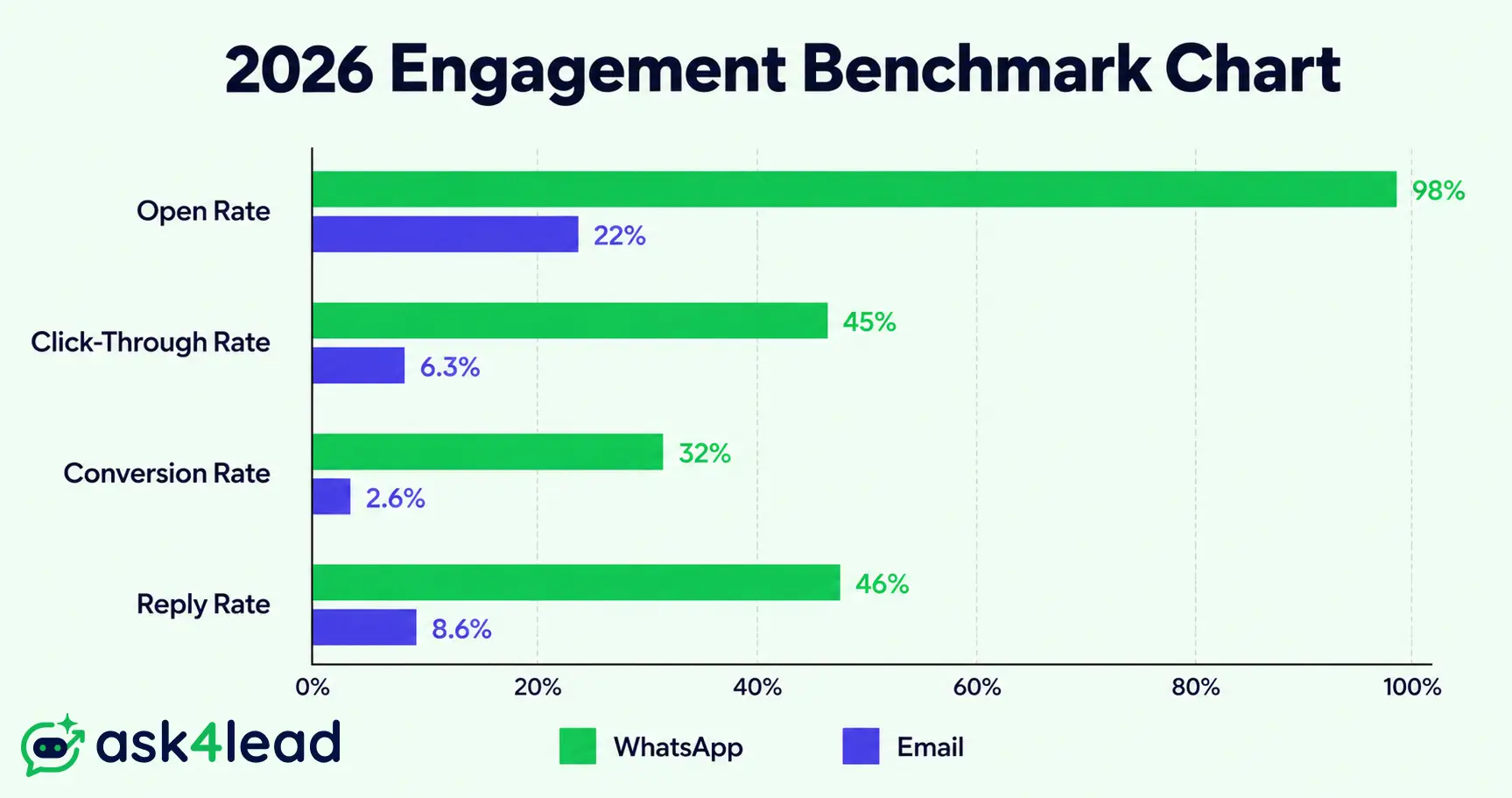
WhatsApp marketing consistently posts higher open, click, and reply rates than email. Email still returns strong ROI at a lower cost per contact.
The ranges below are reported across WhatsApp Business API providers and email platforms in 2026, not Ask4Lead’s own measured data.
| Metric | WhatsApp marketing | Email marketing |
| Open rate | 90-98% | 15-25% (verified, post-MPP) |
| Click-through rate | 45-60% | 2-5% |
| Reply / response rate | 35-40% | 0.1-1% |
| Typical conversion rate | 25-33% | 7-11% |
| Reported ROI | $85-90 per $1 spent | $36-42 per $1 spent |
| Cost driver | Per conversation, by message category | Per contact, flat regardless of sends |
1. Open Rates: Why Email’s Number Is Partly an Illusion
Here is what most comparison articles skip. Apple Mail Privacy Protection pre-loads tracking pixels for roughly half of consumer inboxes.
Raw “opened” counts in your dashboard can run 15-20 points too high because of this.
Strip that inflation out, and verified email open rates sit closer to 15-25%, not the 35-45% some platforms still report.
WhatsApp has no such distortion. A message triggers a real phone notification, the same reflex people have for texts from friends.
That real-time behavior is exactly what an AI sales assistant is built to answer inside, the moment a customer opens the thread.
2. Click-Through and Reply Rates
WhatsApp’s 45-60% click-through rate against email’s 2-5% is close to a 20x gap. A WhatsApp message competes with almost nothing else in the thread.
An email link, by contrast, competes with every other unread message in the inbox. The reply gap is even starker:
- WhatsApp is two-way by default, so a customer just types back.
- Email needs a deliberate reply action most subscribers skip, which keeps replies near 0.1-1% against WhatsApp’s 35-40%.
A better metric for email post-MPP is click-to-open rate (CTOR), which measures clicks against real opens, not inflated pixel counts.
Marketers who track CTOR inside reporting dashboards see cleaner segment data within weeks.
3. Conversion Rate and ROI, Including What Each Message Actually Costs
WhatsApp campaigns commonly convert at 25-33% for time-sensitive offers like cart recovery. Email typically lands at 7-11%.
On raw ROI, email holds up because sending it costs next to nothing at scale. WhatsApp’s cited $85-90 per $1 spent reflects higher engagement against a real per-message cost through the WhatsApp Business API.
Meta bills by conversation category: marketing, utility, authentication, and service. A marketing conversation costs meaningfully more than a routine service reply.
Reach favors email; speed favors WhatsApp.
Why WhatsApp Converts Faster
WhatsApp wins on engagement because it behaves like a conversation, not a broadcast. A customer asks a follow-up question and gets an answer in the same thread.
Compare that to an email reply, a phone call, and a support ticket, stitched across 3 separate tools.
1. The Two-Way Conversation Advantage
WhatsApp mostly replaces the “hope they open this” broadcast approach, not email as a whole.
Businesses moving abandoned-cart alerts from one-way emails to two-way WhatsApp threads routinely see stronger engagement.
The customer resolves hesitation, shipping cost, sizing, timing, right in the thread.
A shared WhatsApp inbox keeps every reply visible to your team, not buried in one rep’s phone. That visibility is what makes the advantage repeatable.
2. The Congestion Problem Nobody Talks About
Here is the part comparison articles never mention. In WhatsApp-saturated markets, the same engaged customers get promotional messages from dozens of brands every week.
Recipients hit fatigue fast, and opt-out rates climb even on lists that opted in cleanly 6 months ago. 2 mechanics tighten the squeeze:
- Meta’s messaging tier caps how many unique customers your number can message per rolling 24-hour window.
- That cap ties directly to your quality rating, which drops fast if you send to a fatigued list.
Send too often, and your tier falls before your revenue does.
3. Template Approval and Quality Rating Friction
WhatsApp is not friction-free. 3 real costs show up as you scale:
- Every marketing message outside a live conversation needs a Meta-approved template, which slows down testing new copy.
- A rejected template can stall a live campaign for days.
- Cold outreach to someone who never opted in gets flagged within days, and repeated violations risk a full account ban.
None of this rules the channel out. It means running it through a tool that manages templates and account health for you.
Why Email Still Has a Job Only It Can Do
Email earns its place because it is nearly free to send at scale, has no daily cap, and is the only channel of the 2 you fully own.
A WhatsApp number can be suspended by Meta. An email list built with real consent stays yours regardless of what any platform decides next.
1. Cost, Ownership, and No Daily Cap
Email is the better format for anything with real length:
- Newsletters and product breakdowns.
- Multi-step decision sequences.
- B2B nurture, where context matters more than speed.
One underused fact: email contact data decays at roughly 20-25% per year, as people change jobs and abandon inboxes. A stale email address at least still gives you a bounce signal you can act on.
2. Where Segmentation Beats the Channel Itself
The honest reason email looks weak in 2026 is execution, not the channel. Businesses sending segmented, behavior-triggered messages, think welcome flows and cart recovery, still see strong results.
Businesses blasting one generic promotion to an entire list every week get ignored instead. Segmented campaigns commonly report 30% more opens than unsegmented blasts sent to the same list.
That gap is bigger than most people assume, and it sits entirely within your control.
How Region and Generation Change the Winner
Geography changes which channel wins more than almost any other factor. WhatsApp is the default personal app across India, Brazil, most of Europe, and the Middle East.
In the United States, email and iMessage still tend to dominate instead.
1. Where WhatsApp Is the Default Inbox
In markets where WhatsApp is the primary inbox, people already live in it. Even a simple WhatsApp campaign reminder converts at a rate SMS or email cannot match there.
That gap shows up in search demand too. India tracks far higher volume for “whatsapp marketing” and “whatsapp crm” than the US or UK.
2. Where Email and SMS Still Lead
US audiences generally treat WhatsApp as a niche app unless they skew international or younger.
Businesses selling mainly to a US audience usually see stronger returns from email and SMS. Check where your customers actually spend their day before assuming either channel wins by default.
3. The Generational Layer Most Comparisons Skip
Region is not the only variable that matters here:
- Older customers still respond best to email and phone calls.
- Younger customers respond faster to WhatsApp, Instagram, and text, often ignoring email entirely.
| Region or audience | Dominant channel | What this means for you |
| India, Brazil, Middle East, much of Europe | Make WhatsApp a primary channel, not an add-on | |
| United States, older demographics | Email, phone calls | Lead with email; treat WhatsApp as supplemental |
| United States, younger demographics | WhatsApp, Instagram, SMS | WhatsApp outperforms email even in a US-first market |
| B2B, long sales cycles anywhere | Email first, WhatsApp for live deals | Email nurtures over weeks; WhatsApp closes once a deal is active |
Matching Each Channel to the Right Job
Channel-versus-channel is the wrong question for most businesses. The right question is which channel fits this specific message.
Route each message type to its stronger channel instead of picking one exclusively.
1. Messages That Belong on WhatsApp
Use WhatsApp for anything time-sensitive or personal:
- Abandoned-cart recovery.
- Appointment reminders and order updates.
- Live back-and-forth with a lead ready to buy.
A customer benefits from replying in the same thread rather than clicking through to a site.
2. Messages That Belong on Email
Use email for newsletters, onboarding sequences, and anything a subscriber might reread later. Email stays the safer choice for cold outreach too.
Messaging someone who has not opted into WhatsApp risks a blocked number. A permission-based email list carries no equivalent penalty.
3. The Behavior-Trigger Framework Practitioners Actually Use
Most guides stop at “segment your list.” Practitioners who manage large lead pipelines route by observed behavior instead of static tags:
- Opens 2-3 emails in a week → move to WhatsApp for a live follow-up, not another email.
- Clicks pricing or a product twice → trigger a same-day WhatsApp check-in.
- Ignores every channel for 90 days → drop to a lower-frequency email touch; never add WhatsApp volume to a cold contact.
- Replies on WhatsApp once → keep that thread on WhatsApp going forward instead of falling back to email out of habit.
| Use case | Better channel | Why |
| Abandoned cart recovery | Higher open and reply rate recovers carts faster | |
| Appointment or booking reminder | Time-sensitive, needs to be seen within the hour | |
| Newsletter or long-form content | No length limit, easy to save and reread | |
| Cold lead nurture, no opt-in yet | No blocking risk, lower-pressure first touch | |
| Live sales conversation with a warm lead | Two-way, immediate, closes faster | |
| Onboarding sequence for new customers | Multi-step, detailed, works over days | |
| Post-purchase support and re-engagement | Both | Email for detail, WhatsApp for urgent issues |
The Compliance and Cost Layer Most Comparisons Skip
Every “which converts better” article compares metrics. Almost none compare what each channel requires you to prove before you send.
That gap matters more every year as data-privacy enforcement grows.
1. Consent and Data Privacy Rules for Each Channel
The 2 channels handle consent very differently:
- WhatsApp requires explicit opt-in consent before any marketing message, enforced directly by Meta at the platform level.
- Email sits under regional law instead: GDPR in the EU, CAN-SPAM in the US, and India’s DPDP Act for any business handling Indian customer data.
Neither channel is automatically safer. WhatsApp bakes consent into the platform; email leaves consent tracking up to you and your provider.
2. What Each Message Actually Costs You
WhatsApp bills by conversation category, so a marketing message costs more than a routine account-status reply. Pricing has shifted more than once in the past year.
Email bills by list size regardless of send volume, which keeps it cheaper at very large contact counts, even though it converts at a lower rate per message.
Running Both Channels Without Losing Context
Most of the frustration people report with either channel traces back to a handful of mistakes, not the channel itself.
1. The Mistakes That Kill Conversion on Either Channel
- Blasting WhatsApp like a newsletter. The same promotion, sent to your whole list every few days, gets reported and blocked.
- Sending 1 generic email to everyone. An unsegmented weekly blast produces the lowest open rates in the range above, then gets blamed on the channel instead of the segmentation gap.
- No shared record between the 2 channels. When WhatsApp lives on a rep’s phone and email lives in a separate tool, the next message repeats what was said or misses the context entirely.
2. A Practitioner Workflow for Routing Messages
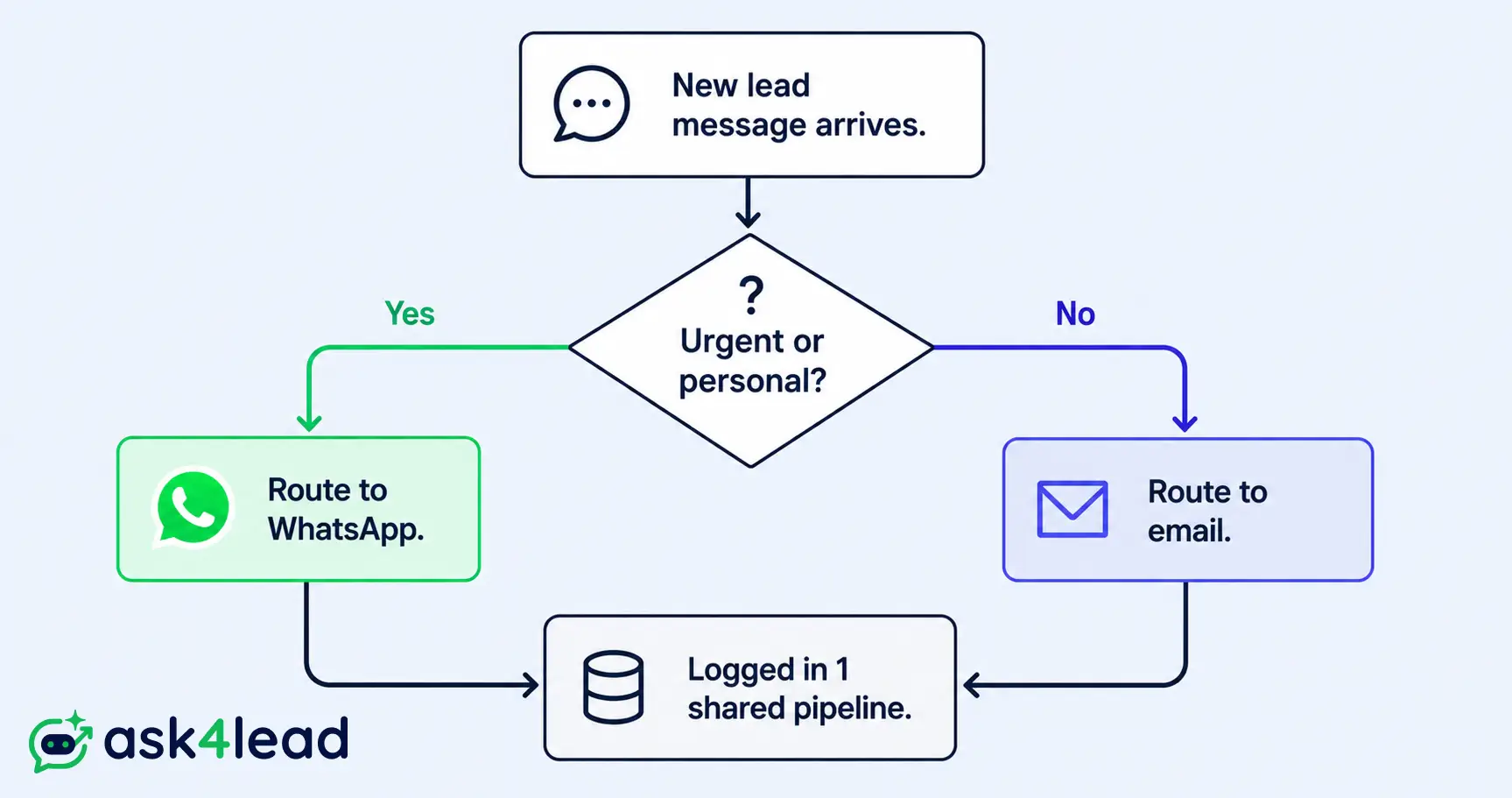
The fix for all 3 mistakes is the same. Route by intent, and keep both channels tied to 1 pipeline instead of 2 disconnected tools.
- Capture how the lead first reached you, and log the channel preference against that lead’s record.
- Route by urgency: time-sensitive goes to WhatsApp, long-form or early-funnel goes to email.
- Keep every touch, on either channel, inside 1 shared pipeline, so tomorrow’s follow-up sees the full history.
3. Try This Workflow With Ask4Lead
Ask4Lead runs both halves of that workflow from 1 workspace, instead of forcing you to stitch a WhatsApp tool to a separate email platform.
Its WhatsApp campaigns handle the urgent side with an AI that asks what the customer actually needs, not a button menu. Its AI email campaigns handle the nurture side.
Both feed the same 9-stage sales pipeline, so nothing gets lost between channels.
Sign up free for 100 AI credits and route your first lead through both channels from 1 place, or browse the full features list first.
FAQs
1. Is WhatsApp marketing more effective than email marketing?
For urgent or transactional messages, yes. WhatsApp typically posts higher open, click-through, and reply rates than email.
2. Does WhatsApp marketing replace email marketing?
No. WhatsApp mostly replaces the one-way “hope they open it” broadcast approach, not email as a whole.
3. What is a good WhatsApp marketing open rate?
Industry benchmarks put a healthy WhatsApp open rate at 90-98%. A lower rate usually means an opted-out list or a throttled account health score.
4. Is email marketing dead in 2026?
No. Generic, unsegmented blasts are largely dead; email itself is not. Segmented email still returns strong ROI, near $36-42 per $1 spent.
5. Can I run WhatsApp and email marketing from 1 CRM?
Yes. Platforms built for both, including Ask4Lead’s multi-tenant CRM workspace, send both from the same workspace and log every reply against 1 record.
6. How much does WhatsApp marketing cost compared to email?
WhatsApp bills per conversation category, so cost scales with volume and type. Email typically bills per contact regardless of send volume.
7. Do I need separate consent for WhatsApp marketing and email marketing?
Yes. WhatsApp opt-in and email opt-in are tracked separately, even for the same customer.
Conclusion
WhatsApp marketing wins on speed, verified open rates, and two-way engagement. Email marketing wins on cost per send, message length, and full ownership of the list.
Neither answer holds up as a blanket rule once you look at the actual use case in front of you. The businesses seeing the best results in 2026 are not picking a side.
They route abandoned carts, reminders, and live deals to WhatsApp. They keep newsletters and cold nurture on email, and track both inside 1 shared work queue, so context never gets lost between them.
Stop guessing which channel a lead should get. Sign up free for 100 AI credits and run your first WhatsApp and email workflow from one pipeline today.
No card required, and every reply lands in the same record your team already works from.
