
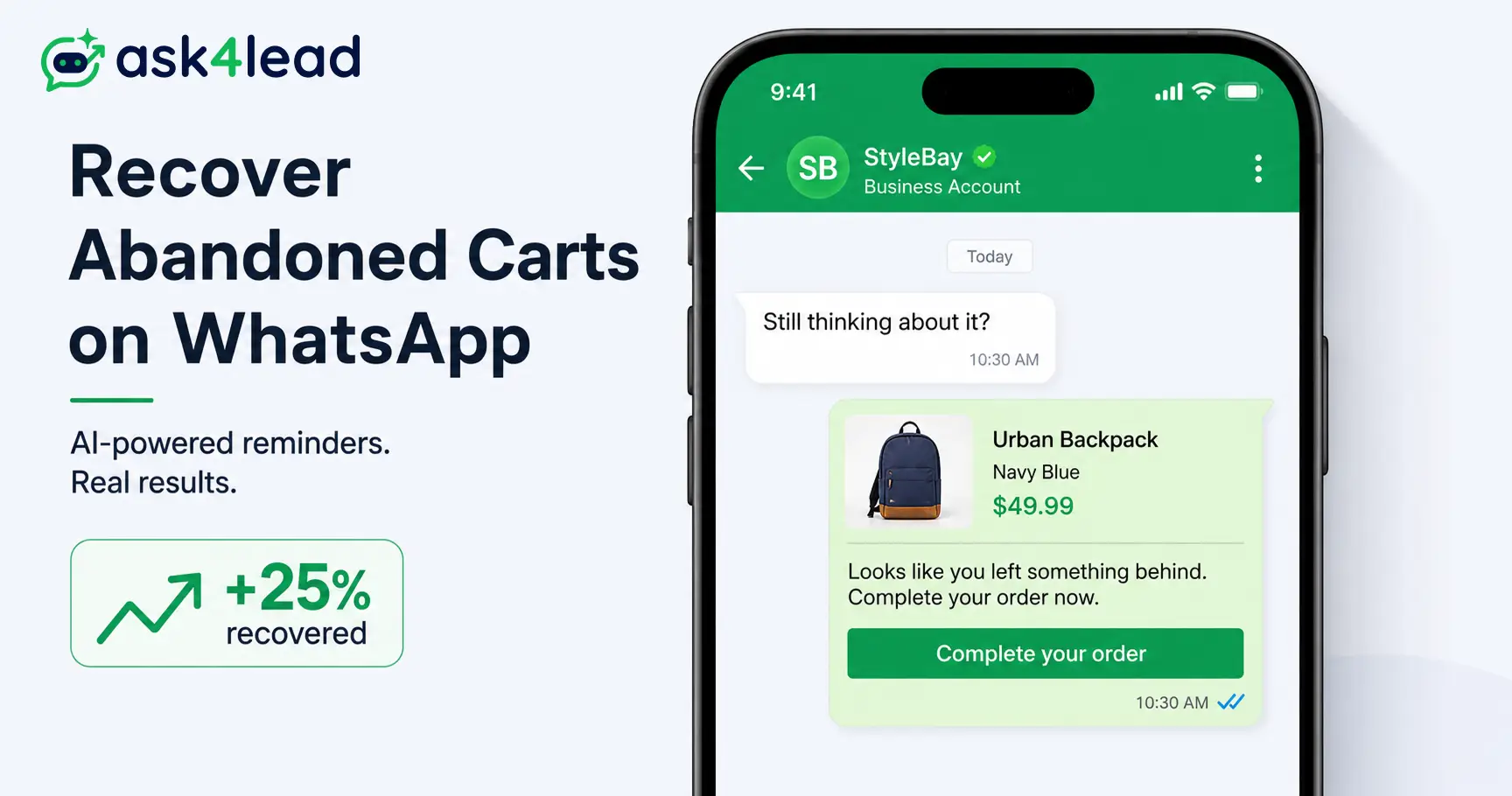
Quick answer: WhatsApp abandoned cart recovery means messaging a shopper on WhatsApp after they add products to a cart and leave without paying. It uses the WhatsApp Business Platform to pull them back to checkout.
For D2C (direct-to-consumer) brands, it recovers more carts per message than email, but only when phone-number capture, consent, timing, and message design are all handled correctly.
Key Takeaways
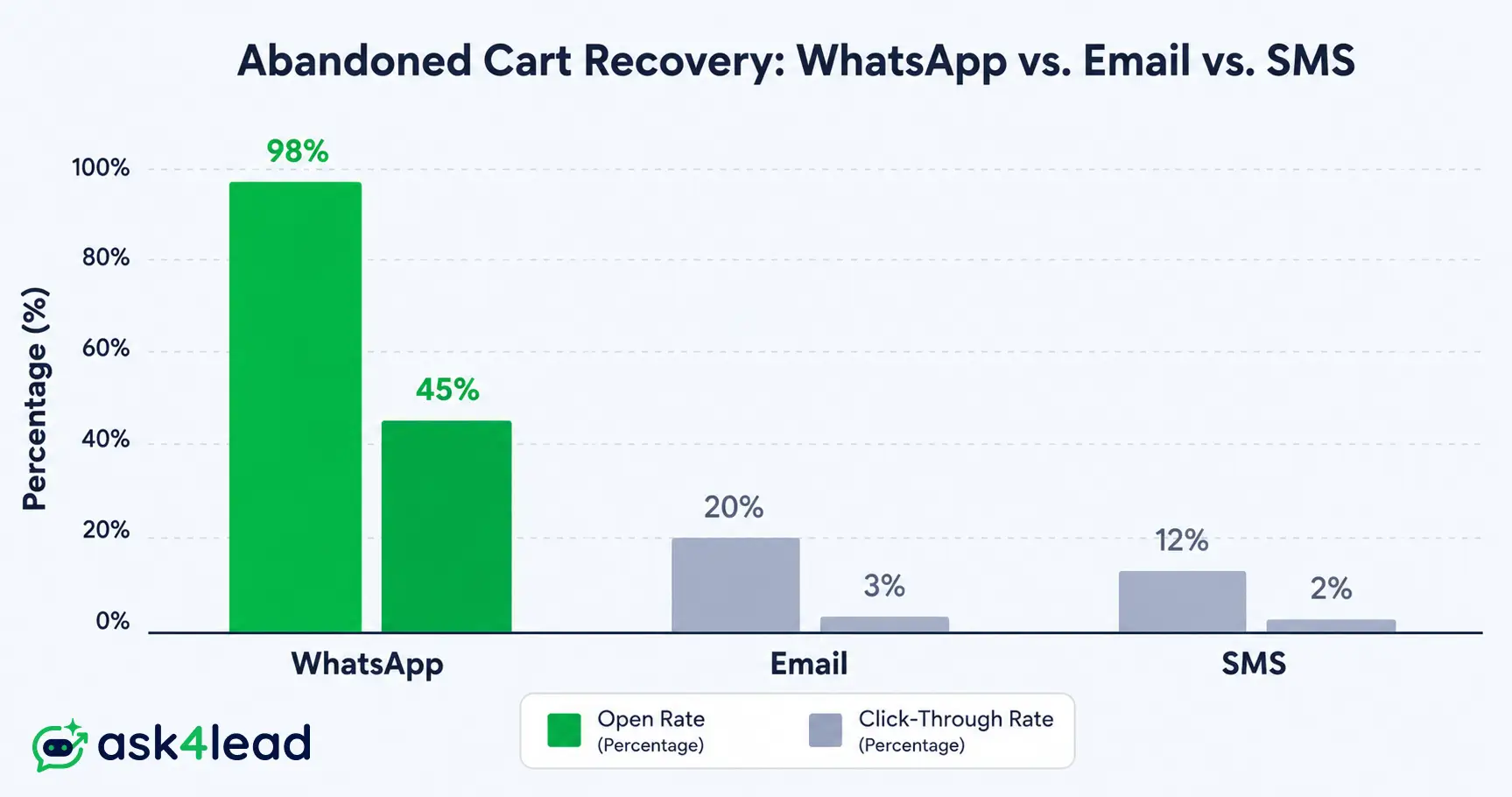
- WhatsApp open rates sit around 98%, against roughly 20% for email, but that gap only pays off if the shopper opted in first.
- A single 3-message flow, spread across roughly 72 hours, beats longer sequences and is far easier to manage than several disconnected flows.
- Meta bills per delivered template message since July 1, 2025, not per conversation, and the category you pick changes the cost.
- WhatsApp’s in-app browser can strip cart data from your links, quietly killing recovery campaigns that look healthy on paper.
- Cash-on-delivery carts and return-to-origin failures respond to WhatsApp differently than prepaid carts, and most playbooks skip this entirely.
- Some cart-recovery vendors send messages from a shared, pooled WhatsApp number, a real account-risk most guides never mention.
What Is WhatsApp Abandoned Cart Recovery?
WhatsApp abandoned cart recovery is a message sent through the WhatsApp Business Platform to a shopper who added an item to their cart and left without paying. The message links straight back to that cart.
It works because WhatsApp messages get opened fast. Data compiled by Infobip puts WhatsApp’s open rate at roughly 98%, against an email open rate closer to 20%.
That gap matters at scale. Baymard Institute’s ongoing research puts the average online cart abandonment rate at 70.22% across 50 studies, rising past 80% on mobile, where most WhatsApp shoppers browse.
1. Cart Abandonment vs. Checkout Abandonment vs. Browse Abandonment
These 3 terms get used interchangeably. That causes real confusion when you’re deciding which flow to build first.
- Cart abandonment: a product was added to the cart, but checkout never started.
- Checkout abandonment: the shopper entered checkout, sometimes even payment details, then stopped.
- Browse abandonment: the shopper viewed a product but never added it to a cart.
Checkout abandonment converts best, since the shopper was closest to buying. Browse abandonment needs a softer, product-led message, not a “complete your order” nudge.
2. Why This Matters More for D2C Brands Specifically
D2C brands run on thinner margin per order than large retailers. A recovered cart moves the bottom line more.
D2C traffic also skews mobile and social-first, exactly where WhatsApp-native shoppers already are. A WhatsApp AI agent built for e-commerce sits directly inside that traffic pattern, no channel switch required.
Why WhatsApp Outperforms Email and SMS for Cart Recovery
WhatsApp wins on speed and attention, not because email is broken. A shopper who leaves your store still has the product open in a mental tab.
Email waits for them to check an inbox. WhatsApp interrupts a screen they open dozens of times a day.
1. The Real Numbers, Compared Side by Side
Published figures vary by vendor. Treat any single “X% better than email” claim with caution, and use the honest range below instead.
| Metric | SMS | ||
| Average open rate | ~98% (Infobip) | ~20-21% | ~95%, but low read-through |
| Median time to read | Under 5 minutes | Hours to days | Minutes, often ignored |
| Typical click-through | 20-60% | 2-5% | 5-10% |
| Reported cart recovery rate | 10-25% of messaged carts | 2-10% of messaged carts | 5-15% of messaged carts |
| Consent requirement | Opt-in mandatory, enforced by Meta | Opt-in recommended, enforced by law | Opt-in mandatory in most regions |
Your real recovery rate rides on average order value, message relevance, and whether you’re solving a real objection instead of nagging. A vendor’s “21x ROI” case study reflects their best customer, not a guarantee for yours.
2. Where WhatsApp Underperforms
WhatsApp cart recovery does worse than email in specific, avoidable situations:
- The shopper never opted in, so the message reads as spam.
- Every message pushes a discount instead of answering a real hesitation.
- The brand sends 4 or 5 messages regardless of engagement, training shoppers to block the number.
- The audience genuinely doesn’t shop over WhatsApp.
If your checkout opt-in rate sits under 15-20%, fix that first. A well-built sequence sent to almost nobody won’t move revenue.
3. The Markets Where It Works, and the Market Where It Doesn’t
WhatsApp cart recovery performs strongly across most of the world:
- India, the Gulf, and North Africa
- Much of Latin America
- The UK, the EU, and Australia
The major exception is the United States, where iMessage and SMS still dominate day-to-day messaging habits. WhatsApp still has over 100 million monthly US users, so treat it as a secondary layer there, not the primary recovery channel.
Before You Automate Anything: Capture the Phone Number and the Consent
Most WhatsApp cart recovery guides start at the message itself. The real first problem happens earlier, and almost nobody writes about it.
1. Why WhatsApp Recovery Fails Before It Starts
Email-based cart recovery works because most checkout flows already collect an email address early. WhatsApp recovery needs a phone number instead.
If your store only asks for a phone number at the very last step of checkout, you have nothing to message once the shopper leaves before reaching that field. Move phone-number capture earlier in the funnel, right alongside email, not buried at the final payment screen.
2. Getting Compliant Opt-In at Checkout
WhatsApp opt-in and consent rules exist for a reason: Meta enforces them at the platform level, not as a legal nicety.
- Add an explicit, unticked checkbox or a “message me on WhatsApp” button, separate from your email opt-in.
- State plainly what the shopper is agreeing to: order updates, and occasional cart reminders if relevant.
- Never pre-check the box, and never fold WhatsApp consent into a general “I agree to terms” checkbox.
- For EU or UK shoppers, keep the consent wording specific enough to satisfy GDPR’s purpose-limitation rule.
3. The One-Click Opt-Out You Can’t Skip
Every recovery message needs an obvious way to stop future messages. A single reply like “STOP,” or a tap-to-opt-out button, is enough.
A shopper who can’t easily opt out reports your number instead. That damages deliverability for every future send, not just to them.
The Message Categories and the Approval Rules Meta Enforces
This is the section most cart-recovery guides skip, and it’s the one that gets accounts flagged.
1. Marketing, Utility, and Authentication Templates Explained
Every WhatsApp template message sent outside an active conversation falls into 1 of 3 categories:
- Marketing: promotional content, including most cart nudges and discount offers. Highest cost, and the wording gets reviewed most carefully.
- Utility: transactional, expected communication, such as a reminder that a saved cart is still available. Cheaper than Marketing.
- Authentication: one-time passcodes only, not relevant to cart recovery.
A first “your cart is waiting” nudge usually needs a Marketing template. A stock or price-confirmation follow-up can often qualify as Utility instead.
2. What Happens When Meta Rejects Your Template
Template rejections are common on first submission. The usual cause: wording that sounds too promotional for a Utility category, or a variable Meta can’t verify.
Build templates with generic, reusable wording. Submit days before you need the sequence live, not the same afternoon.
3. The Free Customer-Service Window Almost Nobody Uses
Here’s a detail most cart-recovery articles miss entirely. Under WhatsApp’s 24-hour session rule, when a customer messages your business first, that opens a free customer-service window.
Any reply you send inside that window, including a cart nudge, costs nothing and skips template approval. Routing more shoppers into starting the conversation themselves cuts both cost and approval friction at once.
The Recovery Sequence That Converts
Skip the temptation to send 5 or 6 messages over a week. A single flow with 3 well-timed messages consistently outperforms a longer sequence.
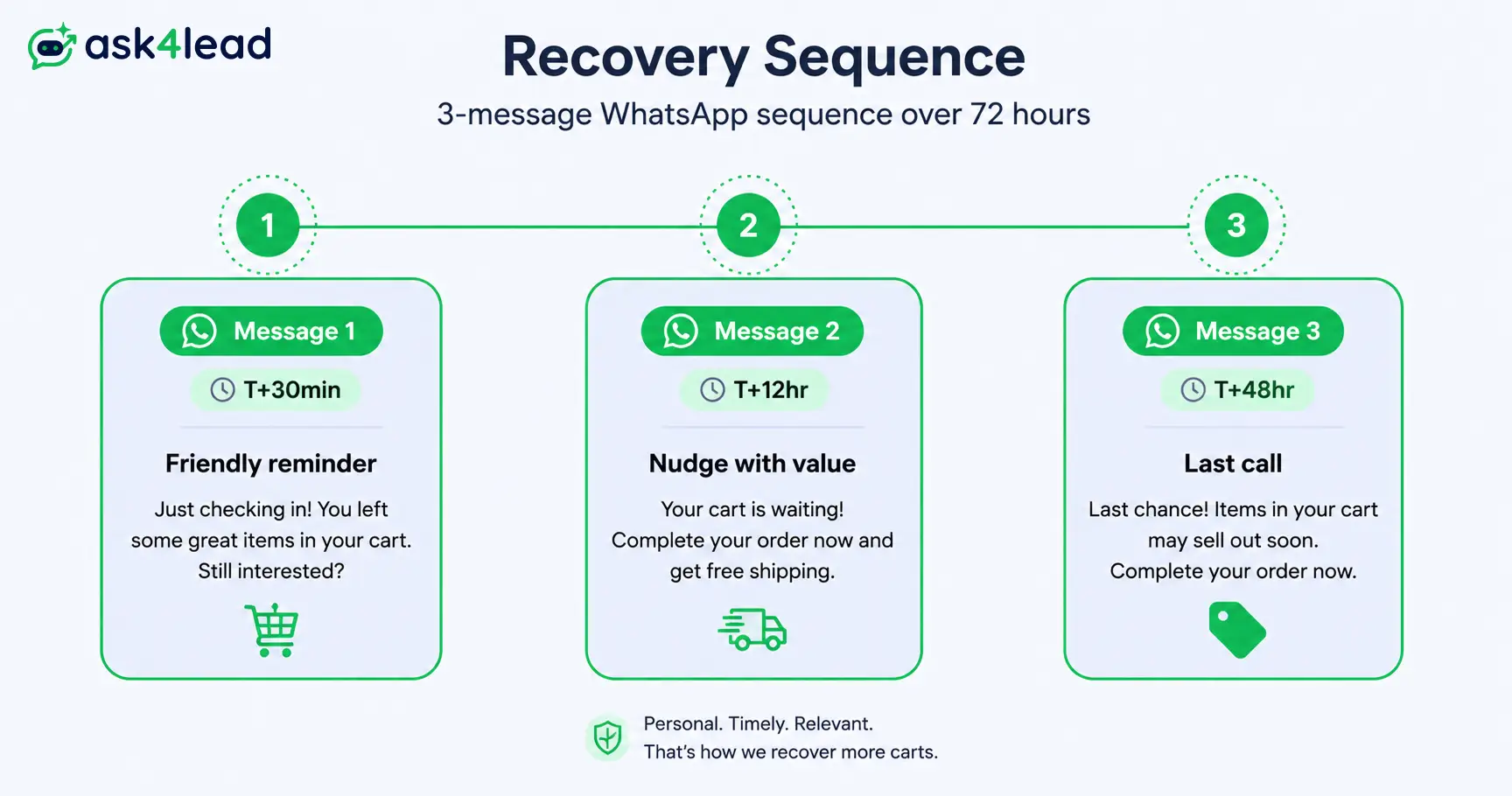
Published timing benchmarks vary across vendors, so here’s the synthesized range instead of one vendor’s specific claim:
| Message | Typical timing range | Purpose | Discount? |
| 1. The reminder | 15 minutes to 1 hour after abandonment | Plain nudge with the cart link | No |
| 2. The objection-handler | 4 to 24 hours later, only if message 1 wasn’t clicked | Answers shipping, delivery, sizing, or payment concerns | No |
| 3. The incentive | 24 to 72 hours later, only if still unconverted | Small, time-boxed discount or free shipping | Yes, capped |
1. Message 1: The Reminder
- Timing: 15 to 60 minutes after abandonment, before the moment fades.
- Content: product image, item name, direct cart link. Nothing else.
- Discount: none. Never lead with one.
2. Message 2: The Objection-Handler and Social Proof
- Timing: 4 to 24 hours later.
- Content: answer the real hesitation, shipping cost, delivery time, sizing, or a review that resolves doubt.
- Cash-on-delivery markets: fold a payment-method confirmation line into this message, since payment friction, not price, drives most drop-off there.
3. Message 3: The Capped Incentive
- Timing: 24 to 72 hours later, only if messages 1 and 2 were ignored.
- Content: a small, time-boxed discount or free shipping, clearly capped.
- Why last: leading with a discount trains shoppers to abandon carts on purpose and wait for the coupon.
4. 1 Flow or 3 Separate Flows?
Build this as a single automation with 3 delayed steps and 1 exit condition, purchase completed. Not 3 disconnected flows.
A single flow wins on 3 counts:
- Easier to manage as your catalog and offers change.
- No duplicate sends if the shopper converts mid-sequence.
- 1 clean set of numbers to measure, instead of 3 fragmented ones.
Wire it to a shared WhatsApp inbox so a rep can jump in manually on a high-value cart instead of letting the automation run blind.
Message Templates That Convert
Generic “still interested?” messages underperform. Here are 3 starting templates, one per stage, meant to be adapted, not copied word for word.
1. A No-Discount Reminder Template
Hi {FirstName}, you left {ProductName} in your cart. Here’s your cart, exactly where you left it: {CartLink}
2. An Objection-Handling Template
Still deciding on {ProductName}? Free shipping over {Threshold}, and {DeliveryTime} delivery to {City}. Any questions before you check out? Just reply here.
3. A Capped-Incentive Template
Your {ProductName} is still saved. Use {DiscountCode} for {DiscountAmount} off, valid for the next {TimeWindow} only: {CartLink}
Pair these with a synced WhatsApp product catalog, so the item shown in chat matches the real product image and price, not a placeholder.
The Silent Link Killer: Why Recovery Links Fail After the Open
A message with a 98% open rate is worthless if the link inside it doesn’t restore the shopper’s actual cart. This is a documented technical problem, not a theoretical one.
1. How WhatsApp’s In-App Browser Strips Your Checkout Session
When a shopper taps a link inside WhatsApp, it usually opens in WhatsApp’s own built-in browser, not their phone’s default Chrome or Safari. That built-in browser can strip cart parameters and tracking tags.
The result: the shopper lands on a generic homepage instead of their actual cart, and your attribution data disappears with it.
2. Fixing the Handoff Back to the Shopper’s Native Browser
Test every recovery link the way a real customer experiences it, tapped from inside WhatsApp on a phone, not previewed on a desktop.
- Confirm cart data survives the tap on both Android and iOS.
- If cart data disappears, route the link through a deep-linking layer built for this exact handoff.
- Re-test after every storefront theme or checkout update, since this breaks silently.
The Shared-Number Trap: A Compliance Risk Most Guides Never Mention
Some cart-recovery apps send messages from a single shared WhatsApp number used across many client stores at once, not a number verified specifically for your business.
1. How a Shared WhatsApp Number Puts Your Account at Risk
If another store on that same shared number gets flagged for spam, your messaging quality rating can drop too, even though you did nothing wrong.
Some tools also let vendors edit an already-approved template’s wording per client without resubmitting it to Meta. That risks the whole number getting suspended for policy drift nobody at your company approved.
2. What to Verify Before You Connect a Recovery Tool
- Confirm the tool onboards you through Meta’s official Embedded Signup, giving you your own dedicated verified number.
- Confirm template changes route through your own Meta Business Manager, not a shared backend.
- Ask directly whether your number is pooled with other businesses, and check how automation bans actually happen before you connect anything.
Cash on Delivery and Return-to-Origin: The Angle Most Guides Skip
Cash-on-delivery carts and prepaid carts abandon for different reasons. Most cart-recovery playbooks still treat every cart the same way.
1. Why COD Carts Abandon Differently
- A prepaid shopper who abandons is usually still deciding on the product itself.
- A cash-on-delivery shopper who abandons is more often reacting to payment friction, or doubt about whether the order is even real.
That second case needs a trust-building message, not a discount.
2. Using the Same Thread to Cut Return-to-Origin
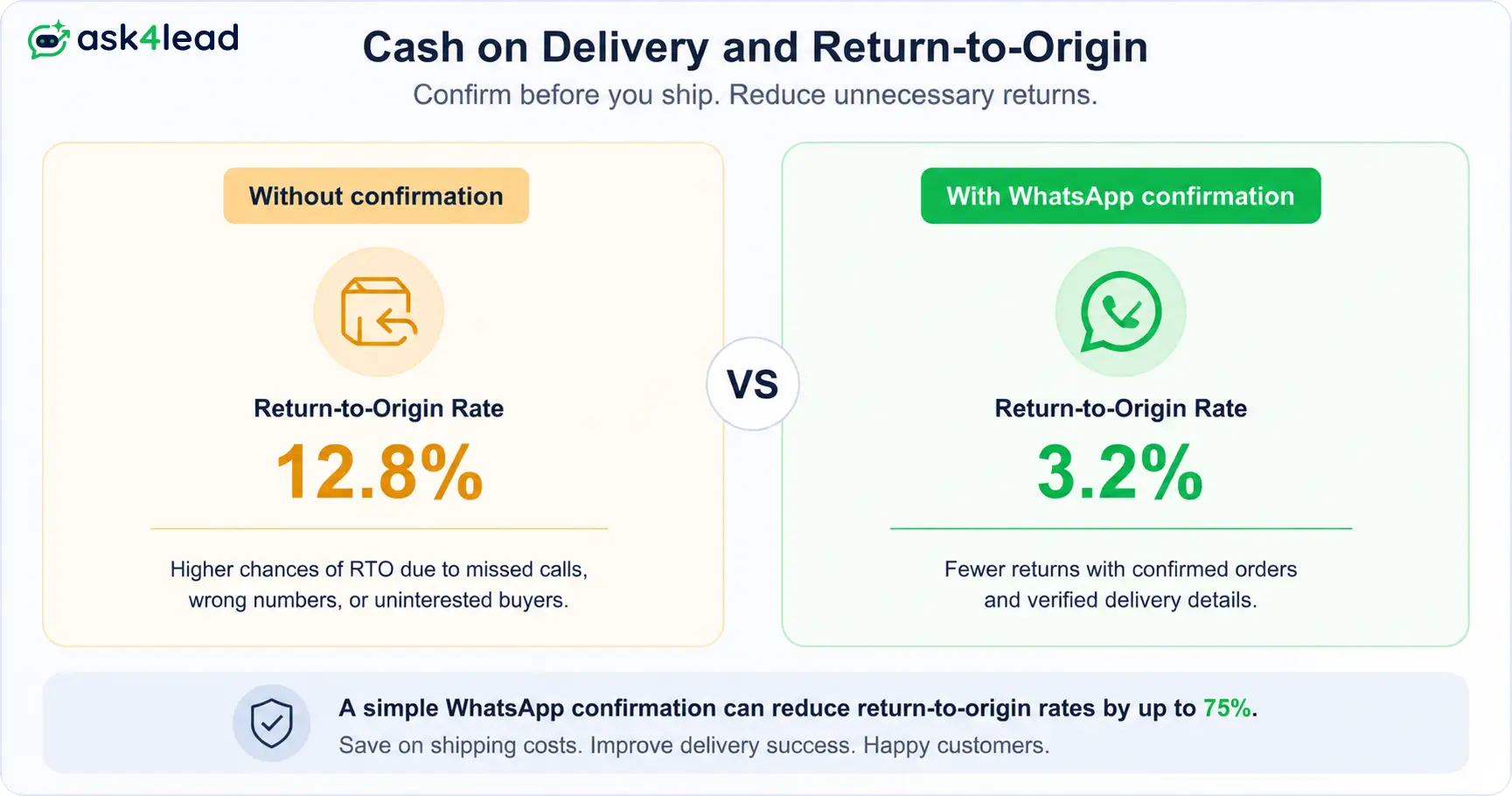
Sending a WhatsApp confirmation shortly after a COD order is placed, asking the shopper to tap “confirm,” catches unintentional or low-intent orders before they ship. Multiple industry-reported figures put meaningful return-to-origin reductions in the 15-25% range when instant confirmation and a pre-delivery reminder run together.
A brand shipping 1,000 COD orders a month at a 30% return-to-origin rate loses roughly 300 failed deliveries. Cutting that rate by even 15 percentage points recovers about 150 orders a month, before any cart-recovery revenue is counted.
What WhatsApp Cart Recovery Really Costs in 2026
WhatsApp cart recovery is not free, and the pricing model changed in a way most 2026 guides still get wrong.
1. How Per-Message Pricing Works Today
- Before July 1, 2025: Meta billed per 24-hour conversation window. A Marketing template plus several Utility follow-ups in the same day cost 1 flat fee.
- Since July 1, 2025: Meta bills per delivered template message, priced by category and the recipient’s country code, individually.
- Always free: replies sent inside an open customer-service window, including the free window covered above.
2. A Simple ROI Check That Doesn’t Double-Count Recovered Revenue
Run the math on your own numbers before committing budget:
- Average order value of a typical abandoned cart.
- Your current email-only recovery rate, usually 2-10% of abandoned carts.
- The realistic uplift WhatsApp adds on top, once opt-in rate and message cost are accounted for.
- The per-message cost for your country, pulled from Meta’s current rate card.
A worked example, at 1,000 abandoned carts a month, $30 average order value:
- Email alone recovers 5%, or 50 orders.
- A well-run WhatsApp sequence, layered on top for opted-in shoppers, typically adds 10-15 more percentage points.
- That’s roughly 100-150 extra recovered orders a month, or $3,000-4,500 in incremental revenue, before subtracting messaging cost.
Watch for 1 mistake that inflates this math: if a customer converts after both an email and a WhatsApp nudge land in the same window, don’t credit the sale to both channels. An AI dashboard that tracks revenue per cart, not just messages sent, catches this automatically.
Matching the Channel to the Cart
Not every abandoned cart deserves the same channel. Base the decision on cart value and region, not a single blanket rule.
1. When WhatsApp Is the Right First Move
Use WhatsApp first for opted-in shoppers in WhatsApp-native markets, and for mid-value carts where a fast, low-friction nudge is enough. Pair it with click-to-WhatsApp ads upstream, so shoppers arrive already inside a WhatsApp thread.
2. When an AI Voice Call Earns the Risk
A WhatsApp message is a nudge; a phone call is a demand for full attention. Reserve calls for:
- Genuinely high-value carts.
- A declined or failed payment worth investigating.
- A custom quote that likely needs a real question answered.
Never use a call as the default channel for every abandonment.
3. When WhatsApp Isn’t Worth Building at All
If your average order value is very low, and your opt-in rate stays weak even after fixing checkbox placement, the messaging cost may not clear the recovered revenue. Some brands are genuinely better off putting that budget into retargeting ads instead.
Run the ROI check above honestly before you build the full sequence.
Choosing a Tool for WhatsApp Cart Recovery
Most WhatsApp cart recovery tools fall into 2 categories. Picking the wrong one for your stage costs you either flexibility or reliability.
1. Single-Purpose Apps vs. a Full WhatsApp CRM
| Tool type | Best for | Limitation |
| Single-purpose Shopify or WooCommerce cart-recovery apps | Stores that only need cart nudges, nothing else | Recovery lives separate from support and your sales pipeline; reps lose context |
| Full WhatsApp CRM with AI | Stores that want recovery, support, and follow-up unified with a real sales team | More setup up front than a single-purpose app |
2. What to Verify Before You Commit
- Onboards you with your own verified number, not a shared one.
- Lets you approve message templates without needing a developer.
- Shows which carts actually converted, not just which messages sent.
- Runs as a WhatsApp AI agent that holds a real conversation, not a button-only chatbot menu.
3. Common Mistakes That Undo a Good Tool Choice
- Sending all 3 sequence messages regardless of whether the customer already converted.
- Leading every message with a discount instead of solving a real objection.
- Never testing the recovery link from inside WhatsApp on a real phone.
- Treating every abandoned cart the same, regardless of value or payment method.
- Choosing a tool without confirming who owns the WhatsApp number behind it.
4. Where Ask4Lead Fits
This is where Ask4Lead differs from a single-purpose recovery app:
- Its AI Sales Assistant reads what a shopper actually types back, a shipping question or a size query, and answers in a real sentence instead of a dead end.
- Every recovered lead lands in a 9-stage sales pipeline with the shopper’s actual question attached.
- Your team keeps human-approval-before-send control over what the AI sends on a high-value cart.
Set up your first WhatsApp cart recovery sequence in an afternoon, with a real conversation engine handling the replies a template-only tool can’t.
FAQs
1. What is WhatsApp abandoned cart recovery?
A WhatsApp message sent to a shopper who added items to a cart and left without paying, using the WhatsApp Business Platform to bring them back to checkout.
2. Do I need customer consent before sending WhatsApp cart recovery messages?
Yes. Meta requires explicit opt-in before you can message a customer with a template outside an active conversation. EU or UK shoppers need consent language specific enough to satisfy GDPR.
3. How much does WhatsApp abandoned cart recovery cost?
Since July 1, 2025, Meta bills per delivered template message, based on category and the recipient’s country. Replies inside a free customer-service window cost nothing.
4. How many WhatsApp messages should I send before giving up on a cart?
3 is the practical ceiling for most D2C brands, spread over roughly 72 hours. More messages usually damage your opt-out rate faster than they add recovered carts.
5. Does WhatsApp cart recovery work in the United States?
It works, but as a secondary channel. WhatsApp has over 100 million monthly US users, but SMS and iMessage remain the primary channels most US shoppers expect.
6. What’s the difference between cart abandonment and browse abandonment?
Cart abandonment means a product was added to the cart. Browse abandonment means the shopper viewed a product but never added it, and needs a softer message.
7. Should I use a phone call instead of WhatsApp for high-value carts?
Reserve calls for genuinely high-value carts, failed payments, or custom quotes. A call demands more attention than a message, so it recovers more when it works and does more damage when it doesn’t.
8. How do I avoid getting my WhatsApp number banned?
Confirm your recovery tool uses your own verified number through Meta’s Embedded Signup, keep your opt-out process simple, and never exceed the 3-message sequence for an unengaged shopper.
Conclusion
WhatsApp abandoned cart recovery works when you treat it as a real messaging channel with real rules, not a free replacement for email. Capture the phone number early, get consent right, and keep the sequence to 3 well-timed messages.
Fix the link-handoff bug before you scale. Watch for the shared-number and double-counting traps most guides never mention.
Do that, and WhatsApp becomes the channel that catches the shoppers email never reaches: the ones reading their phone within minutes of leaving your store.
