
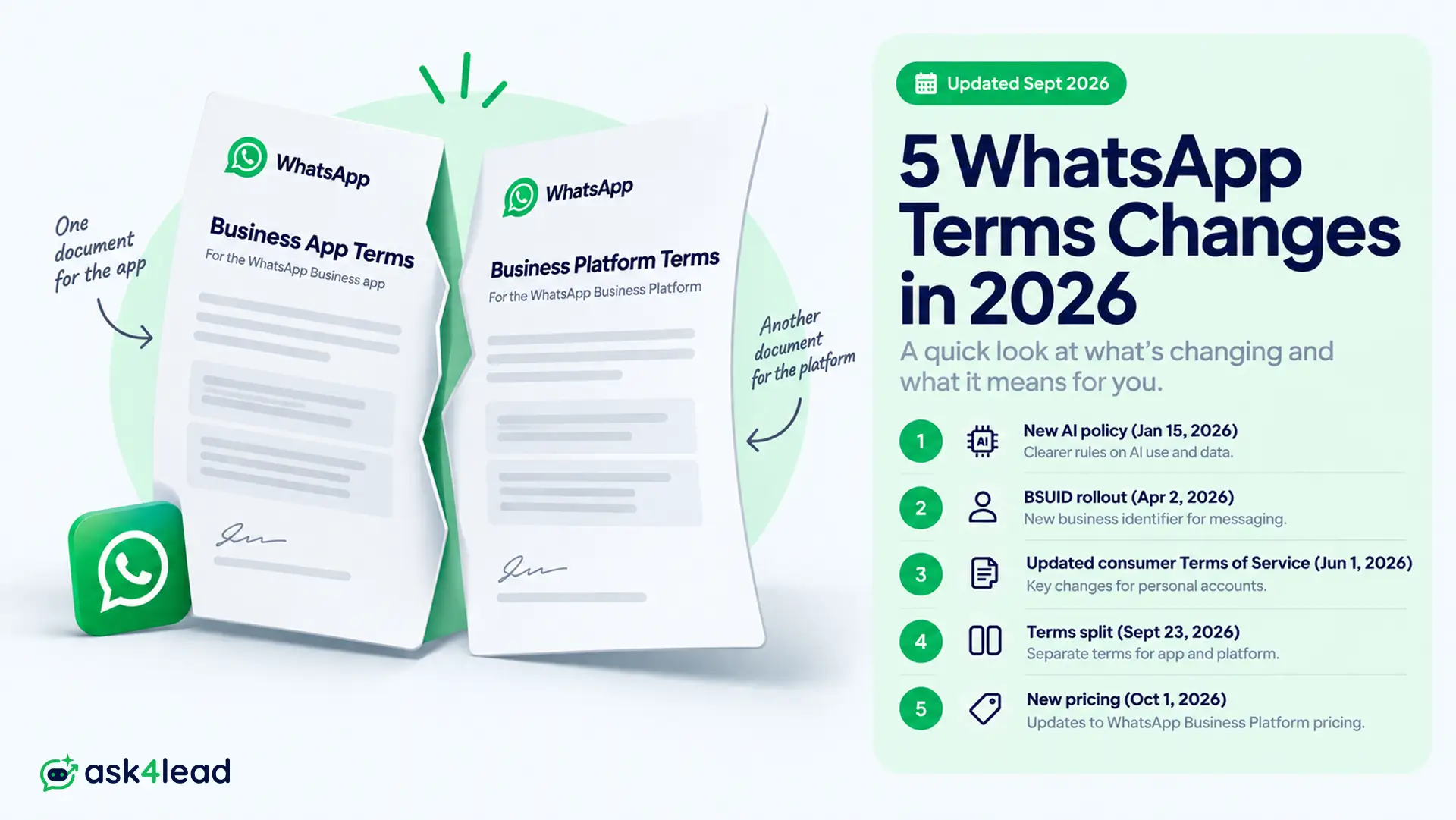
Quick answer: WhatsApp’s “new terms and conditions” in 2026 is not one document. It is five separate changes across two rulebooks: the consumer app’s Terms of Service, and the WhatsApp Business Platform Terms, Meta’s contract for the WhatsApp Business API.
The newest change lands September 23, 2026. Meta splits its combined Business Terms into two documents: one for the free WhatsApp Business App, one for the WhatsApp Business Platform.
Nothing about how the app works changes, only the paperwork behind it.
Key takeaways
- Five separate 2026 changes get lumped together as “WhatsApp’s new terms.” Confusing them leads to the wrong response.
- Sept 23, 2026: Business Terms split into two documents. No functional or privacy change.
- June 1, 2026: The consumer app now blocks the chat list until you accept its Terms of Service.
- April 2, 2026: Contact Book and Business-Scoped User IDs (BSUID) arrive. Phone numbers are not disappearing.
- January 15, 2026: General-purpose AI chatbots are banned on the Business Platform. Task-specific AI is fine.
- October 1, 2026: Free-text service replies start being billed per message.
What Actually Changed in WhatsApp’s Terms This Year
A search for this topic mixes five unrelated stories together, each with its own effective date:
- A consumer chat app prompt
- A legal document split
- A developer changelog
- A content policy
- A pricing page
The Two Rulebooks Getting Confused as One
WhatsApp runs on two separate contracts:
- Consumer Terms of Service: What a regular person accepts on their phone.
- WhatsApp Business Terms: From September 23, 2026, this splits into a Business App document and a separate Business Platform document.
“Why does WhatsApp keep asking me to accept terms” and “WhatsApp Business API terms update” are two different contracts, not one confusing document.
Ask4Lead’s WhatsApp vs WhatsApp Business App vs WhatsApp Business API guide breaks down which product you’re actually asking about.
Every 2026 Change at a Glance
| Change | Effective date | Who it affects |
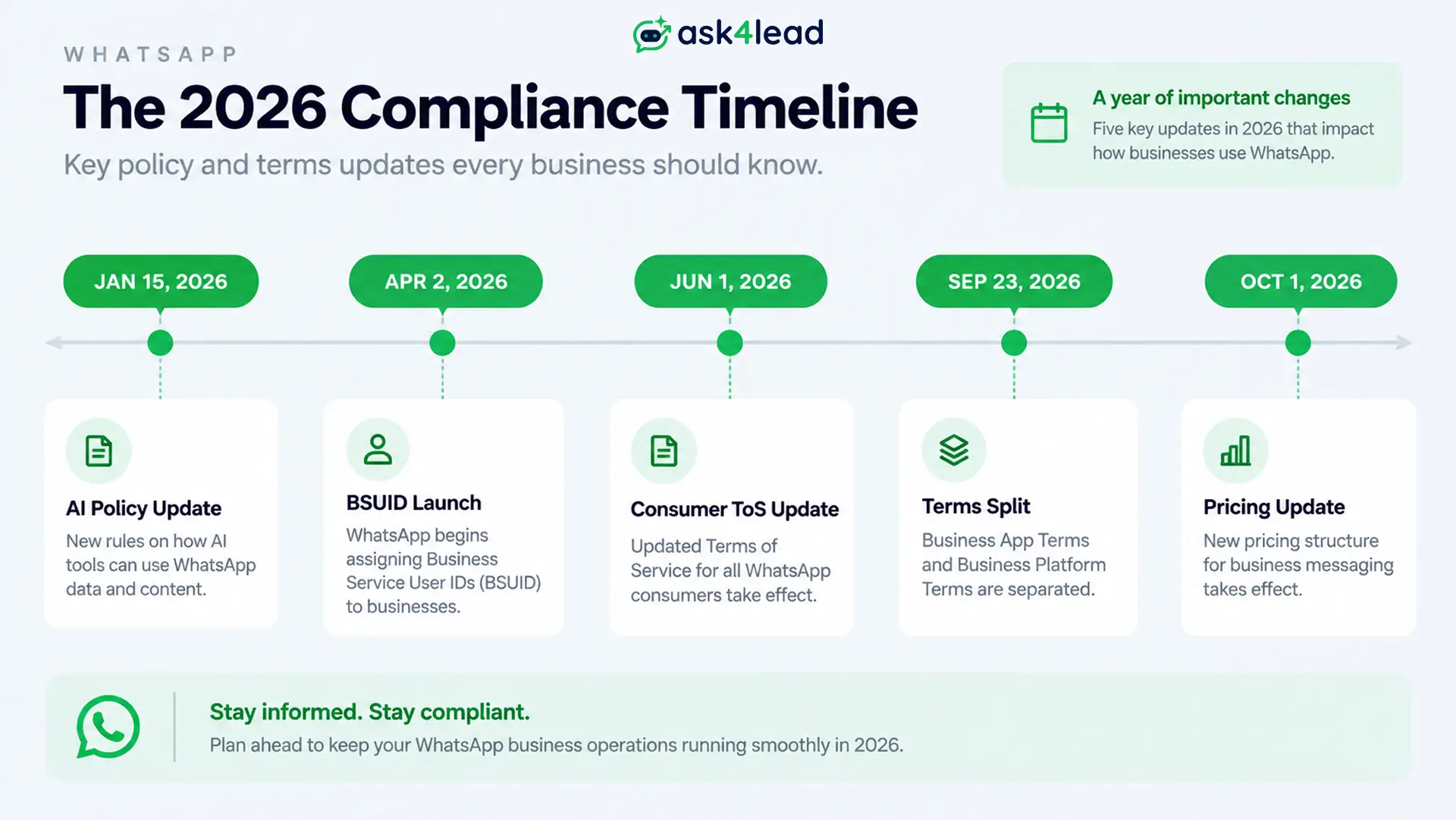
| Business Terms split into two documents | September 23, 2026 | Every Business App and Platform user |
| Mandatory consumer Terms of Service | June 1, 2026 | Every personal WhatsApp user |
| Contact Book and BSUID | From April 2, 2026 | Businesses on the Cloud API and partners |
| General-purpose AI chatbots banned | January 15, 2026 | Businesses running AI on the Cloud API |
| Service messages billed per message | October 1, 2026 | Businesses replying via the API |
Business Terms Split Into Two Documents (September 23, 2026)
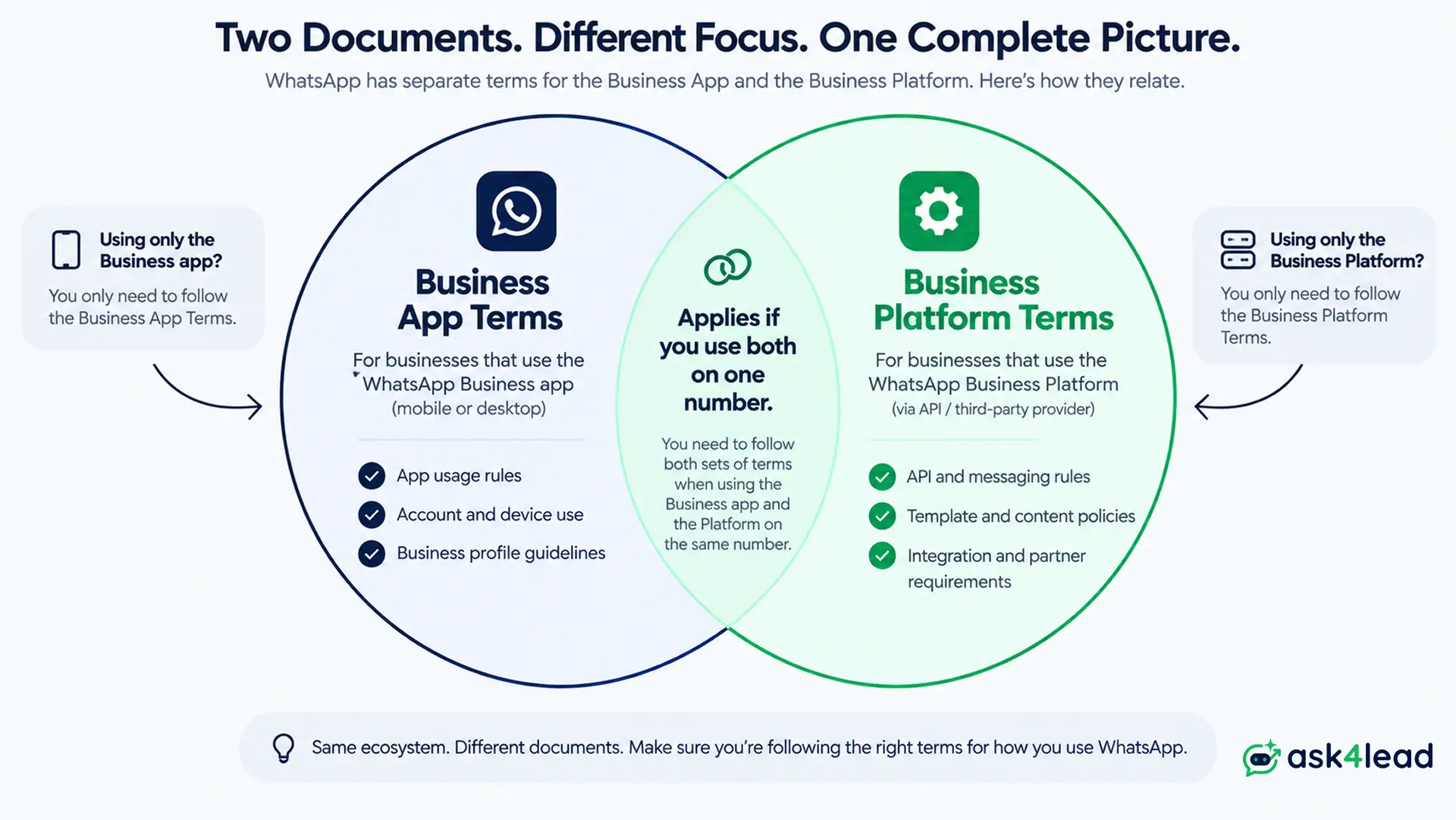
Meta is separating one combined Business Terms of Service into two agreements: one for the App, one for the Platform.
1. What’s Actually Changing on Paper
- If you use only the WhatsApp Business App, only the new App terms apply.
- If you use only the WhatsApp Business Platform, only the Platform terms apply.
- If you use both on one number, both apply at once.
- “Business Services” is renamed “Business App Services” wherever it refers only to the app.
2. What’s Staying Exactly the Same
Meta’s own FAQ is direct about this:
- No change to how your data is processed, used, or shared, including with Meta.
- No change to end-to-end encryption on personal messages and calls.
- No new data rights granted to Meta.
- No action required; continued use after September 23 counts as acceptance.
3. Why a Paperwork Split Still Matters
Separated contracts mean future Platform-only changes, like pricing or policy, no longer need to touch what a shop owner accepts on the free app. Expect the two products to diverge faster from here, not slower.
If you already track WhatsApp opt-in and consent separately for marketing versus app use, this split confirms that instinct was right.
Consumer App: Mandatory Terms Acceptance (June 1, 2026)
Since June 1, 2026, WhatsApp blocks the chat list until a personal user accepts the current Terms of Service. There is no skip option.
What Changed From the Optional 2021 Prompt
| Particulars | Before June 2026 | After June 2026 |
| Chat list access | Available even if you dismissed the prompt | Locked until you accept |
| Notifications and Web | Full access | Briefly still worked, then closed within weeks |
The policy itself dates to 2021, when business chats first got permission to share data with Meta’s advertising systems. Meta said then it had no plans to limit functionality for holdouts. That held for five years.
Why This Outlasts Its Original Reason
The re-acceptance gate isn’t really about the 2021 clause anymore. It’s the mechanism securing consent for everything shipped since, AI features, Status ads, and whatever comes next.
Accepting the consumer ToS as an individual does nothing for a business’s separate marketing consent obligations.
Those two run on entirely different tracks.
Business Platform Terms: Contact Book and BSUID (April 2, 2026)
Meta’s April 2 update introduced Contact Book, turned on by default for every business and partner on the Platform.
1. Contact Book, Auto-Enabled by Default
Contact Book stores a user’s contact info, scoped to your business, for the length of your conversation. It supports the username rollout below: once phone numbers stop being the only identifier, something has to hold the mapping.
Admins could disable it from Meta Business Suite starting March 18, two weeks before the terms took effect.
Only turn it off if you already run your own consent ledger outside WhatsApp. Otherwise you risk losing the ability to message a customer who later adopts a username, a tradeoff that belongs inside your WhatsApp data privacy planning, not outside it.
2. BSUID: the Real Impact
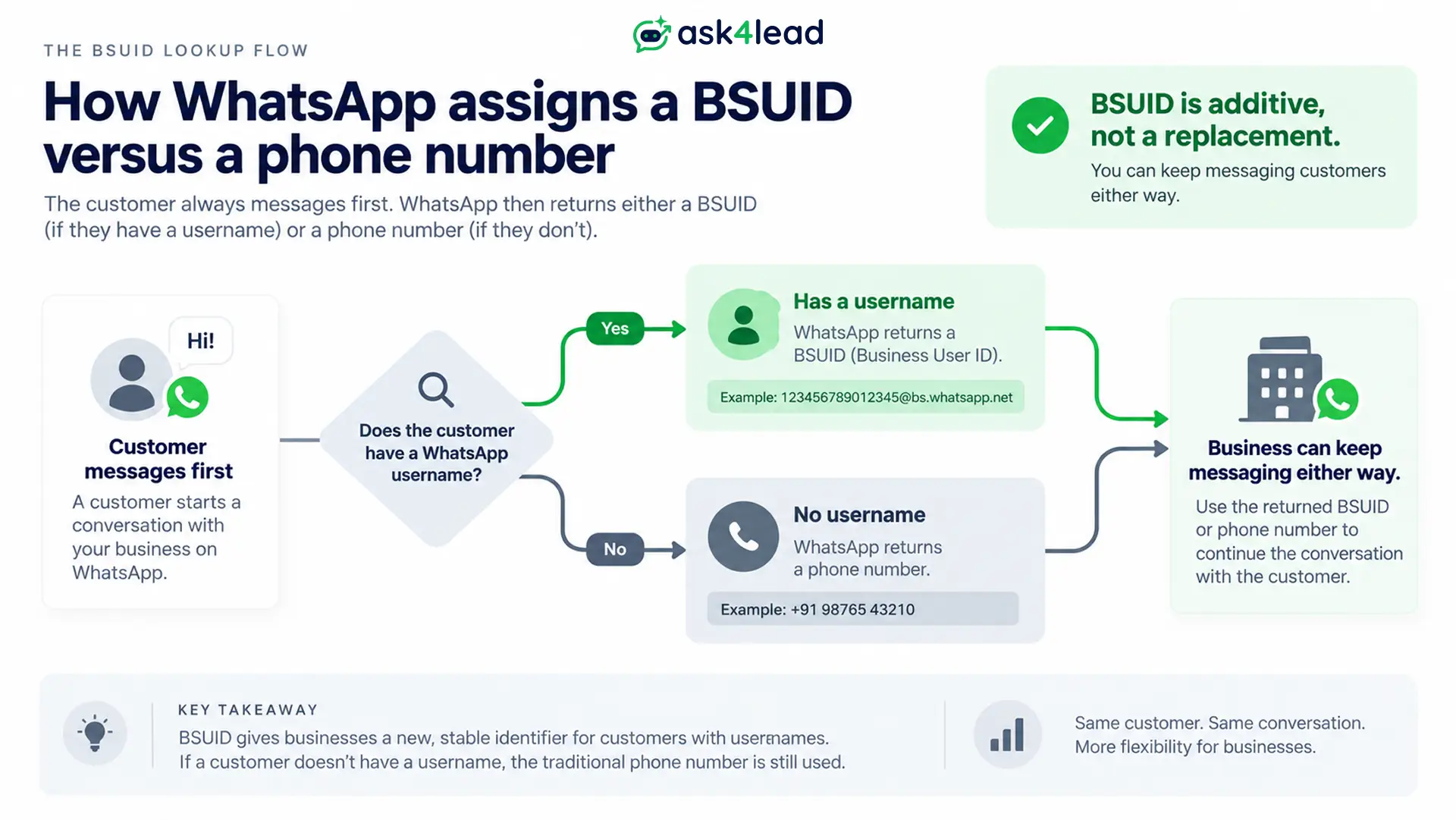
A BSUID is a unique identifier Meta began issuing in April 2026, tied to one user and one business portfolio, formatted like US.13491208655302741918.
Does this mean businesses lose phone numbers? No. This is the most misread part of the update:
- Username adoption is optional for WhatsApp users.
- Adopting one does not hide your business’s phone number from that user.
- It does not stop you from messaging a number you already hold from a lead form or CRM.
- If that customer messages you first instead, you may get their BSUID rather than their raw number, a stable reference either way.
3. Who Must Support BSUID Now
Required, not optional, for:
- Every partner and directly-integrated business on the Platform
- Every advertiser running click-to-WhatsApp ads, since a CTWA chat can start without you ever holding the customer’s number
Store the BSUID as a second lookup key alongside phone number, not a replacement.
One caveat: a direct, unmanaged Cloud API connection carries this migration entirely on its own. A BSP layer usually normalizes it first. Reconsidering your setup either way? See Ask4Lead’s guide to switching WhatsApp Business Solution Providers.
4. The Coexistence Gotcha Nobody Documents
Undocumented by Meta, reported repeatedly by developers running the App and Platform on one number, exactly the scenario the September split now governs:
- Coexistence runs the Cloud API and the Business App on one number at once. It often drops your custom display name to a raw phone number instead.
- Meta Verified can restore that display name. Practitioners report it breaks again the moment Coexistence reconnects.
- A brand-new number often fails Coexistence setup and defaults to standard mode.
- The likely fix: Meta wants roughly seven days of active use on the Business App first.
- Already stuck? Delete the WABA registration, re-register on the Business App, and wait one to two months before retrying.
Test Coexistence on a secondary number first if your green tick verification matters to your brand, not your primary line.
Messaging Limits and the AI Chatbot Policy (January 15, 2026)
Two separate rules from early 2026 get conflated as often as the terms documents themselves.
The Messaging Tier System, As It Actually Works
Reports called the old tier ladder “scrapped,” with verified businesses jumping straight to 100,000 messages a day. That overstates it.
| Messages per 24 hours | How a business reaches it |
| 2,000 | Immediately after completing a scaling path |
| 10,000 | Automatic once usage exceeds 50% over 7 days, with high-quality sends |
| 100,000 | Same 50% rule, one tier up |
| Unlimited | Same rule, top tier |
What changed is the entry point, granted immediately instead of over days. The ladder itself and the quality gate are unchanged.
Older guides citing “Flagged” or “Restricted” statuses are stale too; Meta retired both October 7, 2025. Ask4Lead’s WhatsApp quality rating and broadcast limit guides cover the full mechanics.
Compliant Bot vs Banned Bot
Since January 15, 2026, general-purpose AI chatbots are prohibited on the Platform.
| Signal | Compliant bot | Banned bot |
| Scope of answers | Your products, services, account data | Anything the user asks |
| Grounded in | Your catalog, FAQ, CRM data | General training knowledge |
| Off-topic request | Redirects to a human | Attempts an answer anyway |
A bot that answers anything competes with Meta AI inside the same app. One that only knows your return policy doesn’t.
An AI Knowledge Profile built from your own catalog keeps every answer scoped to your business. That satisfies the policy, and it tends to convert better too.
The October 2026 Pricing Change
Starting October 1, 2026, Meta bills service messages, the free-text replies sent inside a customer-opened 24-hour window. This has been free since November 2024.
Before and After
| Message type | Before Oct 1 | After Oct 1 |
| Template messages | Billed per delivery | No change |
| Free-text reply in the 24-hour window | Free, uncapped | Billed per message |
| Human reply typed from the Business App | Free | Still free |
That last row decides whether October’s change costs your business anything at all.
- Sent through the API: paid.
- Typed by a human on the phone: still free.
Why Every Change Above Now Costs More Together
- A Low quality rating that freezes your tier also caps how many billed replies you can send.
- A general-purpose bot flagged under January’s policy means every reply it sent was paid, not free.
- Coexistence doesn’t exempt API replies from October pricing. It only lets a human step in for free when that’s the better call.
The cheapest businesses after October won’t avoid automation. They’ll decide, message by message, whether a reply needs a human touch or the speed of automation.
Human Approval for AI Replies builds that choice into the workflow: AI drafts a reply, a person approves it before it sends.
How to Stay Compliant With All Five Changes at Once
Handled individually, none of these five demands an emergency response.
Handled reactively, all five compound into the same failure: finding out about a rule after you’ve already broken it.
The 2026 Compliance Checklist
- Accept the consumer prompt the first time it appears; there’s no lasting workaround.
- Confirm whether the App terms, Platform terms, or both govern your setup after September 23.
- Audit whether your CRM’s phone-number-only key survives BSUID before it becomes urgent.
- Check quality rating and messaging tier before launching a large campaign, not after it stalls.
- Review your AI setup against the compliant-versus-banned table above.
- Map which of your message types fall under October’s per-message billing.
Where Businesses Get This Wrong Most Often
The mistake isn’t ignoring these changes. It’s treating a one-line Meta notification as enough warning for a migration that rewards months of lead time, BSUID and October pricing especially.
Agencies feel this hardest. One client’s compliance gap rarely stays contained to that client alone.
Multi-tenant CRM workspaces keep each client’s connection, consent records, and messaging tier genuinely separate. One account’s mistake stays one account’s problem, not five.
FAQs
1. Do I have to accept WhatsApp’s new terms and conditions?
Yes, for the consumer app. Since June 1, 2026, WhatsApp blocks the chat list until you accept. There is no confirmed permanent way around it.
2. What happens if I don’t accept them?
You lose access to the main chat screen. A brief gap let some users still open chats from notifications or use WhatsApp Web, but WhatsApp closed both routes.
3. Does the September 2026 split change how my app works?
No. Meta confirms no change to functionality, data handling, or encryption. Only the document structure changes, split by product instead of combined.
4. Will BSUID replace phone numbers entirely?
No. Username adoption is optional, and adopting one doesn’t hide your phone number from that user or block messaging a number you already hold. BSUID adds a second identifier; it doesn’t remove the first.
5. Can I still run ChatGPT-style AI on the Business API?
Not as a general-purpose assistant. Since January 15, 2026, open-ended AI on any topic is prohibited. AI scoped to your specific business functions remains compliant.
6. Does Coexistence protect me from October’s pricing change?
Partially. It lets a human reply free from the phone app on the same number. It doesn’t make API-sent replies free.
Conclusion: Five Changes, One Response
None of WhatsApp’s 2026 changes need panic. All five reward the same three moves:
- Know which document, App or Platform, actually governs your setup.
- Get your customer data architecture ahead of BSUID, not behind it.
- Stop routing every reply through the API by default now that some carry a real cost.
Businesses that already run this way tend to treat 2026’s terms changes as a documentation update, not a rebuild:
- An AI Sales Assistant grounded in their own catalog, never a general-purpose bot
- WhatsApp Campaigns that pace sends instead of spiking them
- An isolated workspace per client, so one account’s compliance gap stays contained
Talk to Ask4Lead about auditing your WhatsApp setup against all five 2026 changes before October 1, while there’s still runway to fix what’s exposed instead of reacting after the first bill or the first blocked message.
