
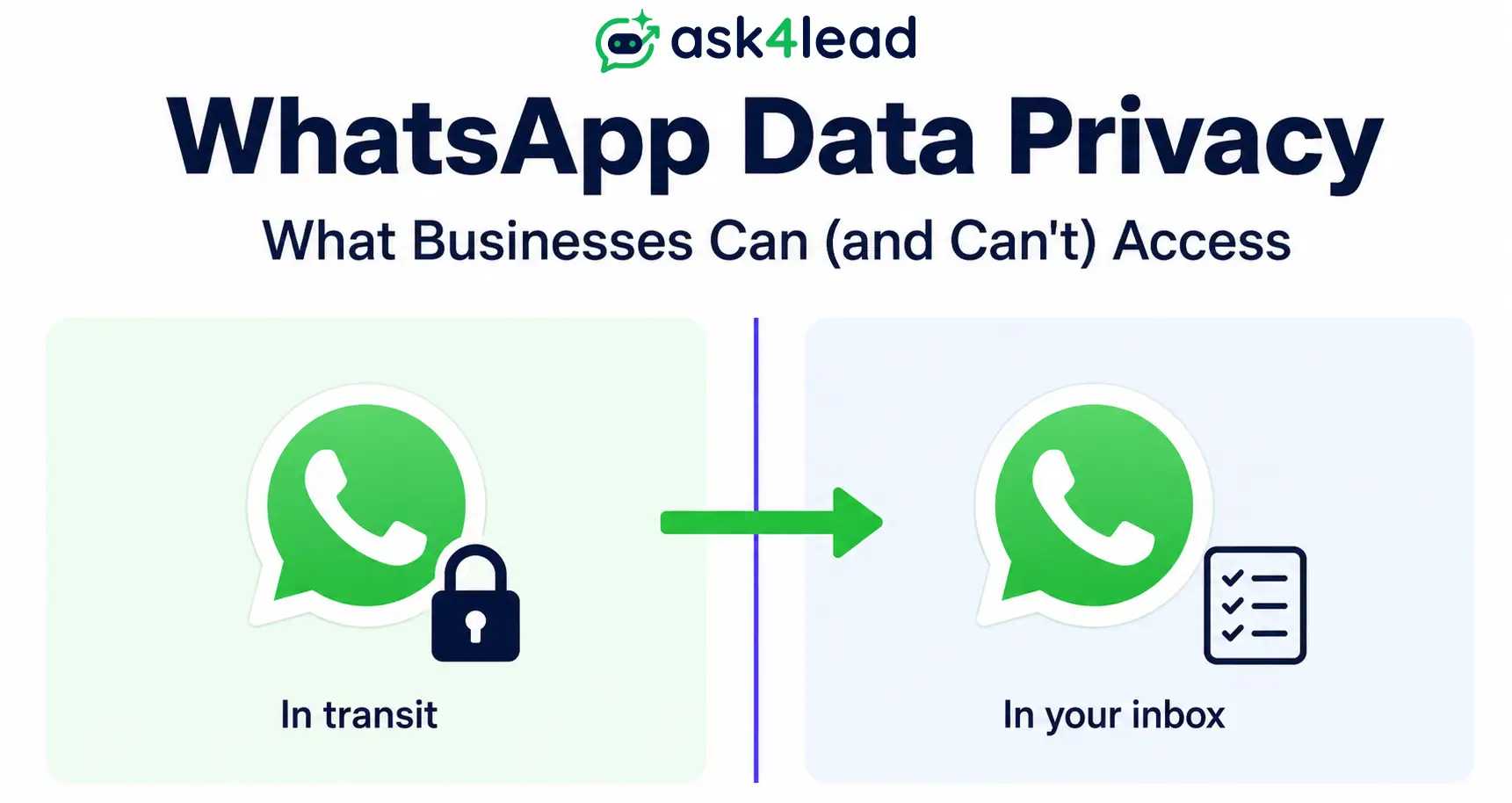
Quick answer: Once delivered, your business can legally access a message’s content, plus the customer’s phone number and delivery metadata. You cannot access a message before it’s sent, or message anyone without opt-in consent.
1 thing almost nobody explains: if a customer reports your business, Meta’s review team gets your last 5 messages, unencrypted.
Key takeaways
- WhatsApp privacy has 2 layers: Meta’s encryption, and your business’s own data handling.
- Encryption stops the moment a message reaches your inbox. Everything after that is on you.
- Meta logs business-specific metadata most owners never see, including some contacts who don’t even use WhatsApp.
- The free Business App isn’t GDPR or DPDP compliant on its own.
- A reported chat sends your last 5 messages to Meta’s review team, with no notice to you.
- Most privacy failures aren’t about encryption. They’re about who on your team can see a full chat history, and what happens when that person quits.
What “WhatsApp Data Privacy” Actually Means When You Run a Business on It
WhatsApp data privacy is a split of control, not one setting you can toggle.
- Meta’s job: secure the message while it travels.
- Your job: everything that happens to it after it lands in your inbox.
Mixing up those 2 jobs is where most compliance mistakes start.
The 2 layers of control: Meta’s encryption and your business’s data handling
- Meta uses the Signal Protocol to encrypt every message in transit.
- Nobody, not even Meta, can read that content while it’s traveling. That’s Layer 1, and it genuinely holds.
- Layer 2 starts the instant the message decrypts on your side. WhatsApp’s own Business App privacy policy confirms it directly.
- Once delivered, a message “may be visible to several people in that business.” From there, storage, access, and retention are entirely your calls.
Why “it’s encrypted” does not mean “it’s private” once a customer messages you
- Most owners stop thinking about privacy the second they see the “encrypted” label. That’s the mistake.
- Encryption covers the trip. It says nothing about what happens after arrival.
- Customers make the opposite error. They assume a business reading their message is a breach.
- It isn’t. It’s the expected outcome of messaging a business at all. Both sides are just describing 2 different layers.
What Your Business CAN Legally Access on WhatsApp
Once delivered, you get the full message, the customer’s contact details, and more behavioral metadata than most owners realize.
| What you can access | Source | Business use |
| Message content, post-delivery | Customer sends it directly | Answering, qualifying, routing |
| Name, number, public profile | WhatsApp contact metadata | CRM records, identification |
| Delivery and read timestamps | Meta’s message-status events | Response-time tracking |
| Template performance data | WhatsApp account health reporting | Protecting your messaging tier |
| Conversation duration and category | Meta’s business-metadata layer | Reporting, capacity planning |
1. Message content, once it’s delivered to your number
Every message a customer sends is fully readable by whoever has inbox access.
That’s true whether it’s 1 owner-operator or a 20-person team. It’s not a loophole, it’s how WhatsApp customer service has always worked.
2. Contact details: name, phone number, and public profile
- You also get the customer’s display name and phone number.
- Their photo and status show too, if made public. A WhatsApp green tick badge is visible as well.
- That green tick tends to raise trust before your team even replies.
3. Delivery, read, and activity metadata Meta hands you
Sent, delivered, and read timestamps come with every conversation.
This exact data feeds your WhatsApp quality rating, the score Meta uses to decide how many people you’re allowed to message next.
4. The business-specific metadata almost no owner knows about
Meta doesn’t just log that a message happened. It logs the type of business interaction too:
- The category and industry your business is registered under.
- How long the conversation lasted, start to finish.
- Whether the chat involved a transaction, and what type.
- Contacts your customer has saved, including numbers of people who’ve never installed WhatsApp.
That last point matters more than it looks. If your sales team has customer numbers saved and WhatsApp is on their phone, those numbers can reach Meta’s servers as metadata.
That includes people who’ve never touched the app. It isn’t your business collecting this directly, but it’s happening because of how your team uses the platform.
What Your Business CANNOT Access, and What Happens If a Chat Gets Reported
Some things are permanently off-limits. 1 thing runs the opposite direction, into your business, and almost nobody explains it.
1. A message before your customer sends it
End-to-end encryption is a real, working barrier here.
There’s no legitimate way for a business to see a message before delivery. If any tool claims otherwise, treat that as a red flag.
2. Anyone who has not given opt-in consent
Opt-in means the customer explicitly agreed to be contacted.
Messaging without it isn’t a gray area. It risks your number getting banned, and it breaks both GDPR and DPDP.
3. Support-chat data reused for marketing, or kept with no limit
A customer messaging for order tracking hasn’t agreed to your promotions. 3 things you’re specifically barred from doing:
- Sending marketing to a contact who only consented to support conversations.
- Storing chat data indefinitely with no retention policy.
- Sharing a customer’s data with a third party they never agreed to.
4. What actually happens when someone reports a chat
Almost every WhatsApp privacy guide leaves this out entirely.
When someone reports your business account, WhatsApp forwards your last 5 messages to its review team. This happens with no notice to you.
Those messages are decrypted for that review. It’s a narrow, moderation-only exception, not a backdoor into everyday chats.
But it does mean “WhatsApp can never see message content” is technically inaccurate.
Meta’s own privacy help center confirms reported content gets reviewed.
If your team is sending anything borderline, a single report is all it takes for that exchange to reach a reviewer.
WhatsApp Business App vs. Business API: Why the Privacy Rules Differ
The free app and the paid API aren’t 2 versions of the same setup. The privacy controls are structurally different.
| Particluars | Business App (free) | Business API |
| Devices, users | 1 phone, 1 login | Multiple team members via a shared inbox |
| Access log | None | Available through a compliant provider |
| GDPR/DPDP fit | Not compliant on its own | Compliant with a signed data processing agreement |
| Offboarding | Manual, easy to miss | Access revoked centrally, no device handoff |
| Automation | Not supported | Message templates and human-approved AI replies |
| Backup encryption | Off by default | Configurable at the provider level |
1. The free Business App’s compliance gap
The free app is built for a solo owner replying from 1 phone, and it does that well.
What it lacks is any admin control, access log, or offboarding process. That’s exactly why it fails GDPR and DPDP once more than 1 person touches it.
2. What changes once you move to the Business API
The API routes conversations through a Business Solution Provider, or BSP, a Meta-approved partner.
A compliant BSP enforces:
- Role-based access, so not everyone sees every chat.
- Audit trails, so access is tracked, not assumed.
- A signed data processing agreement.
Our WhatsApp Business App vs. Business API breakdown covers the full setup differences.
3. The backup encryption gap almost nobody closes
Here’s the detail most guides skip. WhatsApp chat backups to Google Drive or iCloud are not encrypted by default.
You have to manually turn this on, with a password or a 64-digit key.
If your team backs up chats to personal cloud accounts with that setting off, customer history sits unencrypted in someone else’s cloud. That’s a real liability, not a hypothetical one.
Who Inside Your Company Can Actually See a Customer’s Chat History
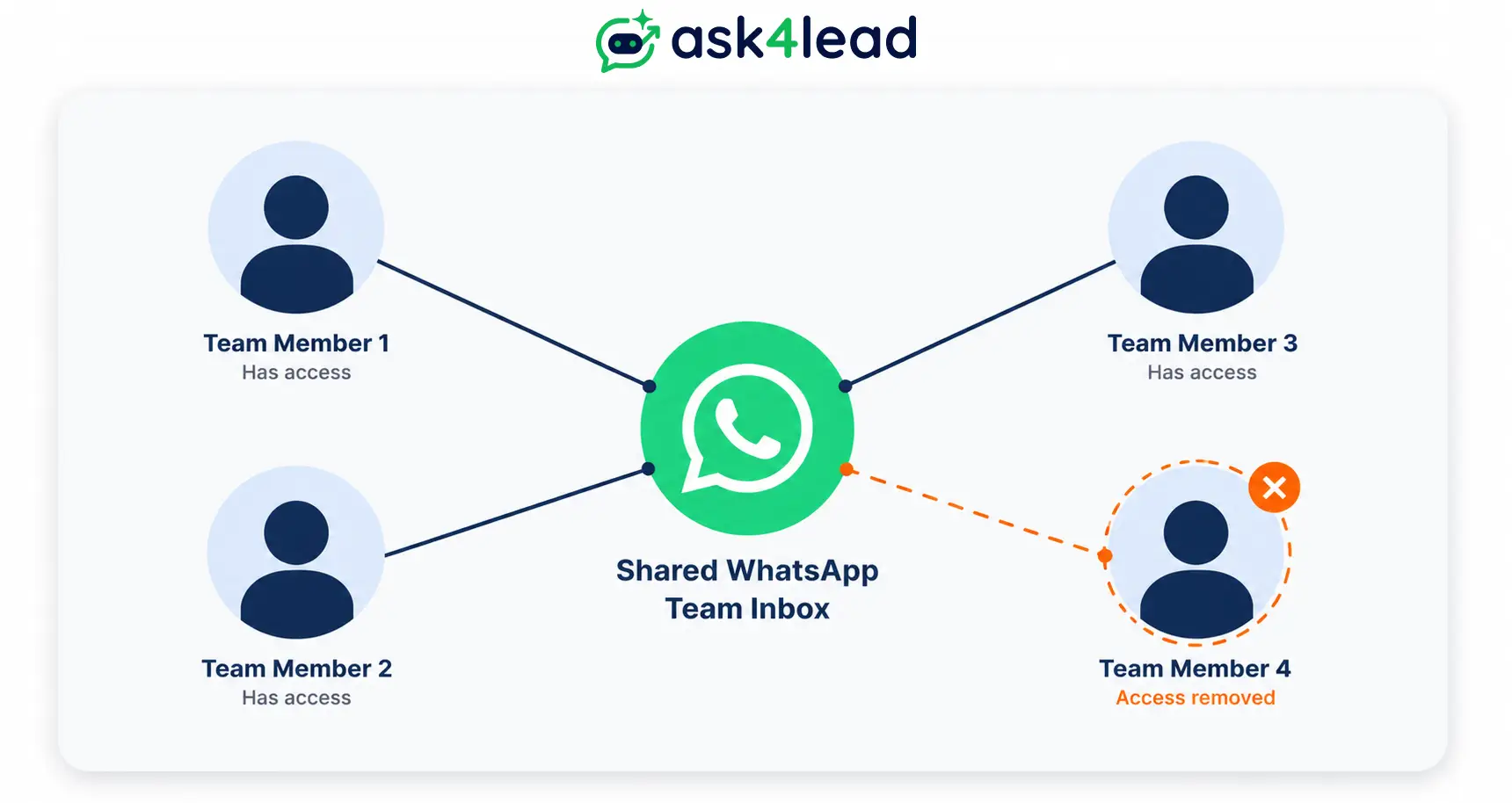
By default, whoever has your inbox open can see a customer’s full history and phone number. That includes chats they never personally handled.
The shared-inbox reality most businesses miss
A team on 1 shared number usually gives every agent the same full-access view.
That’s convenient for coverage. But it also means a customer’s entire purchase history is visible to a rep who’s never spoken to them.
Our shared WhatsApp inbox for multiple agents guide covers the setup side of this.
The offboarding risk nobody plans for
The bigger exposure shows up when someone leaves the team.
If they were running WhatsApp from a personal phone, they may still have every customer’s number on that device. You have zero way to revoke it.
2 fixes close both gaps at once:
- Role-based access, so each agent sees only the conversations assigned to them.
- Audit logs, so you can see who opened a conversation and revoke it instantly.
GDPR, DPDP, and What You Must Be Able to Prove
GDPR and India’s DPDP Act ask the same 3 questions, in different words:
- Do you have a legal reason to contact this person?
- Can you prove it?
- Can you delete their data on request?
| Requirement | GDPR (EU) | DPDP Act (India) |
| Legal basis to contact | Documented consent or another lawful basis | Explicit, informed, specific consent |
| Access and deletion rights | Customer can request access or erasure | Data principal can request access or correction |
| Retention limit | Must be defined and justified | Must match the stated purpose |
| Who enforces it | National data protection authorities | Data Protection Board of India |
1. GDPR essentials for customers in the EU
GDPR applies whenever you message someone in the EU, no matter where your business is based.
It requires documented consent, plus the ability to show or delete a customer’s data on request.
Our GDPR compliance for WhatsApp marketing guide covers the consent mechanics in full.
2. DPDP Act essentials for customers in India
India’s DPDP Act runs on the same logic as GDPR: explicit consent, a retention period tied to purpose, and correction rights for the customer.
That customer is called a “data principal” under this law. If your base is India-first, this is the framework you’re actually operating under, not GDPR.
3. The 1-line answer that reassures a worried customer
You don’t need a legal disclaimer for every chat. 1 honest line does the job:
“Your message is encrypted on its way to us. Once it reaches our team, we use it to help you and don’t share it outside our business without your permission.”
That single line answers “is this safe?” without turning a sales chat into a compliance lecture.
How a WhatsApp CRM Changes What You Can Access, Store, and Prove
A CRM doesn’t grant new access rights. It gives you a record of the access you already had, which is exactly what GDPR and DPDP expect you to produce.
Centralizing chats instead of scattering them across personal phones
The shared-inbox risk and the offboarding risk trace back to the same root cause.
Customer data ends up on individual devices instead of a controlled platform.
Ask4Lead, a humanized AI WhatsApp chatbot and CRM, fixes that with a multi-tenant CRM workspace.
Every conversation sits inside 1 governed system, not on whoever’s phone answered first.
Ask4Lead’s approach: access with a trail, not a data grab
Every action inside Ask4Lead is recorded with a full audit trail. You can show exactly who viewed or replied to a conversation, and when.
- The AI Knowledge Profile grounds AI replies in your own catalog and FAQs, not open-ended scraping of customer data.
- Human approval before an AI reply sends means nothing reaches a customer unseen, if that’s the control you want.
If your team is still on personal WhatsApp numbers with no access log, that’s the real privacy risk, not encryption.
Sign up free for Ask4Lead and put a real access trail behind every reply your team sends.
FAQs on WhatsApp Data Privacy for Businesses
1. Can a business read my WhatsApp messages before I send them?
No. End-to-end encryption blocks this for everyone, including Meta. Once delivered, the business reads it like any received message.
2. Is the free WhatsApp Business App GDPR or DPDP compliant?
Not on its own. It has no admin controls, access logs, or data processing agreement. The Business API paired with a compliant provider is what meets those requirements.
3. Can my employees see a customer’s full phone number and chat history?
In most default shared-inbox setups, yes. Role-based access limits each agent to only the conversations assigned to them.
4. What happens to WhatsApp chat data when the employee who managed it leaves?
If they used a personal phone or shared login, they may still have that data on their own device. A centralized inbox with audit logs removes access the moment you remove the person.
5. Does Meta see the content of my customers’ messages to my business?
Not under normal use. The 1 exception is a reported chat, where your last 5 messages get forwarded to WhatsApp’s review team.
6. Are WhatsApp chat backups on Google Drive or iCloud encrypted?
Not by default. You have to manually enable encrypted backups with a password or a 64-digit key.
7. How long can a business keep customer WhatsApp data?
Only as long as you can justify under GDPR or DPDP, tied to why you collected it. Both laws require a stated retention period.
Conclusion
WhatsApp’s encryption does 1 job well: it protects a message on its way to you.
Everything after delivery is on your business. Who sees it, how long you keep it, whether backups are encrypted, whether you could prove any of it to a regulator.
Get the 2-layer model straight. Close the shared-inbox and offboarding gaps most teams never audit, turn on encrypted backups, and keep your GDPR or DPDP answers ready.
That’s the real difference between a business that merely uses WhatsApp, and one that can actually stand behind every conversation on it.
