
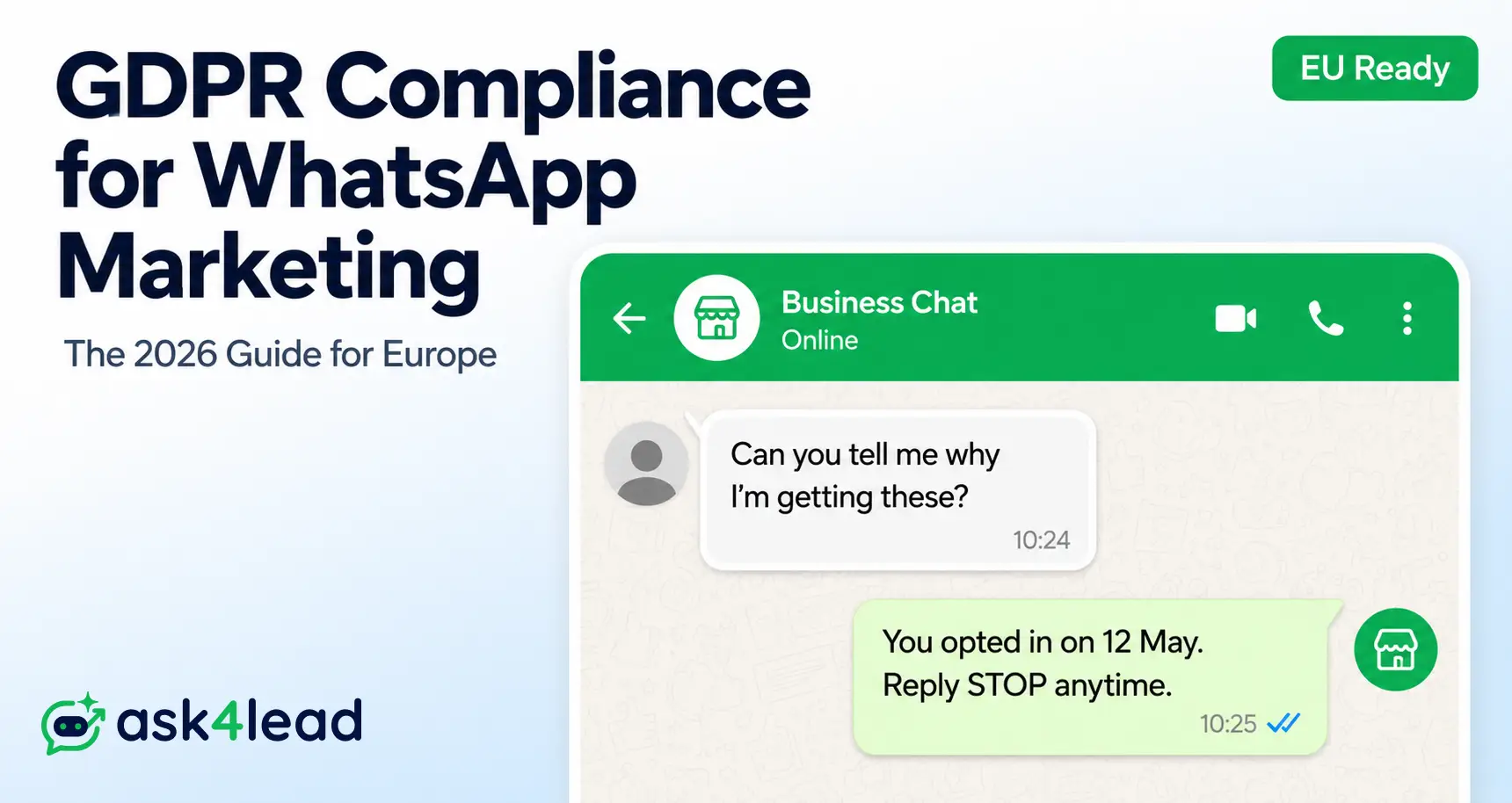
GDPR compliance for WhatsApp marketing means 3 things are true at once. You have a valid legal basis, almost always explicit consent.
You also need a signed Data Processing Agreement (DPA) with Meta and any Business Solution Provider (BSP, a Meta-approved company giving you API access).
And a working process for the rights EU and UK contacts hold over their own data.
Most guides stop at consent, already covered in the WhatsApp opt-in and consent guide. This piece covers what’s missed.
That’s who’s legally on the hook, what a data request actually entitles someone to, and a 2026 platform change most compliance content hasn’t caught up to yet.
Quick answer: WhatsApp marketing is legal under GDPR only through the WhatsApp Business API, with documented consent, a signed DPA, and a real process for data requests and breaches. The free WhatsApp Business App can’t clear that bar at scale.
Key takeaways
- GDPR applies by contact location, not company size or headquarters. There’s no small-business exemption.
- Consent is the only workable legal basis for marketing messages. Legitimate interest doesn’t cover it.
- Uploading a customer contact list to sync with WhatsApp, without consent from every person on it, has led to real court-ordered damages in Germany.
- As of January 2026, WhatsApp Channels are regulated as a Very Large Online Platform under the EU’s Digital Services Act.
- WhatsApp’s own €225 million fine in 2021 was for a transparency failure, not a marketing violation.
What GDPR Compliance for WhatsApp Marketing Actually Requires
GDPR compliance rests on 3 pillars. A lawful reason to message someone, paperwork proving your data flows are covered, and a real process for that person’s rights.
Skip one, and the other 2 don’t protect you.
The 3 Pillars Regulators Actually Check
Regulators investigating a WhatsApp marketing complaint check the same 3 things every time.
- Legal basis: was there documented, WhatsApp-specific consent before the first message?
- Paper trail: is there a signed DPA covering Meta and any BSP or CRM in the chain?
- Rights process: can the business actually respond to a data request or a breach on time?
Why “We’re Too Small to Matter” Is a Costly Myth
There’s no small-business exemption and no minimum-revenue threshold under GDPR. A 7-person startup and a multinational carry the same legal obligation.
Enforcement in practice is calibrated to risk, not company size. But B2B buyers increasingly ask vendors to prove compliance before signing.
That makes this a sales problem long before it’s a regulator problem.
Choosing a tool built for this from day 1 avoids that scramble later. Ask4Lead’s best WhatsApp marketing software roundup covers what to check before you commit to one.
The 3 Versions of WhatsApp, and Only One Scales Compliantly
WhatsApp for business isn’t one product. It’s 3 different tools with 3 very different compliance profiles, and confusing them is where most non-compliant setups start.
1. The Personal App and the Free Business App
The personal WhatsApp app and the free WhatsApp Business App are built for 1 person on 1 phone. Neither offers a formal data processing agreement with Meta.
Both sync your entire phone contact list to WhatsApp’s servers by default. That single step is the source of the German court rulings covered later in this piece.
2. The WhatsApp Business API Is the Only Option That Scales
The WhatsApp Business API is the only version covered by Meta’s Business Data Processing Terms, a formal contract that functions as your DPA.
It also categorizes every message: marketing, utility, authentication, session. Each category carries its own consent bar.
| Factor | Personal or Free Business App | WhatsApp Business API |
| Built for | 1 person, 1 phone | Structured, multi-agent, scaled sending |
| Formal DPA with Meta | Not offered | Yes, Business Data Processing Terms |
| Consent audit trail | Manual, easy to lose | Attached to a CRM record, exportable |
| Contact list handling | Bulk-syncs your phone contacts | Controlled per-contact, opt-in gated |
| Realistic for EU marketing at scale | No | Yes, with a compliant BSP or platform |
If your setup is still the free app on a personal phone, that’s a scaling problem before it’s a compliance one. Ask4Lead’s bulk WhatsApp messaging guide is the next read.
3. The Bring-Your-Own-Device Problem Nobody Plans For
Sales teams running WhatsApp from personal phones is a real, common setup. It’s also a compliance blind spot.
Company contact data ends up on a device the business doesn’t control, backed up wherever that person’s phone backs up.
When that employee leaves, the conversation history and the proof of consent usually leave too. There’s rarely a record left behind showing anyone ever opted in.
A shared team inbox run through the Business API solves this by keeping every conversation, and its consent record, on infrastructure the business actually owns.
Legal Basis: Why Consent Is the Only One That Works
Under GDPR Article 6, you need one of 6 lawful bases before processing personal data. For marketing messages, only one of those 6 realistically applies: consent.
1. What Valid Consent Looks Like Under Article 4(11)
GDPR Article 4(11) defines valid consent as freely given, specific, informed, and unambiguous. A checkbox either clears that bar or it doesn’t, there’s no partial credit.
Clears the bar:
- Names your business, not a generic “our partners”
- States what you’ll send and roughly how often
- Requires an active, unticked click to opt in
Fails the bar:
- Pre-ticked by default
- Bundled with, or made conditional on, an unrelated purchase
- Buried inside a general terms and conditions page
2. Why Legitimate Interest and “Low-Volume” Outreach Both Fail
Legitimate interest lets you email an existing customer about a similar product without asking twice. That basis does not carry over to WhatsApp.
Meta’s own platform policy backs that up. It requires documented opt-in before any marketing template can send.
A real misconception shows up in cold-outreach circles: some businesses treat WhatsApp like cold email, assuming a low daily volume, 20 to 50 messages, keeps them under an informal radar. It doesn’t.
Volume has nothing to do with legality. One unsolicited marketing message to an EU contact with zero consent on file is already a violation, regardless of how many you sent that day.
Meta’s own quality rating system tracks block and report rates too, so an uninvited campaign risks a platform penalty on top of the legal one.
3. The Contact-Sync Liability Most Businesses Don’t See Coming
A German appeals court awarded non-material damages of €250 to €750 per contact, under GDPR Article 82. The business had synced its customer address book to WhatsApp without individual consent.
Article 82 lets anyone claim compensation for unlawful processing. With thousands of contacts synced, that liability adds up fast.
This is exactly what happens when a phone’s contacts app syncs into WhatsApp automatically. It’s not a marketing decision at all, it’s a phone setting most people never check.
Controller and Processor Roles: Who Answers to Regulators
Your business is the data controller for WhatsApp marketing. You decide why and how contact data gets used, so you carry the legal responsibility, even individually, without a formal company structure.
| Role | Who | Answers for |
| Controller | Your business | Legal basis, consent records, regulator questions |
| Processor | Meta, plus any BSP or CRM | Security, contractual terms, the DPA itself |
Your Business Sets the Purpose, So You Carry the Risk
If a regulator asks why a contact received a message, that question comes to you, not Meta. Under GDPR Article 4(7), the controller is whoever sets the purpose and means of processing.
Connect through a platform like Ask4Lead’s WhatsApp Business API integration, and onboarding runs through Meta’s own Embedded Signup flow. That keeps the data relationship with Meta direct, not routed through undisclosed sub-processors.
Meta and Your BSP Are Processors Under a Signed DPA
GDPR Article 28 requires a written contract with every processor you use. For WhatsApp, that’s Meta’s Business Data Processing Terms.
For any BSP or CRM layered on top, it’s whatever DPA that provider offers.
Ask for it, and keep a copy on file. A provider that can’t produce one is a real warning sign, not paperwork theater.
Handling Data Subject Access Requests From WhatsApp Contacts
A data subject access request (SAR) is a contact asking what personal data you hold on them.
Under GDPR Article 15, you must respond within 1 month. That extends to 3 for genuinely complex cases.
1. What a Data Subject Access Request Entitles Someone To
A SAR covers:
- Phone number and opt-in source
- Consent timestamp and exact wording
- Message and campaign history tied to that contact
It does not cover:
- Conversations about other people
- Internal notes on unrelated contacts
- Your full customer database
“WhatsApp is encrypted, so we don’t hold the data” is a common but incorrect excuse. Encryption protects message content in transit, not the opt-in record your CRM stores against that contact.
Ask4Lead’s audit trail feature turns a request like this into a fast, exportable answer, not a manual search through spreadsheets.
The same request can also ask for erasure under Article 17, not just access. That same record needs to support deleting the contact too.
2. The 1-Month Clock and “Manifestly Unfounded” Requests
The clock starts the day the request arrives, not the day someone gets to it.
GDPR does let you push back on a request that’s genuinely “manifestly unfounded or excessive,” a real legal term.
That’s a narrow exception, though, not a general excuse.
Most marketing SARs are neither. They’re just a person who wants to know why they’re getting messages, and how to stop.
3. Why Shorter Retention Windows Cut Your Exposure
Data you no longer hold is data you can’t be forced to disclose, and can’t lose in a breach.
A defined retention policy, deleting contacts who never converted after a set window, shrinks your SAR workload and your breach exposure at the same time.
This is a genuinely underused lever. Most compliance advice focuses only on collecting consent correctly, and skips what happens to that data 12 months later.
Ask4Lead’s lead management feature makes stale, unconverted contacts easy to spot and clear on a schedule, instead of a database that only grows.
Cross-Border Data Transfers: the US Question, Explained Properly
Meta is a US company, so EU contact data flowing through WhatsApp can be requested by US authorities. 3 mechanisms determine whether that’s actually lawful under GDPR.
| Mechanism | What it does |
| EU-US Data Privacy Framework | Primary route, an adequacy decision the European Commission recognizes on its own |
| Standard Contractual Clauses | Fallback for transfers the framework doesn’t reach, accepted by the EDPB and the UK’s ICO |
| EU data hosting | Meta runs infrastructure in both the US and EU, which helps latency, not legal exposure |
The Data Privacy Framework Is the Primary Legal Route
Meta and WhatsApp LLC are certified under the EU-US Data Privacy Framework. That certification is what makes routine transfers to WhatsApp LLC in the US lawful in the first place.
The US CLOUD Act Still Applies
The US CLOUD Act lets US law enforcement compel American companies to hand over data they control, regardless of where that data is physically stored.
This isn’t unique to WhatsApp. The same exposure applies to Gmail, Zoom, and most US-headquartered SaaS tools.
GDPR doesn’t ban working with US processors outright. It requires the transfer be covered by a mechanism like the DPF or SCCs, which WhatsApp’s business terms provide.
Special-Category Data: Why Healthcare Needs a Higher Bar
Health data isn’t ordinary personal data under GDPR. It sits in a stricter tier, and generic WhatsApp marketing setups usually aren’t built to clear that bar.
Article 9 Sets a Higher Consent Standard
GDPR Article 9 classifies health data as a special category. It requires explicit consent, or another narrow legal exception, on top of the standard Article 6 basis.
A general marketing opt-in doesn’t cover appointment reminders that reveal a diagnosis or treatment type.
Clinics and healthcare providers messaging patients over WhatsApp need consent language specific to that use, not a repurposed retail opt-in flow.
Why the Same Rule Applies Beyond Healthcare Clinics
The same logic applies anywhere a message could reveal something sensitive:
- Healthcare: an appointment reminder that names a diagnosis or specialist
- Finance: a message referencing a loan rejection or credit decision
- Insurance: a note about a medical exclusion or claim status
Ask4Lead’s healthcare industry playbook covers what a compliant setup looks like in that specific context.
What Changed in 2026 That Most Compliance Guides Still Miss
GDPR itself hasn’t changed, but the platform it runs on has, twice, in ways that directly affect WhatsApp marketing in Europe.
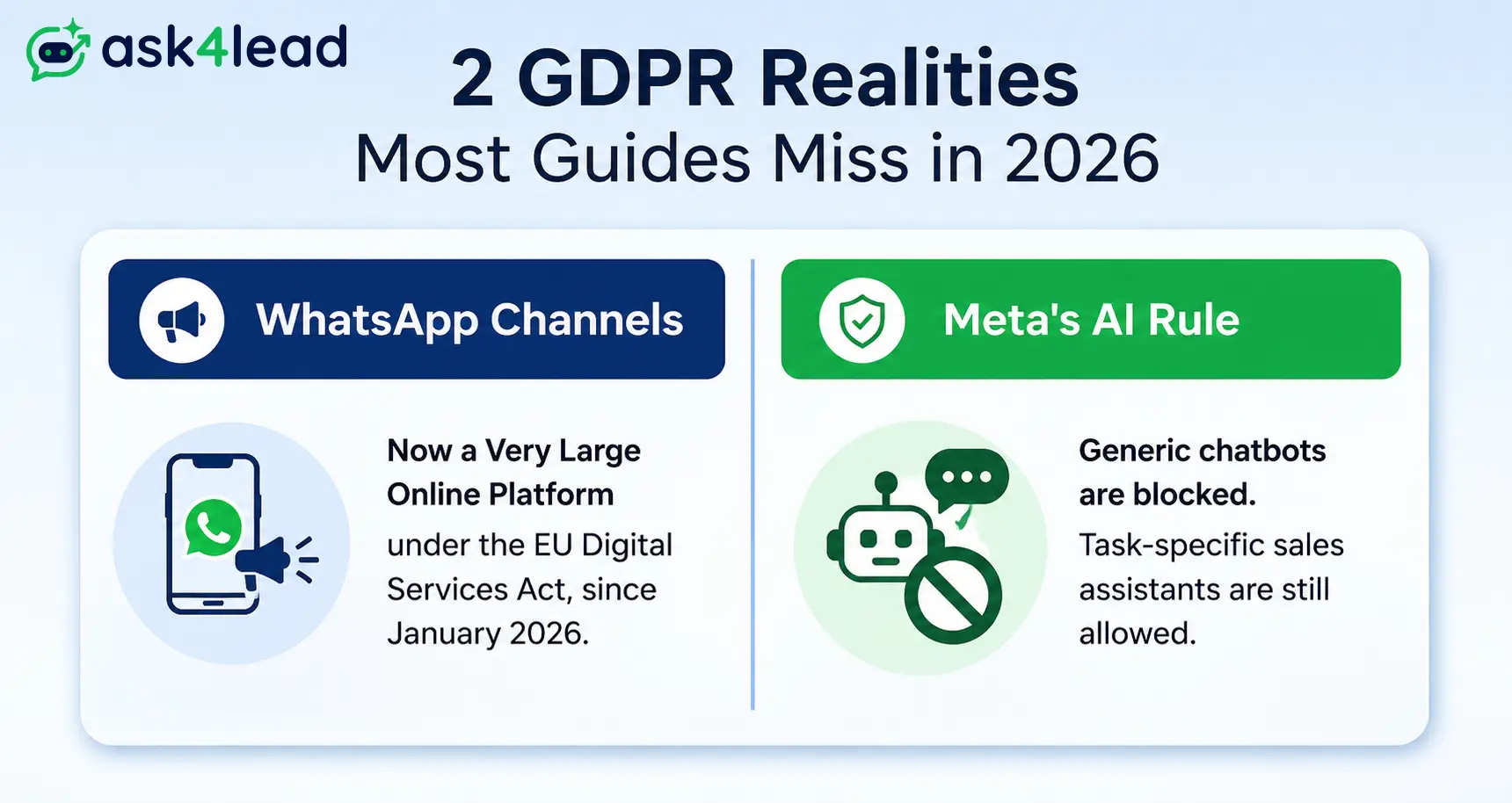
| Change | Applies to | In effect since |
| VLOP designation under the DSA | WhatsApp Channels only, not 1:1 marketing | 26 January 2026, full obligations by mid-May 2026 |
| Generic AI chatbot ban | Every bot on the WhatsApp Business Platform | 15 January 2026 |
WhatsApp Channels Are Now a Very Large Online Platform
On 26 January 2026, the European Commission designated WhatsApp a Very Large Online Platform (VLOP) under the Digital Services Act, because its Channels feature passed 45 million EU users.
This applies specifically to Channels, the broadcast-to-followers feature, not standard 1:1 Business API marketing.
If you use Channels for announcements, Meta has until mid-May 2026 to roll out new risk-assessment obligations. Those affect how that content gets moderated.
Meta Now Blocks Generic AI Chatbots, Not Task-Specific Ones
Since January 15, 2026, Meta bans general-purpose, assistant-style AI chatbots from the WhatsApp Business Platform. Bots built for a specific task, like sales, support, bookings, or order tracking, remain fully permitted.
This is a platform rule from Meta, not a GDPR requirement. It’s just as important for anyone building AI-driven WhatsApp marketing.
An AI sales assistant grounded in a business’s own product catalog is exactly the kind of structured, task-specific bot Meta still allows.
Breach Notification Rules and What Non-Compliance Actually Costs
If a breach affecting WhatsApp contact data occurs, GDPR splits your duty in 2, and only one half has a hard clock.
| Duty | Deadline | Trigger |
| Notify your supervisory authority (Article 33) | 72 hours from becoming aware | Any breach |
| Notify the affected contacts (Article 34) | Without undue delay | Only if the risk to them is high |
1. The 72-Hour Clock Is Hard, Not a Target
The clock starts when you become aware of the breach, not once the investigation wraps up. Most compliance processes handle this with a short initial notice, followed by a fuller report later.
2. WhatsApp’s Own €225 Million Transparency Fine
In September 2021, Ireland’s Data Protection Commission fined WhatsApp Ireland €225 million. It’s one of the largest GDPR fines ever issued.
It was for failing the transparency requirements in Articles 12 through 14, not for a marketing violation.
WhatsApp hadn’t clearly explained to users and non-users how their data was processed. Regulators scrutinize the full picture, privacy notices included, not just whether a checkbox got ticked.
3. The Legal Ceiling Scales With Your Business
The maximum penalty under GDPR Article 83(5) is €20 million, or 4% of global annual turnover, whichever is higher.
Most small and mid-sized businesses that get flagged face a correction order or a formal warning first, not a headline fine.
But that ceiling exists, and it scales up as your business grows, so the habits you build now matter more later, not less.
A Practical GDPR Compliance Checklist for WhatsApp Marketing
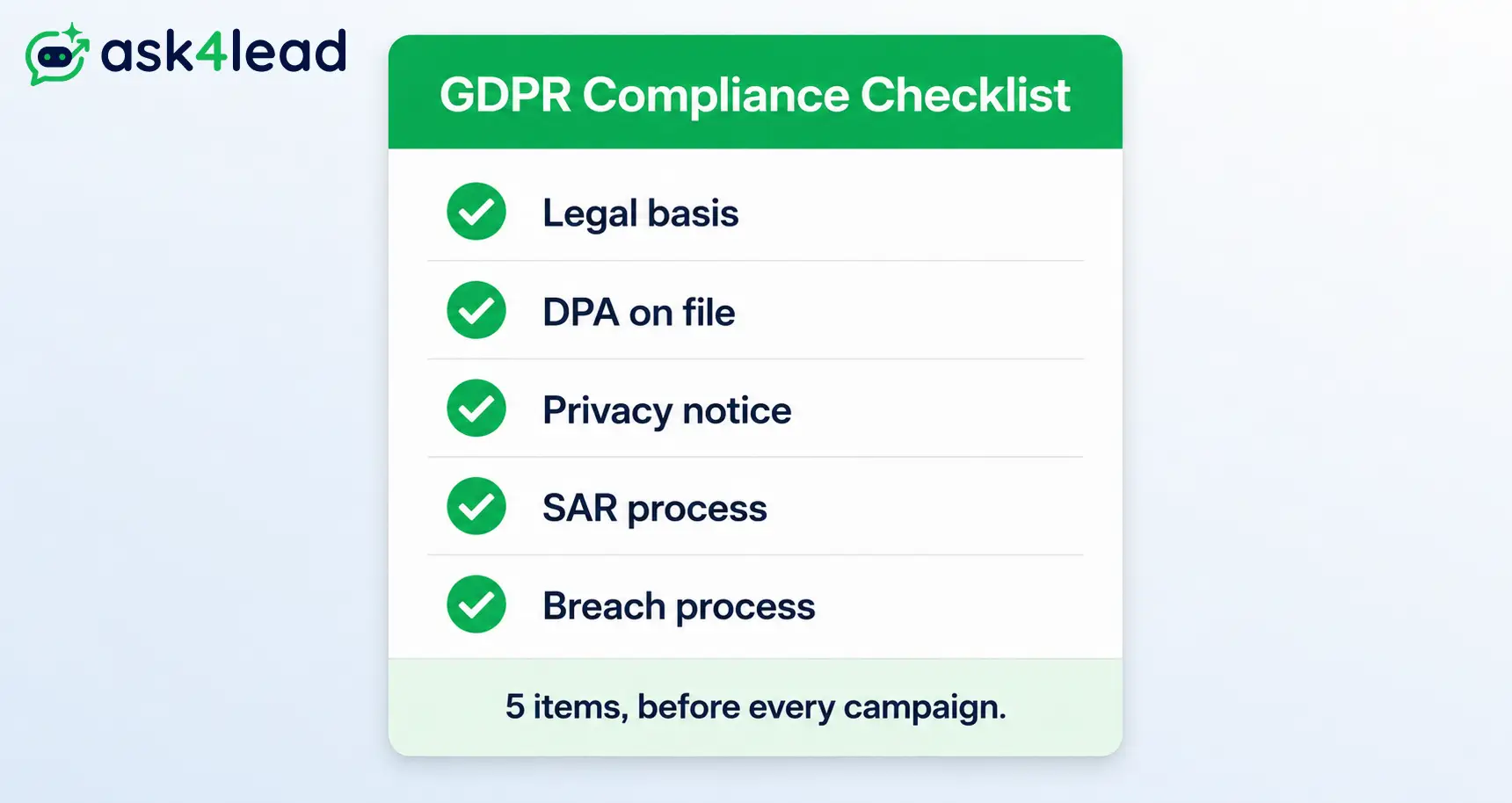
Everything above turns into 5 concrete things to have in place before your next campaign reaches a European contact.
Before Your First Campaign
- Legal basis: documented, WhatsApp-specific consent for every contact.
- DPA on file: signed terms with Meta and any BSP or CRM you use.
- Privacy notice: updated to name WhatsApp as a messaging channel.
- SAR process: a workflow ready to respond within 1 month.
- Breach process: a plan to notify your supervisory authority within 72 hours.
What to Keep Reviewing as You Scale
These 5 items need to hold up under review, not just exist on day 1. Ask4Lead’s WhatsApp Campaigns feature only lets broadcasts reach consented contacts.
WhatsApp Account Health surfaces quality-rating drops in real time, and human approval before AI replies send keeps a person in the loop.
Once compliant, the WhatsApp lead generation guide and WhatsApp marketing strategies cover what to send next.
FAQs
1. Is WhatsApp marketing legal under GDPR?
Yes, with documented WhatsApp-specific consent, a DPA with Meta and any BSP, and a working process for data requests and breaches. Without consent, it isn’t legal, regardless of volume.
2. Can I use the free WhatsApp Business App for GDPR-compliant marketing?
Not realistically at scale. It has no formal data processing terms with Meta and no audit trail. It also syncs your phone contacts by default, a setting that has already triggered real court damages in Germany.
3. What happens if a WhatsApp contact sends a data subject access request?
You have 1 month, extendable to 3 for complex cases, to hand over that person’s own data. Not conversations about other people, and not your entire database.
4. Is it a GDPR violation to buy or scrape a WhatsApp contact list?
Yes, in practice. A purchased or scraped list carries no consent given to your business by name, so every number on it is cold until a fresh, documented opt-in.
5. Does the 2026 WhatsApp Channels ruling affect my marketing campaigns?
Only if you use Channels specifically for broadcasts. Standard 1:1 Business API marketing campaigns aren’t directly affected by the Very Large Online Platform designation.
6. How much can a business actually be fined for a WhatsApp GDPR breach?
Up to €20 million or 4% of global annual turnover, whichever is higher. Most small and mid-sized businesses face a correction order or warning first, though. Individual contacts can also claim damages directly under Article 82, separately from any regulator fine.
Conclusion
What GDPR Compliance for WhatsApp Marketing Comes Down To
GDPR compliance for WhatsApp marketing in Europe comes down to 5 things working together: valid consent, a signed DPA, an honest privacy notice, a real SAR process, and a breach plan.
Get the legal basis right first. Nothing else matters if you never had permission to message that contact in the first place.
Build a Compliant WhatsApp Marketing Workflow From Day 1
Ask4Lead keeps consent, campaigns, and conversations in a single workspace. Every broadcast only reaches contacts who actually opted in.
Your team never has to reconstruct a compliance trail by hand when a request or an audit lands.
