
Quick answer: From October 1, 2026, Meta charges for WhatsApp service messages, the free-form replies sent inside the 24-hour customer service window. These have been free since November 2024. The new rate matches each market’s utility and authentication rate, and every WhatsApp business phone number gets 1,000 free service messages a month before charges apply.
WhatsApp Business API pricing is changing for the first time since 2024. It lands on every business running support or sales through the WhatsApp Business API.
Most pricing pages stop at the rate table. This guide adds 3 things almost nobody covers yet: Coexistence billing, a new AI budget-drain risk, and the exact steps to protect your margin.
Key takeaways
- WhatsApp Business API pricing changes in 1 specific way on October 1, 2026: free service messages start costing the same as a utility or authentication template.
- Every phone number gets 1,000 free service messages a month; nothing beyond that is free.
- Coexistence and the 72-hour ad entry point do not exempt API-sent replies.
- An unmonitored AI agent or a repetitive conversation can now drain your budget directly, not just your support team’s time.
- Fewer messages per resolved conversation is the only lever that reliably lowers this new cost.
What’s Actually Changing in WhatsApp Business API Pricing
1. Service Messages Lose Their Free Status
A service message is any free-form reply your team or AI agent sends within 24 hours of a customer’s last message. It needs no pre-approval, unlike a template.
Meta made these messages free in November 2024 to pull customer support onto WhatsApp. That free ride ends October 1, 2026.
2. The 4 Message Categories, Compared
Every WhatsApp reply falls into one of 4 billing categories:
| Category | What it is | Billed since | Rate from October 1, 2026 |
| Marketing | Promotional templates you send first | Always chargeable | Existing per-market rate, volume tiers apply |
| Utility | Order updates, receipts, account alerts | Always chargeable | Existing per-market rate, volume tiers apply |
| Authentication | One-time passwords, login codes | Always chargeable | Existing per-market rate, volume tiers apply |
| Service | Free-form replies inside the 24-hour window | Free since November 2024 | Same rate as utility and authentication, no volume tiers |
A support conversation that cost nothing in September 2026 costs roughly what a receipt notification costs from October, message by message, with zero discount for scale.
3. The 1,000 Free Messages Per Phone Number
Every connected WhatsApp business phone number gets 1,000 free service messages a month before the charge kicks in. A small business handling a few dozen conversations a day can run most months inside that allowance.
A team exchanging more than 30 to 40 service messages a day on 1 number burns through it before the month ends.
Why Is Meta Charging for WhatsApp Service Messages Now?
From Free Adoption Driver to Billed Category
Meta made service messages free to move support volume onto the API at scale, including at WhatsApp-heavy customer support teams. That volume has arrived.
Meta now bills it like every other category: per message, by country.
A Short Billing Timeline
WhatsApp Business API pricing has moved through 4 distinct models in 4 years:
- Before mid-2022: Billed per 24-hour conversation, not per message.
- 2022 to mid-2025: Per-category billing (marketing, utility, authentication, service), with service free from November 2024.
- July 1, 2025: Conversation billing replaced with per-message billing for the paid categories.
- August 1, 2026: Meta’s own tool, Meta Business Agent, moves to per-token billing, a model separate from every category above.
- October 1, 2026: Service messages join the paid categories, with the 1,000-message monthly allowance.
Because Meta Business Agent runs on that separate per-token model, a third-party AI agent or a human team replying through the API absorbs this new charge in full.
How Much Will WhatsApp Service Messages Actually Cost?
1. The Math Behind Your Bill
Meta commits to publishing country-by-country rates by September 1, 2026, matching each market’s utility rate. You can estimate your exposure now:
- Subtract the free tier: your monthly service messages minus 1,000.
- Multiply by your market’s utility rate, commonly $0.01 to $0.02 per message.
- Repeat per phone number, since the 1,000-message allowance applies per number, not per account.
Example: 15,000 service messages a month from 1 number, at $0.015 each, adds roughly $210 in new monthly charges.
Pull your own volume from Ask4Lead’s reports and analytics dashboard rather than guessing.
2. Real-World Cost Impact by Business Size
Scale that math up and the gap widens fast:
| Monthly service messages | Estimated new monthly cost | Business profile |
| 5,000 | $50 to $75 | Small support team, 1 WhatsApp number |
| 48,000 | Low thousands (USD) | Mid-size support or sales operation |
| 300,000+ | Multiplies existing template spend several times over | Multi-agent WhatsApp operation |
| Several million a year | Reaches 5 figures a month | Large-scale support or logistics business |
A business already spending around $1,000 a month on templates should expect that figure to multiply once service messages join the bill, not simply add a small surcharge.
3. Where the 72-Hour Free Entry Point Still Helps
Meta’s 72-hour window after a click-to-WhatsApp ad click still helps, but only partway:
- The template message that opens the ad-triggered chat stays free.
- Every service message reply that follows is billed once that window closes.
Service Message Versus Template Message: Why the Difference Now Decides Your Rate
The 24-Hour Customer Service Window, Explained
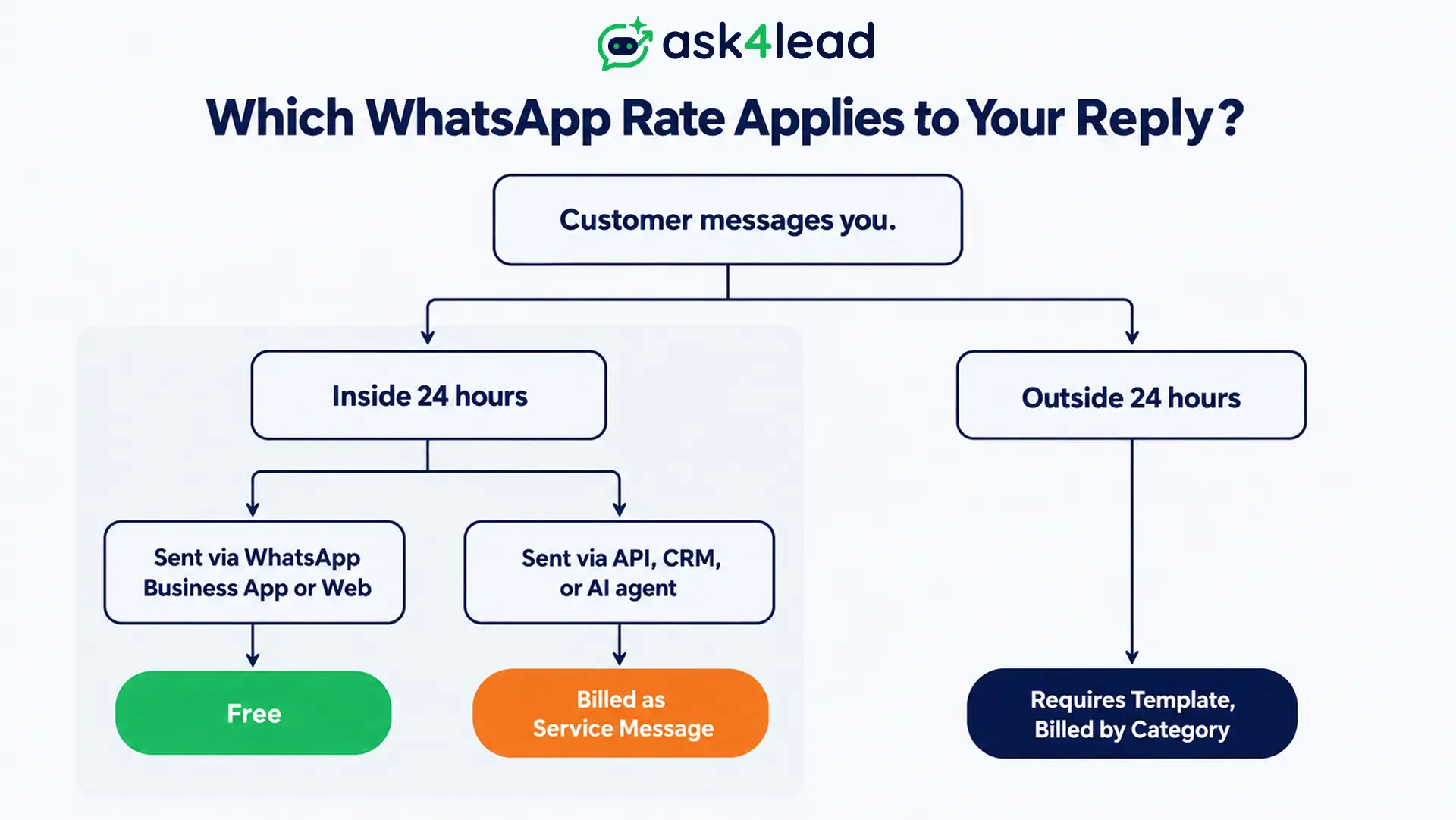
The clock starts the moment a customer messages your business. For the next 24 hours, free-form replies are service messages, no template required.
Once 24 hours pass with no reply, an approved template reopens the thread, billed at the marketing, utility, or authentication rate.
Why Letting a Thread Go Stale Now Costs You Twice
A thread that starts Friday evening and goes quiet often needs a paid template just to say hello again on Monday. That 1 scheduling gap stacks a billed template on top of whatever service messages already ran.
- Resolve the conversation inside the 24-hour window: every reply is billed at the service rate.
- Let the thread go stale past 24 hours: 1 template charge just to reopen it, and that rate is not automatically cheaper.
WhatsApp Coexistence Does Not Avoid the New Charges
What Actually Stays Free
WhatsApp Coexistence lets a business use the free WhatsApp Business App for some conversations and the paid API for others, on the same number. This is the single most confused part of the whole change.
The charge follows how the message was sent, not which feature is switched on:
- Typed directly by a person in the WhatsApp Business App or WhatsApp Web: stays free.
- Sent through the API, by a person or an AI agent: billed as a service message.
Where the Confusion Comes From
Many businesses assume Coexistence protects the whole phone number, since app-side replies genuinely stay free. It does not.
A team running Ask4Lead’s shared WhatsApp inbox or a CRM-connected chat is still routing every reply through the API layer, the exact layer this charge targets.
The Hidden Budget-Drain Risk Behind AI Agents and Chatty Customers
How a Single Repetitive Conversation Inflates Your Bill
Almost no pricing guide flags this: once every reply carries a cost, message volume itself becomes a budget risk, not just a support metric.
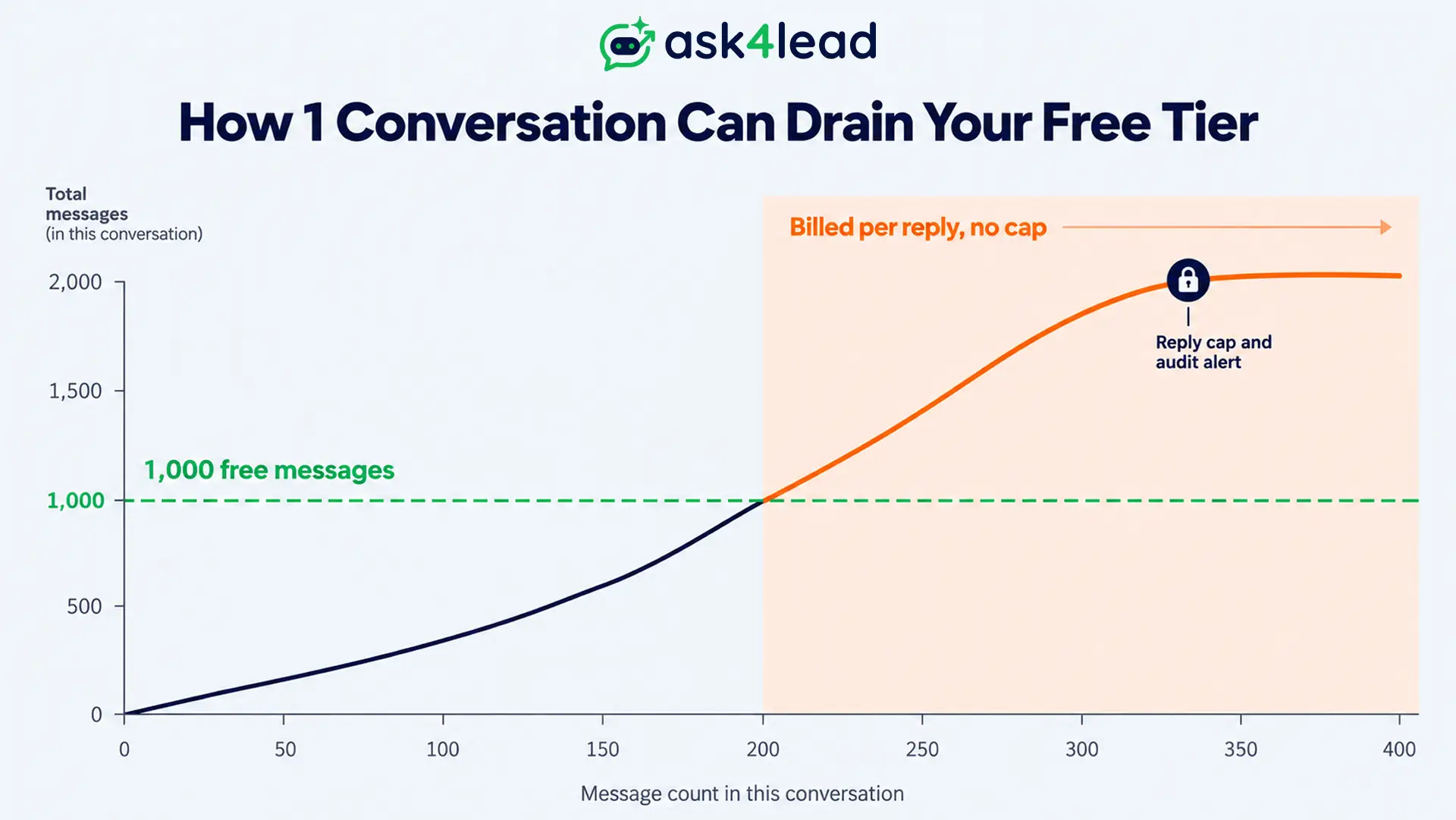
A customer, a bot, or even a bad-faith user who repeats the same question dozens of times in a single session forces dozens of billed replies. Meta charges per reply regardless of who or what triggered it.
An AI agent with no limit on how many times it will respond in a single thread can burn through your free tier in 1 conversation.
The Guardrails That Actually Prevent It
3 controls stop this before it hits your invoice:
- A cap on replies per conversation per hour, so 1 chat cannot generate unlimited billed messages.
- Human approval before an AI reply sends, catching a bot stuck in a clarifying-question loop before it multiplies.
- An audit log that flags any single conversation crossing an unusual message count, so a spike gets caught the same day, not at month end on the invoice.
How to Cut Your WhatsApp Business API Costs Before October 1
1. Audit Your Message Volume First
Pull your last 3 months of service message volume from your BSP or API dashboard, then run it through the math above. This single number decides whether October 1 is a rounding error or a real budget line.
Confirm a payment method is on file in Meta Business Suite well before the deadline. Businesses without one risk having service message delivery stopped once billing begins.
2. Redesign Conversations to Close in Fewer Turns
Every unnecessary back-and-forth is now a line item. 2 recurring causes drive up message counts:
- A CRM that is not synced in real time, forcing a bot to ask for an order ID across 3 separate messages instead of 1.
- Loose auto-close timers that leave resolved threads open for days, inviting a reopen-and-repeat cycle later.
Tightening both is what keeps well-run teams under budget, not abandoning WhatsApp. A shared work queue that surfaces what needs a reply today stops threads from going stale.
3. Put Structure Around Free-Text Replies
Buttons, lists, and WhatsApp Flows collect an order, a date, or an answer in 1 or 2 taps. Fewer exchanges means fewer billed service messages per resolved conversation.
Skip any unofficial, browser-automation-based WhatsApp connection some communities suggest as a workaround. It violates WhatsApp’s terms and risks a permanent number ban, which costs far more than this charge ever will.
Should Your Business Move Off WhatsApp, or Just Run It Smarter?
Why Switching Channels Rarely Saves Money
SMS pricing sits close to the new WhatsApp service rate in most markets, and email replies lag far behind WhatsApp’s.
- A resolved WhatsApp thread often takes 1 conversation.
- The same issue over email can mean several unanswered messages before a customer gives up.
The lever that controls this cost is not the channel. It is how many messages a conversation takes to resolve.
Start Free With 100 AI Credits
The businesses that come out ahead after October 1, 2026 cut messages per conversation instead of abandoning WhatsApp.
Ask4Lead’s AI sales assistant holds a real, plain-English conversation, not a button menu forcing 5 or 6 taps to state a problem that is not on the list.
It asks what the customer needs in 1 or 2 exchanges, then hands your team a qualified lead with the full context attached.
If service message costs are about to hit your invoice for the first time, this is the moment to act.
Start free with 100 AI credits and see how few replies a knowledge-grounded conversation actually needs.
FAQs
1. Is WhatsApp Business API still free to use after October 1, 2026?
No. The API connection carries no licensing fee, but templates were already billed, and service messages join them from October 1, after the first 1,000 free per phone number each month.
2. What happens if my business does not add a payment method before October 1, 2026?
Service message delivery risks pausing once billing starts. Check billing settings in Meta Business Suite now, and watch WhatsApp Account Health for warnings.
3. Do messages sent from the WhatsApp Business App or WhatsApp Web get charged?
No. A reply typed directly by a person in the free WhatsApp Business App or WhatsApp Web stays free. Only replies sent through the API, including via a connected CRM, shared inbox, or AI agent, are billed.
4. Does the 1,000 free service message allowance reset every month?
Yes. It is a monthly tier per business phone number, not a one-time credit, so it renews at the start of each billing month.
5. Will an AI chatbot make my WhatsApp bill higher than human agents would?
Not by default. The charge applies per service message regardless of who sends it. An AI agent that resolves a query in fewer replies costs less overall; a bot stuck looping clarifying questions can cost more.
6. Is the 72-hour free entry point from ads still free after October 1, 2026?
Yes, but only for the template message sent through that ad flow. Any service message reply that follows is billed once it falls outside that window.
Conclusion: One Rate Change, One Lever That Controls It
Content alone will not stop this bill from landing.
The businesses that protect their margin audit their message volume now, confirm a payment method is on file, add guardrails around AI replies, and cut how many messages each conversation takes to resolve.
That last part is exactly what Ask4Lead is built for: a WhatsApp CRM that holds a real, plain-English conversation instead of trading a dozen clarifying messages for 1 qualified lead.
See your own message count before the October 1 rate table even lands, and turn fewer replies into more closed deals.
Start free with 100 AI credits and find out how few messages a knowledge-grounded conversation really needs.
This guide is based on Meta’s own WhatsApp Business Platform pricing documentation and its non-template message pricing page.
