
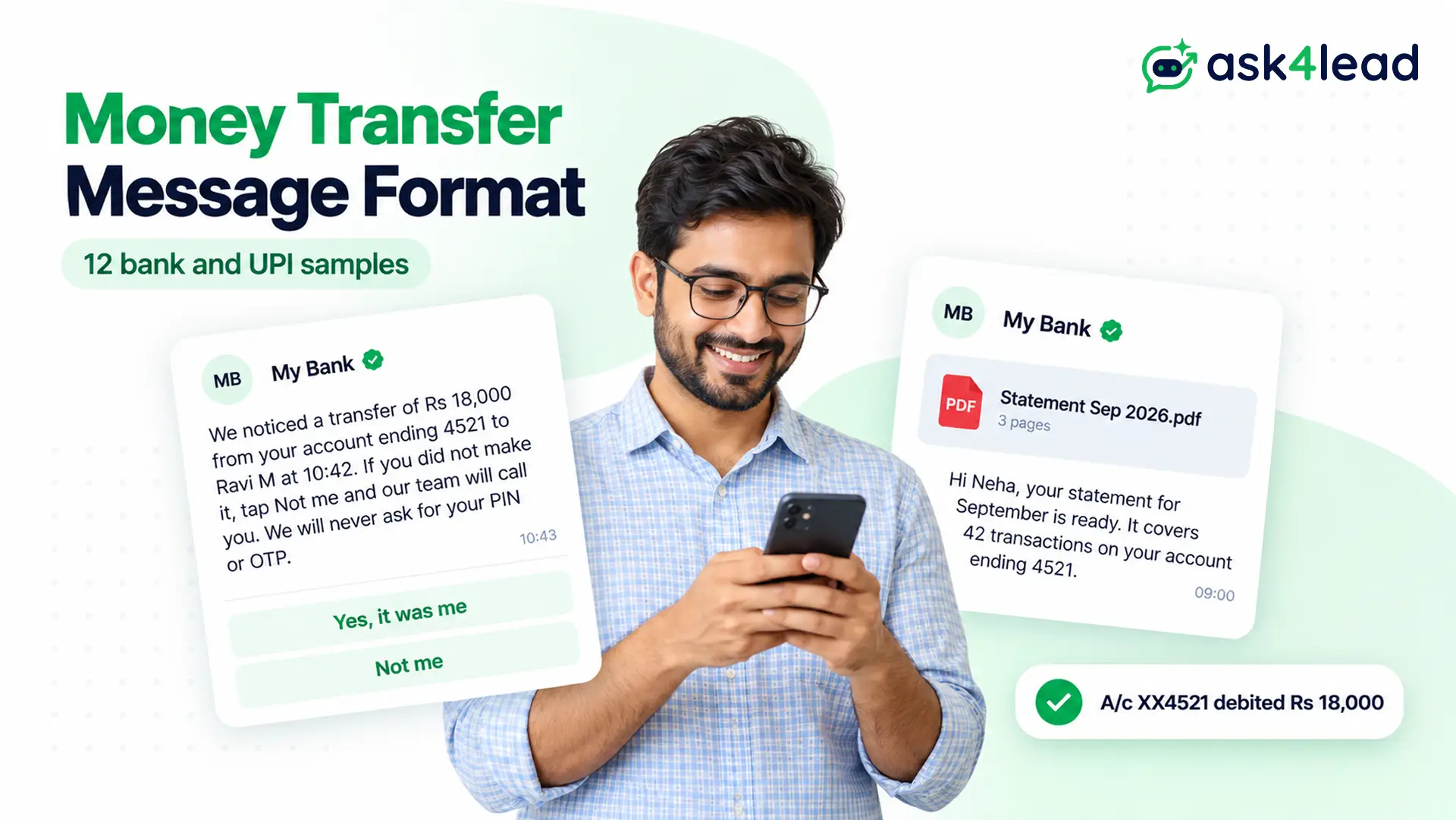
A money transfer message format is the fixed order of details in a bank alert or payment message: the amount, debited or credited, the account’s last 4 digits, the date and time, the channel, a reference number and a “Not you?” contact. Below, you get 12 samples to copy for bank SMS alerts, WhatsApp Business API templates and personal texts.
Each business sample lists its variables and its Meta category. You will also see what RBI and TRAI expect in an Indian bank SMS.
What a money transfer message format must include
A money transfer message format answers 3 questions: how much moved, which account it touched, and how to object. In fact, RBI’s June 2026 rules ask for the same details in alerts you receive from 1 January 2027.
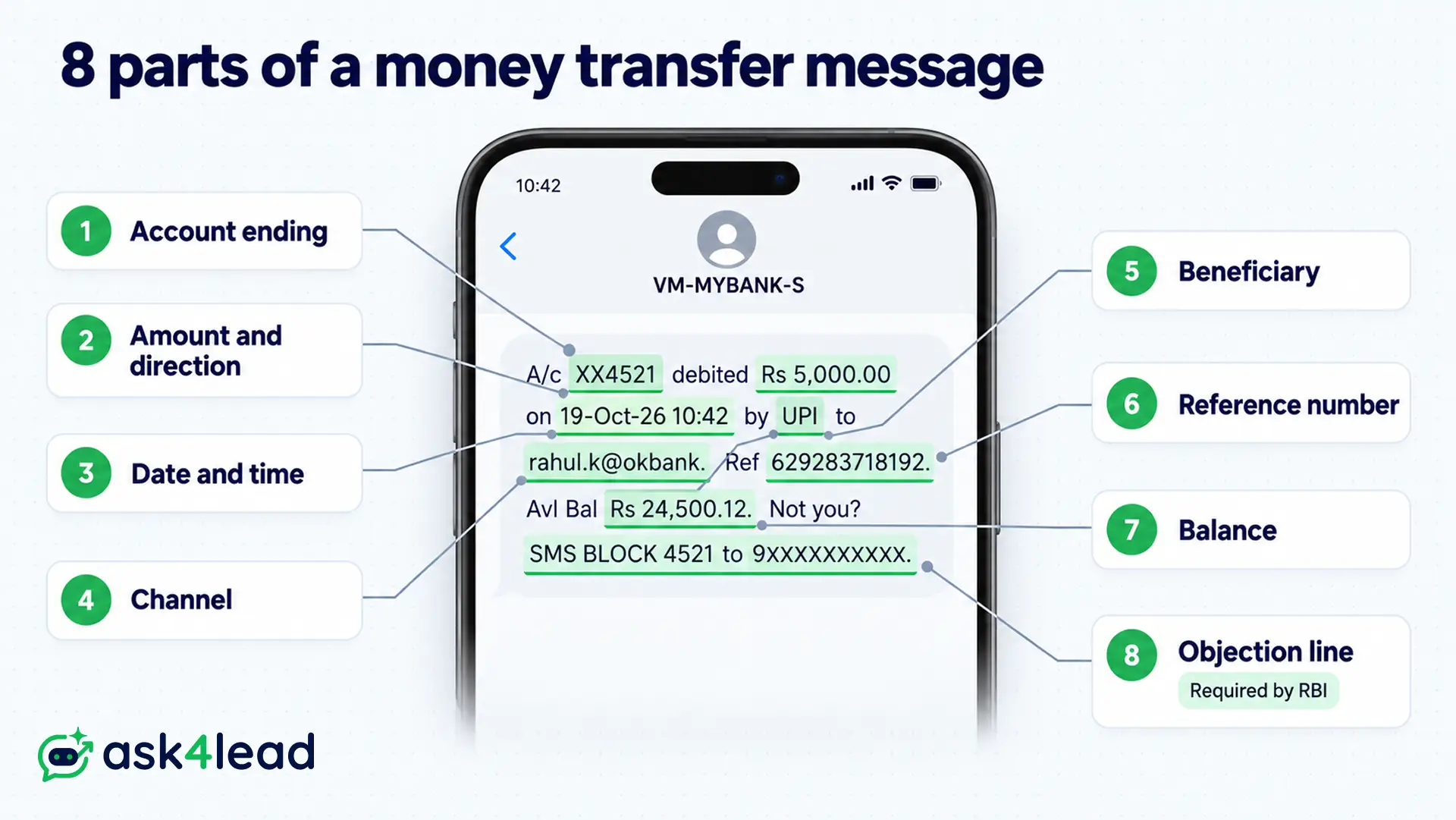
So build every money transfer message format from these 8 parts, in this order:
| Part | Sample value | Why you need it |
| Account ending | A/c XX4521 | Because a full number helps fraudsters |
| Amount and direction | Rs 5,000 debited | So money in or out is clear at once |
| Date and time | 19-Oct-26, 10:42 | Since disputes start with “when?” |
| Channel | UPI, IMPS, NEFT or RTGS | So the customer knows where to check |
| Beneficiary or sender | To rahul.k@okbank | Because an unknown name signals fraud |
| Reference number | Ref 629283718192 | Since it matches the statement line |
| Balance | Avl Bal Rs 24,500 | Also useful, though optional on WhatsApp |
| Objection line | Not you? SMS BLOCK to 9XXXXXXXXX | Because RBI wants a reply number |
For NEFT and RTGS, the reference is a UTR (unique transaction reference, the ID each transfer gets).
Money transfer message format for bank debit and credit SMS
In a bank SMS, the money transfer SMS format puts the direction of the money first, then the proof.
This bank transaction message format skips greetings and uses short forms such as A/c, Ref and Avl Bal.
1. UPI debit alert
A/c XX4521 debited Rs 5,000.00 on 19-Oct-26 10:42 by UPI to rahul.k@okbank. Ref 629283718192. Avl Bal Rs 24,500.12. Not you? SMS BLOCK 4521 to 9XXXXXXXXX.
Variables: account ending, amount, date and time, payee, reference, balance. The last line gives you the reply number that RBI asks for.
2. IMPS or NEFT credit alert
A/c XX4521 credited Rs 1,500.00 on 19-Oct-26 by IMPS from Priya S. Ref 529183659102. Avl Bal Rs 26,000.12. Not you? Call 1800 XXX XXXX.
Variables: account ending, amount, date, channel, sender, reference, balance. For RTGS, add the time too, since you will check large payments within minutes.
3. Salary credited message
Dear Customer, your salary of Rs 42,000.00 from Sunrise Foods Pvt Ltd reached A/c XX4521 on 31-Oct-26 by NEFT. UTR SUNF2610310042. Avl Bal Rs 61,240.50.
Variables: amount, employer, account ending, date, UTR, balance. Always name the employer, because fake “salary” alerts rarely do.
4. Failed transfer and reversal message
Your UPI transfer of Rs 2,000.00 to Ravi M on 19-Oct-26 failed. Ref 629283718192. If the amount left A/c XX4521, it will return to the same account, so please check your statement before you send it again.
Variables: amount, payee, date, reference, account ending. However, never promise a refund date that your bank does not publish.
Money transfer message format for WhatsApp: 5 bank templates
A bank message to customer on WhatsApp needs a template, which is a message format Meta approves in advance. You need one when you message first, or after the 24-hour customer service window closes.
Use these 5 if you run an NBFC, a brokerage, a payment app or a marketplace that pays sellers.
5. Payout sent message format for money transfers to sellers
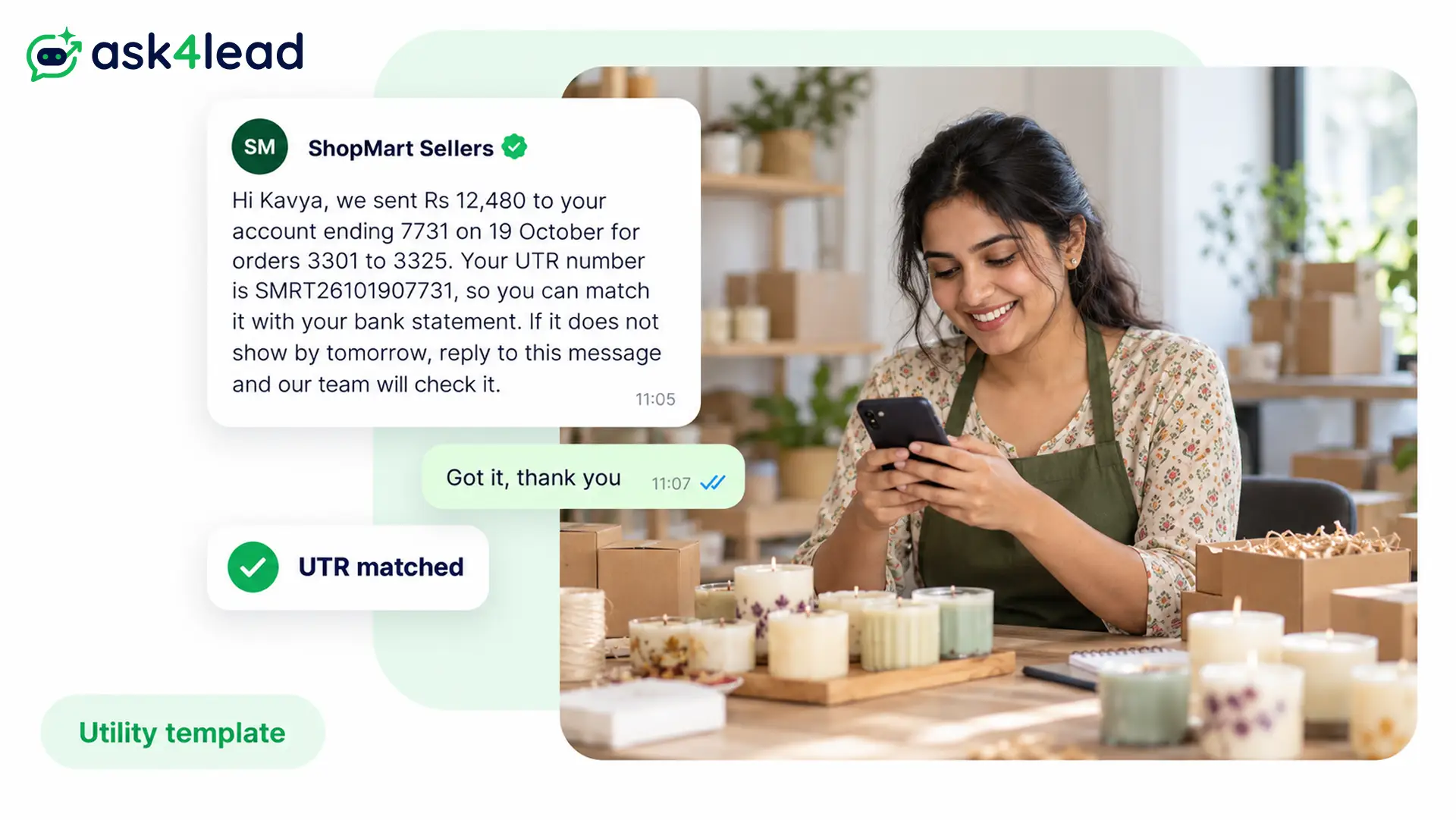
Hi {{1}}, we sent Rs {{2}} to your account ending {{3}} on {{4}} for {{5}}. Your UTR number is {{6}}, so you can match it with your bank statement. If it does not show by tomorrow, reply to this message and our team will check it.
Category: utility, because the reader is waiting for this transfer. Also keep fixed words between the variables, since Meta rejects a body of bare placeholders.
6. Low balance alert
Daily update for your account ending {{1}}: your available balance is Rs {{2}}. Your minimum balance is Rs {{3}}, so please add funds before {{4}} to avoid a charge.
Category: utility. In fact, Meta’s own utility example is a daily balance update for an “account ending in” 4 digits.
7. “Did you make this transfer?” fraud check
We noticed a transfer of Rs {{1}} from your account ending {{2}} to {{3}} at {{4}}. If you did not make it, tap “Not me” and our team will call you from {{5}}. We will never ask for your PIN or OTP.
Quick replies: Yes, it was me · Not me
Category: utility, since Meta treats fraud alerts as essential. Keep the last line, because scammers copy fraud checks and then ask for the OTP.
8. Monthly account statement with a PDF
Header: PDF document (the statement)
Hi {{1}}, your statement for {{2}} is ready. It covers {{3}} transactions on your account ending {{4}}. To open the PDF, use this password format: {{5}}.
Category: utility. Fill {{5}} with the rule, such as “first 4 letters of your name plus birth year”.
9. New payee added alert
Hi {{1}}, a new payee, {{2}}, joined the transfer list on your account ending {{3}} at {{4}}. If you did not add this payee, call {{5}} now, before any money moves.
Category: utility. This alert can stop fraud early, because it arrives before the money leaves.
Personal money transfer message format for WhatsApp texts
A personal money transfer message format needs only the amount, the method and the reference. You type these from your own WhatsApp, so no approval applies. Still, never skip the reference, because your reader can check it in their bank app.
10. “I have sent the money” to a friend or family member
Hi Ravi, I sent Rs 2,500 to your UPI ID just now for the trip. The UPI ref is 629283718192, so please check and tell me once it shows.
11. Payment sent message to a client or vendor
Dear Mr Mehta, we transferred Rs 48,000 today by NEFT against invoice 2041. The UTR is MYBK26101900481, and please confirm once it reaches your account.
12. Asking for a money transfer politely
Hi Anil, a gentle reminder about the Rs 6,000 for the October rent. You can send it by UPI to anil.s@okbank, and please share the reference once done. Thank you!
When someone says they have paid, check your own bank app first. The money received message guide covers that side, including fake “credited” texts.
RBI and TRAI rules behind a bank SMS format in India
A bank SMS format in India follows two regulators. RBI decides what an alert must contain, while TRAI decides how the SMS travels.
As a result, a real money transfer message format looks alike across banks. A fake one usually breaks a rule.
RBI’s transaction alert rules from 1 January 2027
RBI’s June 2026 amendment covers electronic transactions on or after 1 January 2027:
- Instant SMS above Rs 500: banks must alert every electronic transaction above Rs 500, and any smaller alert must be free.
- Fixed content: account or card number, amount, date, time, channel, and the beneficiary or point of transaction.
- A reply number inside the SMS, so you can object at once.
- Zero liability for third-party fraud that you report within 5 calendar days. Then the bank gets 45 calendar days to resolve a domestic complaint.
Until then, RBI’s 2017 customer liability rules apply. Under them, SMS alerts are already mandatory and customers can reply to them. The zero liability window is 3 working days.
TRAI’s DLT registration and header suffixes
Every commercial SMS in India goes through DLT (distributed ledger technology, TRAI’s registry of senders, headers and templates). So a bank registers its header and each alert before it sends them.
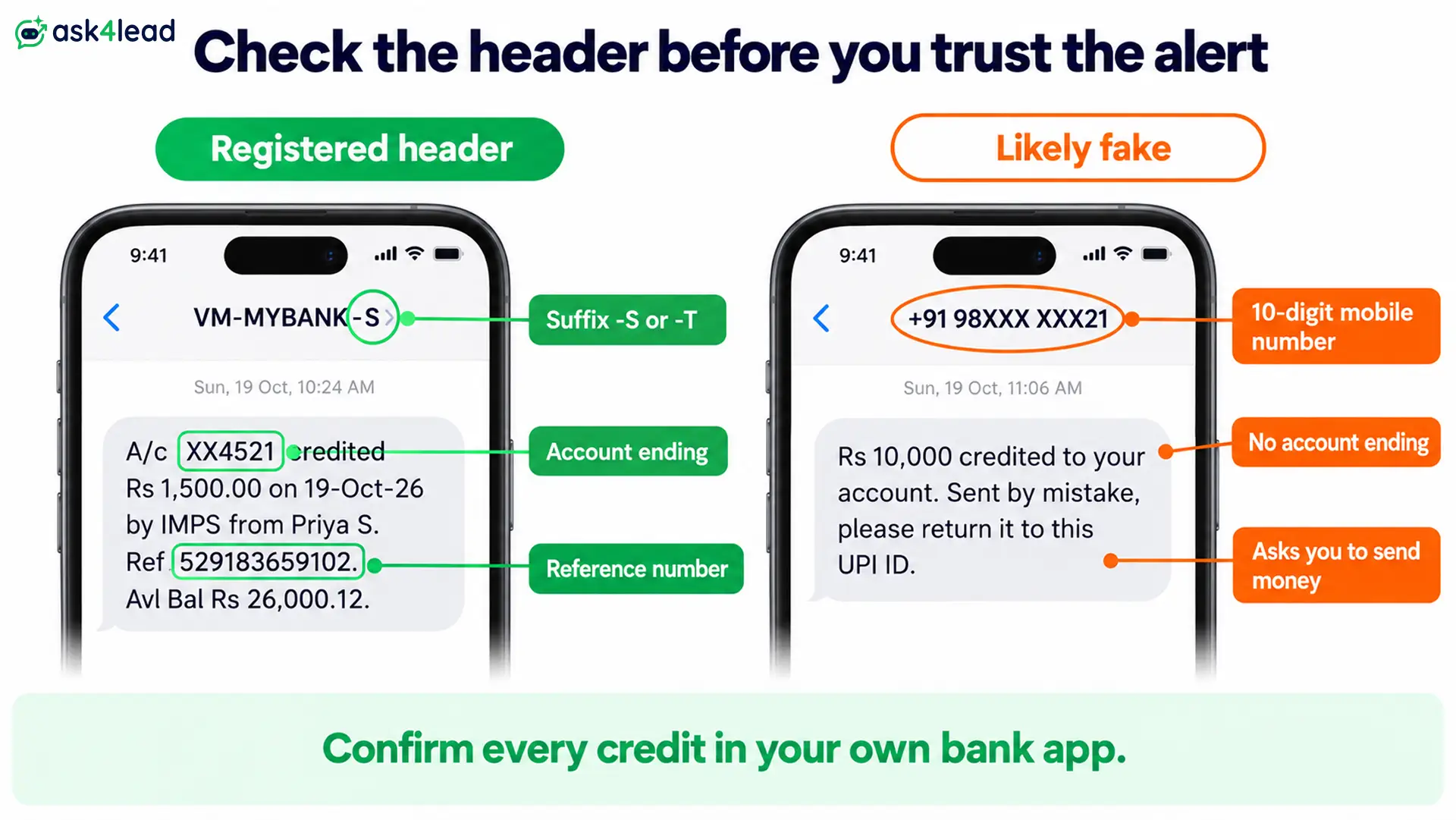
Since TRAI’s February 2025 amendment, operators also add a suffix to each header. It reads -S for service, -T for transactional, -P for promotional and -G for government.
Therefore, a real alert arrives from a header ending in -S or -T. In contrast, a “credited” text from a 10-digit mobile number is likely fake until your bank app shows the money.
Which Meta category a money transfer message format gets
On WhatsApp, a bank transaction message stays utility when the customer’s own action triggers it. It also stays utility when it is essential, such as a fraud alert. Meta’s template categorization rules also bar any promotional intent in utility.
However, OTPs follow a separate rule. Only authentication templates may carry a one-time password, and they allow no URLs, media or emojis. So never put an OTP inside a transfer alert.
| Message | Likely category | Why |
| Templates 5 to 9 | Utility | Because a transfer, balance or payee change triggers each one |
| OTP for a transfer | Authentication | Since only authentication templates may carry a passcode |
| Payout alert plus “Get a top-up loan” | Marketing | Because Meta files mixed content as marketing |
The category also sets the price. Under Meta’s pricing rules, utility templates inside an open customer service window became chargeable on 1 October 2026.
Only utility inside a free entry point window (the window after a customer taps your ad) stays free. The 2026 WhatsApp API pricing guide lists the rates.
Why money transfer message format templates get rejected
Meta usually rejects a money transfer message format for its variables or a sensitive detail, not for the alert itself. Meta’s template review page lists these causes:
- A variable opens or closes the body, for instance “{{1}} debited” instead of “We sent Rs {{1}}”.
- Too many variables for the length of the message.
- Numbers skip ({{1}}, {{2}}, {{4}}), or the braces do not match.
- Special characters inside a variable, such as #, $ or %.
- A full card number, although the last 4 digits are fine.
Here is a before and after. The draft “{{1}} Rs {{2}} Dr A/c {{3}} {{4}} Ref {{5}}” starts with a variable and holds little but placeholders. In contrast, template 5 carries the same facts in full sentences, so the reviewer sees what each variable means.
For more causes, see the guide to WhatsApp template rejection reasons. If your wording changes later, edit the approved template instead of starting again.
Worked example: one money transfer message format, two prices
Take a marketplace that pays 2,000 Indian sellers in October. It sends template 5, its money transfer message format for payouts, to each one. At Meta’s India utility rate of Rs 0.115 per delivered message (from 1 October 2026), you get:
2,000 × Rs 0.115 = Rs 230
Now suppose the team adds “Need working capital? Get a loan in 10 minutes” to the same template. Meta then treats the whole message as marketing, at Rs 0.8631 each:
2,000 × Rs 0.8631 = Rs 1,726.20
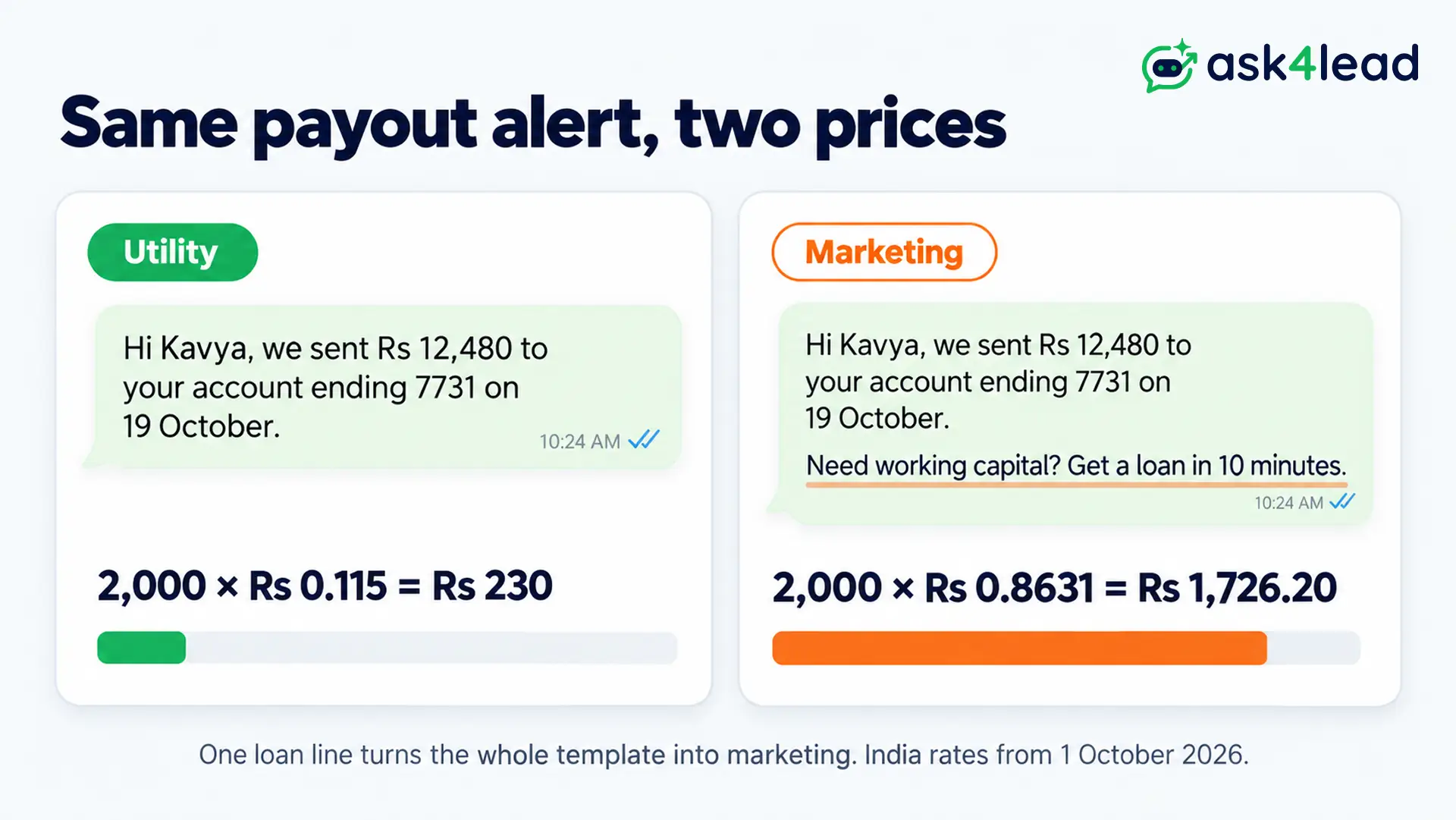
So one loan line raises the bill about 7.5 times, and sellers who only wanted their money may block you. Instead, send the offer as a separate marketing template to sellers who agreed to offers. Your provider may also add its own fee.
This sum does not apply to sellers who never agreed to WhatsApp messages. For them, collect opt-in consent first, because blocks pull down your WhatsApp quality rating. Lenders should also follow the financial services compliance rules.
SWIFT and SMS banking: the bank-to-bank money transfer message format
Some people who search for this mean the instruction one bank sends another. You rarely write these, because your bank’s form or app fills them in.
- SWIFT MT103: the classic cross-border transfer message. Its numbered fields include :20: (reference), :32A: (date, currency and amount), :50K: (sender) and :59: (beneficiary).
- ISO 20022: since 22 November 2025, banks send cross-border payment instructions in this newer format. According to Swift’s announcement, the pacs.008 message now does the MT103’s job.
- SMS banking commands: a few Indian banks accept a text such as PAY, a payee nickname and an amount. Since each bank sets its own syntax, copy it from your bank’s page.
Which money transfer message format to set up first
Start with the payout or debit alert (template 1 or 5), since every transfer needs one. Next, add the fraud check and the new payee alert, because they stop losses before money moves.
Before you submit a template or register an SMS, check that you have:
- The amount, direction, account ending, date, channel and reference
- A reply number or “Not me” button, plus a line saying you never ask for an OTP
- No offer, loan pitch or upsell in a transaction alert
- Fixed words around every variable, with sample values
Once RBI’s 2027 rules apply, bank alerts will look even more alike. So a message that skips a part will stand out as a fake.
Run your transfer alerts and replies from one WhatsApp number
Your transfer alerts will bring replies such as “it has not reached me”, and you need to answer them fast. If you run a licensed bank, your core banking system sends the RBI alerts.
For NBFCs, brokers and marketplaces, Ask4Lead, a humanized AI WhatsApp chatbot and CRM, handles the WhatsApp side:
- Template builder: build the payout template, preview it on iPhone and Android, and track Pending, Approved or Rejected.
- Account Health: watch your quality rating and messaging limit before a large payout run.
- Human approval for AI replies: a manager checks AI drafts before they answer a money question.
- Audit logs: see which teammate sent each manual message, in case a customer disputes a reply.
Ask4Lead sells this software, and each feature named here is on its features pages. Lenders can also see the WhatsApp AI agent for finance.
Sign Up Free on Ask4Lead: 100 AI Credits Included
FAQs
1. What is the format of a money transfer message?
It lists the amount, debited or credited, the account’s last 4 digits, the date, the channel and a reference. Bank alerts also add a reply number.
2. How do I write a money transfer SMS?
Start with the account ending and “debited” or “credited”. Then give the amount, date, channel and reference in one or two lines.
3. What should a bank message to customer include?
It should name the account ending, amount, date, time and channel. From 1 January 2027, RBI also wants the beneficiary and a reply number.
4. Can a WhatsApp transfer alert include an OTP?
No. Meta allows a one-time password only in an authentication template, so send it separately.
5. Is a WhatsApp transaction alert free?
No. Since 1 October 2026, Meta charges utility templates inside the customer service window too, unless a free entry point window applies.
6. How can I tell if a bank SMS is genuine?
First, check that the header ends in -S or -T rather than showing a mobile number. Then confirm the transaction in your own bank app.
